
Correcting the headline: ‘Coelacanth’ yes; ‘Ancient’ no
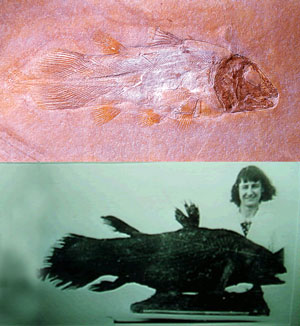
Since 1938 other coelacanths have been caught, not just off the African and Madagascan coastlines, but also in Indonesian waters. When news of yet another specimen being caught by fishermen makes the headlines, it’s a great opportunity for Christians to use it in their witnessing, e.g. asking the question: ‘Why no evolution in all that (supposed) time?’
I know of some Christians who, wary (and rightly so) of the strong evolutionary anti-God bias of the secular media, avoid or take little interest in daily news reports.
While I certainly endorse the earnest Christian’s desire to focus on thinking about ‘whatever is true, … whatever is right, whatever is pure, whatever is lovely …’ (Philippians 4:8), it’s important to note that not everything that is reported in the secular news media is false. Some of what is reported is not only true, but strategically very useful in the hands of Bible-believing Christians. The trick is to be able to separate out the facts from the evolutionary millions-of-years Bible-denying ‘spin’ that so many reporters and journalists weave into their articles these days. Admittedly this requires more effort and alertness on the part of the believer compared to simple avoidance. However, the ability to exercise ‘the Berean standard’ (Acts 17:11) in our daily lives is a very useful discipline to have (Hebrews 5:14), enabling Christians to sort through the dross and pick up gems valuable for demolishing evolutionary ideas (2 Corinthians 10:5) and proclaiming the truth of God’s Word.
A classic example was the recent headline ‘Ancient coelacanth caught in Indonesia’.1 How ancient? The article explained the coelacanth (Latimeria chalumnae) was ‘a species once thought as extinct as dinosaurs,’ i.e. that it ‘was believed to be extinct for 65 million years until one was found in 1938 off Africa’s coast.’ The 1938 discovery ‘ignited worldwide interest’, and this latest Indonesian catch of a ‘living fossil’ (as the article described it) was also notable because the fisherman managed to keep it alive in a pool for a further 17 hours—’an extraordinary survival time’ for such a deep-water fish, according to a local marine biologist. Other coelacanth specimens have been caught in recent years, including one in the same waters off North Sulawesi in 1998, but the 17 hours that this latest coelacanth remained alive after being caught surpasses that of specimens captured previously.
Separating fact from fiction
Let’s now separate out the eyewitness-observed facts in the article from the evolutionary storyline woven through the article.
Now that we’ve removed the evolutionary storytelling, how are the eyewitness-sourced facts of the article ‘strategically very useful’ for Bible-believing Christians?
Using fact to destroy fiction
When reaching out to non-Christians who assume that evolution explains our origins, we can use news items like this to show how evolutionary ideas about millions of years just don’t ‘stack up’ with the evidence, in stark contrast to the biblical account of history.
Evolutionists assume that the fossil-bearing rock layers have been laid down over millions of years, hence when creatures like the coelacanth are absent from upper rock strata (which evolutionists say straddle ‘the last 65 million years’) they presume that means that the coelacanth must be extinct. Hence, a news item like this one complete with a photo of the fisherman in the pool with his live, freshly caught coelacanth, flies in the face of evolutionary interpretations of the ‘fossil record’.
So, when witnessing to non-Christians, you could point to the photo of the fisherman holding his still-wriggling catch and say something like: ‘For a fish that evolutionists had supposed was extinct for 65 million years, you can’t get much fresher than that!’
You could then point out that the Bible describes an event that helps us to understand why we find so many beautifully preserved fossils, such as the coelacanth, right around the world—i.e. there was a global Flood. A great many fossils show evidence of having been buried quickly under water-borne sediment, thwarting scavengers and decay—hence the often exquisite degree of preservation. So the ‘fossil record’ is a sobering legacy of the global Flood of just 4,500 years ago (and its aftermath), and reflects the order of burial in that event, not the order of evolution (’appearance’) and extinction (’disappearance’) over millions or billions of years.
Thus, when creatures such as the coelacanth turn up alive and well, it’s no surprise to Christians who know that the Bible can be trusted from the very first verse. But for evolutionists, the discovery of a ‘living fossil’ is often not only a surprise—why no evolution in 65 million years?—but also can completely overturn previous evolutionary notions about it. For example, evolutionists once said that amphibians evolved from a Rhipidistian fish, something like the coelacanth. It was explained that they used their fleshy, lobed fins for walking on the sea-floor before emerging on the land. As long as the coelacanth was ‘extinct’, such speculation seemed impossible to disprove. But with the discovery of a living coelacanth in 1938 and their subsequent observation, it was found that the fins were not used for walking but for deft maneuvering when swimming. Also, its soft parts were found to be totally fish-like, not transitional. It’s now known also that the coelacanth has some unique features. It gives birth to live young after about a year’s gestation, it has a small second tail to help its swimming, and a gland that detects electrical signals. (Surely evidence of having been designed.) Thus the finding of live coelacanths proved fatal to the idea that such were a ‘transitional form’ from which amphibians (and subsequently land animals and birds) are descended.2
Accordingly, the coelacanth is a nice little ‘gem’ of a witnessing tool, and the secular media’s fascination with such an ‘ancient’, ‘living fossil’ regularly opens up opportunities for alert Christians to use the ‘news of the day’ in their outreach. (See our past items on the coelacanth, including: Living fossil turns up—again, More living fossil coelacanths, Dinosaur fish lady dies, The Lazarus effect—Creation 29(2):52–55, 2007.)
Of course, it is wise to be prepared for ‘questions arising’, e.g. the obvious one relating to the latest article is ‘But what about the dinosaurs? If the dinosaurs haven’t been extinct for 65 million years, where are they today?’
To answer, you could point out:
- There are intriguing and persistent modern-day ‘sightings’ of unidentified creatures bearing strong resemblance to scientists’ reconstructions from fossils. See, e.g., A living dinosaur?, Dinosaurs living in Africa?, Mokele-mbembe: a living dinosaur?
- There are inscriptions and documented descriptions of ‘dragons’ and other dinosaur-like creatures in relatively recent history. See, e.g., Bishop Bell’s brass behemoths, Dinosaurs and dragons—stamping on the legends, Dragons: animals … not apparitions, Settlers feared the bunyip, chapter 10: ‘Dinosaurs from Anglo-Saxon and other records’, in Bill Cooper’s book After the Flood.
- ‘Fresh’ dinosaur tissue that could not possibly be millions of years old has been discovered. See, e.g., Dinosaur bone blood cells found, Sensational dinosaur blood report!, Still soft and stretchy, Schweitzer’s dangerous discovery.
When pointing this out to others, be ready for incredulity, as it can take a while for some people to get over their ‘shock’ at hearing of such things for the first time, and they may challenge you with a return question that comes out of the evolutionary paradigm: ‘But if dinosaurs and people lived together, surely we would find their fossils together?’
So, how should we be ready (1 Peter 3:15) to answer? In cases like this, sometimes it can be more strategic to answer the question by asking a question—one that highlights the flawed assumptions behind the original question, e.g., ‘Coelacanths and whales live together—but why don’t we find their fossils together?’3
By thus prompting your questioner to think for himself (or herself), and reminding them again of your earlier words about the biblical Flood, who knows where the conversation might proceed from there? If further questions arise, there’s plenty of free online material available from here to help you with providing answers. And don’t be disheartened if your questioner doesn’t exhibit any apparent change-of-heart—after all, anyone ‘labouring in the Lord’ does not labour in vain (1 Corinthians 15:58). And how’s this for incentive to persevere with ‘imparting wisdom’ in the face of indifference or hostility:
Those who are wise will shine like the brightness of the heavens, and those who lead many to righteousness, like the stars for ever and ever. Daniel 12:3
References
- Ancient coelacanth caught in Indonesia, USA Today, http://www.usatoday.com/tech/science/
discoveries/2007-05-21-coelacanth-indonesia_N.htm, acc. 25 June 2007. Return to Text. - W. Roush, W., ‘Living Fossil’ Is Dethroned, Science 277:1436, 5 September 1997 Return to Text.
- Dr Carl Wieland elaborated on this point in his recent debate with an evolutionist-available on DVD. For our online review/summary of the debate, see Clash over origins. Return to Text.
Readers’ comments
Comments are automatically closed 14 days after publication.