
Creationists are ‘liars’ (?)
Geologist Donald Prothero doesn’t like the fact that we don’t agree with his ideas on evolution.

Published: 26 March 2008(GMT+10)
I love the attitude some evolutionists have toward professional, scientific debate. Because creationist scientists do not agree with their biased, subjective and unsubstantiated ideas they spit the dummy and call us liars.
The latest tirade from geologist Donald Prothero is in an opinion piece in NewScientist entitled ‘Evolution: What missing link?’1 I like that title.
His article was picked up by the Telegraph newspaper in the UK which reported, ‘Creationists “peddle lies about the fossil record”.’2
Lies? Are creationists really lying?
No!
It’s just that Prothero does not like the fact that we don’t agree with his ideas. It upsets him so much that he describes creationists in this way: ‘Foremost among their tactics is to distort or ignore the evidence for evolution; a favourite lie is “there are no transitional fossils”.’3
A favourite lie. That means he thinks creationists use lots of lies. Wow, that is some accusation. Especially when that would involve hundreds of thousands of Christians denying the moral standards of the very Bible we claim to be defending.
But the fact is that creationists are not convinced by the arguments that evolutionists put forward. We can’t help it if they are not convincing. I’m sorry that he doesn’t like it. It would be nice if he was prepared to listen to what creationists are actually saying (instead of what he thinks they are saying) and to understand their concerns about evolutionary interpretations of the evidence. I think it would even help his research. But he must be quite upset and emotional to be calling us liars.
Prothero began his NewScientist article like this:
‘When Charles Darwin published On the Origin of Species in 1859, there was relatively little evidence in the fossil record of evolutionary change. Darwin spent two chapters of his book apologising for the paucity of the fossil record, but predicted that it would eventually support his ideas.’
Yep. There is no argument here. Creationists would agree with Prothero, except I wouldn’t call it ‘relatively little evidence’. I would call it more of an ‘absence of evidence’. Darwin described it as ‘the most obvious and serious objection which can be urged against the theory.’4
What Prothero shows here is that Darwin’s theory was accepted in spite of the evidence from the geological record. In effect Darwin said, ‘Trust me! I’ve got a great theory, but unfortunately I don’t have the fossil evidence. But don’t worry. We’ll find it.’ Prothero goes on:
‘What Darwin was bemoaning was the lack of "transitional" fossils—those with anatomical features intermediate between two major groups of organisms. At the time, such fossils were conceived as "missing links" in the "great chain of being" from lowly corals through higher organisms such as birds and mammals to humans (and ultimately to God).’5
Darwin was definitely bemoaning the lack of transitional fossils, and he was right to expect them. Based on his theory he anticipated finely graduated organic chains, but you don’t find them. To the intense annoyance of evolutionists, creationists have been drawing attention to this persistent scarcity of fossil evidence for decades. Prothero continues:
‘We now know this is a misconception.’
Be alert. When an evolutionist says, ‘We now know … ’ you can be sure that he now realizes that the evidence does not fit his theory. This statement means that he is about to change his story so he can hold onto his theory in spite of the contradictory evidence. Prothero again:
‘Life does not progress up a hierarchical ladder from "low" to "high" but is a branching bush with numerous lineages splitting apart and coexisting simultaneously.’
Sounds like a bit of spin here. In fact Darwin had a concept of a bush from the beginning, and the only diagram that appeared in his first edition showed exactly what Prothero describes, ‘numerous lineages splitting apart and coexisting simultaneously’.6 Darwin’s first sketch (see figure 1) of an evolutionary tree from his First Notebook on Transmutation of Species (1837) also resembles a branching bush. Prothero again:
‘For example, apes and humans split from a common ancestor 7 million years ago and both lineages are still around.’
So, both lineages are still alive on the earth but the common ancestor is not. In other words there is no evidence for that common ancestor, fossil or living. So how does Prothero know there was a common ancestor? Because, in his mind, evolution is a fact.
‘For this reason the concept of “missing link” is a misleading one. A transitional form does not need to be a perfect halfway house directly linking one group of organisms to another. It merely needs to record aspects of evolutionary change that occurred as one lineage split from another.’
The interesting thing here is how evolutionists have discovered a technique for preserving their theory without needing evidence of intermediate forms. How do they do that? One way is by means of cladograms.
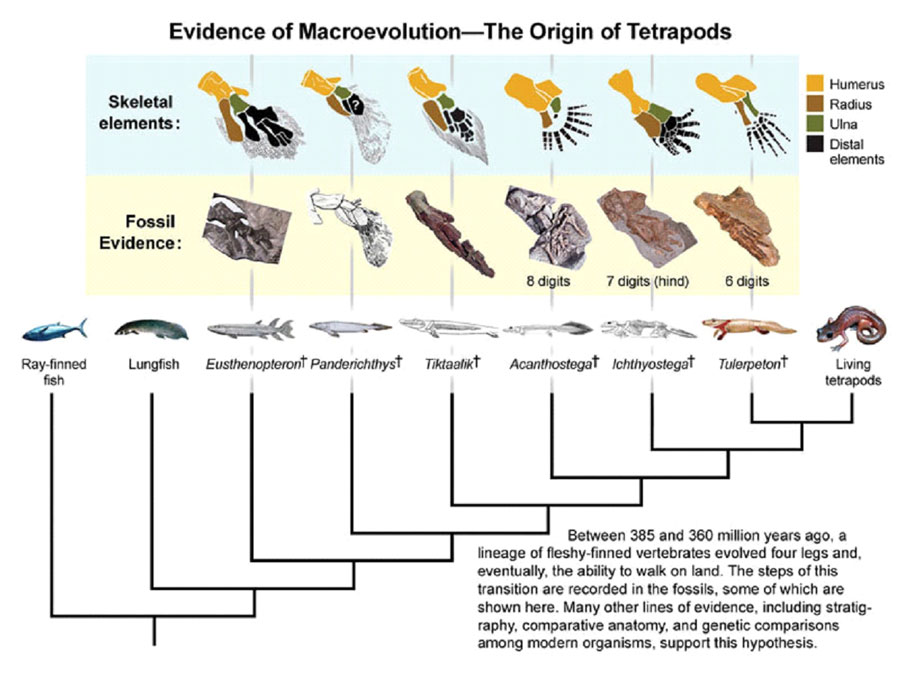
Kevin Padian, Curator in the Museum of Paleontology at the University of California at Berkeley illustrates the technique in an article in Geotimes entitled ‘Improving Evolution Education’.7 In that article he has a diagram illustrating the ‘origin of the tetrapods’ (see figure 2) which illustrates transitional forms between fish and land animals. Notice how the diagram resembles a bush, and is not distinctly different from Darwin’s early sketch. Padian says:
‘Between 385 and 360 million years ago, a lineage of fleshy-finned vertebrates evolved four legs and, eventually, the ability to walk on land. The steps of this transition are recorded in the fossils, some of which are shown here. Many other lines of evidence, including stratigraphy, comparative anatomy, and genetic comparisons among modern organisms, support this hypothesis.’
I’m glad he used the word ‘hypothesis’. But the cladogram he presents does not establish phylogenetic (ancestor-descendant) relationships. All it does is arrange things according to similarities.
Notice that the cladogram shows nine different animals arranged in order. Observe that these animals are linked together with solid black lines, conveying the impression that groups of animals evolved from a common ancestor. It’s like a bush. There are eight common ancestors indicated by the intersection of lines on the diagram.
So, does this diagram demonstrate that evolution is a fact as Padian claims? Let’s look at the evidence. Is there evidence for the animals shown on the tips of the cladogram? Yes, lots of it. We have many examples of ray-finned fish, lungfish and living tetrapods. And we have fossil evidence of the other animals shown, such as tiktaalik. So the evidence exists and it is at the tips of the cladogram, or the tips of the bush.
Do we have evidence of the common ancestors that are indicated by the intersection of the lines on the cladogram? For example, do we have evidence of the common ancestor that gave rise to the living tetrapods and fossil tulerpeton, as required by the intersection of their lines? No, we don’t. What about where the other lines intersect, do we have examples of those common ancestors? No, we have none at all.
Distorting and ignoring the evidence for evolution?
Examples of transitional forms?

The illustrations connected with Prothero’s article (about creationist lying) made me chuckle. I like this one on the NewScientist site that pointed the reader to Prothero’s article.9 NewScientist had the caption: “What missing link? Reports of huge gaps in the fossil record have been greatly exaggerated, says geologist Donald Prothero.” I especially like the way the artist has the animal halfway between the water and the land. It conveys the concept of a transitional form extremely well, don’t you think?

The one on the front cover of NewScientist is very amusing.10 The text on the cover says ‘Amazing missing links’. I agree that the artist’s image is amazing, a comical representation of a transitional form. I’m interested to know what else they’ve found.

Perhaps the artist who illustrated the Telegraph item for human evolution provided the most convincing evidence of all. What do you think? Telegraph caption: “Apes and humans split from a common ancestor seven million years ago and both lineages are still around.” I wonder if this watercolour painting was intended to be serious or comical.
So all Padian has done in his cladogram is arrange an assortment of animals, fossil and living, into a sequence according to various characteristics. In his mind the diagram proves evolution is a fact. But he believed that before he drew the diagram. To a creationist the diagram does not say anything about whether any of the animals have a common ancestor.
And that is what Prothero is so upset about, that creationists won’t accept the arguments evolutionists put forward to support their evolutionary ideas.
But think about it. We could apply the cladogram methodology to dinner cutlery. We could arrange knives, forks, spoons, splades, etc in a cladogram and it could look very impressive. But that would not prove that spoons and forks had a common ancestor. We could apply it to transport vehicles such as bicycles, motorcycles, cars, trucks and semi-trailers. The cladogram would work wonderfully on these objects too but that would not mean that bicycles and motorbikes are each descended from a common ancestor.
As creationist Walter ReMine said in his book The Biotic Message, cladograms give an illusion of a phylogeny (a family tree) when in fact there is none:
‘Illusion is created with tree-structured imagery, such as cladograms and phenograms. These are said to be evidence for evolution, but they do not identify a single ancestor-descendant relationship.’8
Prothero seems to get so angry because he thinks creationists are ‘distorting and ignoring the evidence’. I’d like to explain to him gently that we are not doing any such thing. It’s just that we are not convinced by the spin in diagrams like cladograms. I’m sorry if it upsets him, but we don’t agree with his ideas. It would be nice if evolutionists would be open to discuss the ideas and arguments instead of being abusive and calling us names.
But then the question of whether we are created by an intelligent being or whether we are simply the product of impersonal material processes is an emotional one. It has huge personal implications—for this life and the next.
In addition to the received comments posted below, Tas Walker has responded to another comment in Creationists are hypocritical, which is posted as one of our weekly feedback articles.
Re-featured on homepage: 18 November 2009
References and notes
- Prothero, D., Evolution: What missing link? New Scientist Issue 2645, 27 February 2008. Return to text.
- Cockcroft, L., Creationists ‘peddle lies about fossil record’, telegraph.co.uk, 28 February 2008. Return to text.
- We recommend against arguing there are no transitional forms (see Arguments we think creationists should not use). Since there are candidates, even though they are highly dubious, it’s better to avoid possible comebacks by saying instead: ‘While Darwin predicted that the fossil record would show numerous transitional fossils, even 140 years later, all we have are a handful of disputable examples.’ Return to text.
- Darwin, C., On the imperfection of the geological record, Chapter X, The Origin of the Species, J.M. Dent & Sons, London, pp. 292-293, 1971. Return to text.
- The reader could be misled by Prothero here; the ‘Great Chain of Being’ leading up to God was a pre-evolutionary concept adapted from Greek thought. It may have laid the ground for Darwinism, but it is clear that even without it, the notion of gradual step-by-step changes from one type to a totally different type (e.g. reptile to bird) demands the existence of a chain of creatures which had varying combinations of the anatomical features of both groups. E.g. if a reptile turned into a bird over vast periods of time, the limb did not turn into a wing instantly, but changed progressively over the generations. Thus large numbers of creatures with ‘intermediate’ features should have lived and died, with as much chance of being preserved as fossils as the ‘end forms’. Return to text.
- See the reproduction of Darwin’s original illustration, darwin-online.org.uk. Return to text.
- Padian, K., Improving evolution education, GeoTimes 53(2):59, Feb 2008. One way of improving evolution education would be to teach it factually, unlike the latest attempt by the NAS in their publication Science, Evolution and Creationism. Return to text.
- ReMine, W.J., The Biotic Message, St Paul Science, Saint Paul, MS, p. 277, 1993. Return to text.
- The teaser only appeared for a few days as the top story on the website newscientist.com. Return to text.
- NewScientist Issue 2645, 1 March 2008. Return to text.


Readers’ comments
Comments are automatically closed 14 days after publication.