
Dino ‘puberty blues’ for paleontologists
Dinosaur juveniles and adults wrongly labelled as separate species
Nanotyrannus was a bit like a Tyrannosaurus rex, except it had 17 teeth in its lower jaw, while a T. rex had 12 lower jaw teeth and a less elongated skull.
However, now it seems that Nanotyrannus should never have been identified as a separate species at all. Leading dinosaur paleontologist Dr Jack Horner of Montana State University says that Nanotyrannus was in fact a juvenile T. rex, whose skull changed dramatically as it matured. The transition to adulthood also saw it trade its small, blade-like teeth to make room for a larger set of adult teeth.
The Nanotyrannus mix-up came to light after a dinosaur mid-way between a ‘Nanotyrannus’ and T. rex was discovered, which had 14 lower jaw teeth.
Horner, with his paleontologist colleague Dr Mark Goodwin of the University of California, cited this as just one of many examples of juvenile and adult dinosaurs having been wrongly labelled as separate species. They suggest that as many as a third of all known dinosaur species will need to be reclassified.1,2
Some paleontologists, e.g. Dr Hans-Dieter Sues of the National Museum of Natural History in Washington, D.C., think that the estimate of one-third of dinos needing reclassification might be an exaggeration. However, he does acknowledge that there are indeed well-known instances of different species names being given to dinosaurs that were in fact juveniles and adults of the same species. He explained that in the 1970s paleontologists discovered that some duck-billed dinosaur species were in fact merely at different stages of maturity—representing a smaller number of species. “Many dinosaurs—just like many present-day vertebrates—changed a lot in their appearance as they grew up,” he said.1
Of course, we can observe dramatic juvenile-to-adult transitions occurring today in many land animals, e.g. those which have antlers and horns as adults, but not as juveniles. And the physical changes are even more dramatic in amphibious vertebrates, e.g. frogs, as they make the transition from tadpoles to adults. The tadpoles and adult frogs are, of course, the same species. In birds, too, the physical changes associated with the juvenile-to-adult transition can be dramatic. Hornbills, for example, grow a distinctive helmet-like head casque. (Perhaps the head crests served a similar function in the crested theropod dinosaurs?)
Horner and Goodwin noted very marked changes in the form of Triceratops fossils that had died at various stages of life. They found that the youngest animals’ tiny straight horns changed as they got older—juvenile horns curving backward, adult horns pointing forward. Also, the juveniles’ triangular spiked bones surrounding the frill became flattened as the animal matured, lengthening into a bony fan-like shield. Thus, despite the radically different appearance of juveniles and adults, they are the same species.
The list goes on. E.g., we have featured Dracorex hogwartsia, ‘the dinosaur that looks like a dragon’,3 pointing out that some paleontologists have suggested that it and Stygimoloch spinifer are actually immature forms of Pachycephalosaurus wyomingensis.4 In other words, different names were unwittingly given to juveniles and adults of the same creature.
This announcement that one-third of dinosaur species ‘never existed’ follows an earlier analysis of the 1,401 scientific names given to dinosaurs from 1824 to 2004 which showed that about 16% of names were duplicates, and 32% embodied other errors.4–8 “It’s a bit scary”, University of Bristol (UK) paleontologist Michael Benton said at that time. He explained that paleontologists “were keen to name new species” and would often “rush into print with new names for every odd leg bone, tooth, or skull cap” they happened to find. “Later work, on more complete specimens, reduced more than 1,000 named dinosaurs to 500 or so,” he said.9
And now the dinosaur ‘puberty blues’ have further forced paleontologists to rethink dinosaur species classification—there have been way too many dinosaur names. And even if the remaining acceptable dinosaur names still number in the hundreds, Noah didn’t need to take those hundreds of named dinosaur species aboard the Ark; just the representative kinds, as we shall now explain further.
Dinosaurs on the Ark—‘species’ vs ‘kinds’; adults vs juveniles

Now it is known that skulls which are less similar to each other (than are the above two) are actually adult and juvenile forms of the same species.
The dramatic culling of dinosaur species names by paleontologists is right in line with an important principle we set out in our past articles and other publications, e.g. in chapters 13 and 19 of The Creation Answers Book. We presented the skulls of Apatosaurus and Diplodocus as an example of dinosaurs given different species names (not just species, in fact, but different genus names) which are clearly the same biblical ‘kind’ (Genesis 1:24–25). We explained that the various kinds of animals created by God would today mostly be represented by a larger grouping than what is called a species. One common definition of a species is a group of organisms that can interbreed, producing fertile offspring, and which does not mate with other species. However, most of the so-called species within a particular genus or family have not been tested to see what they can or cannot mate with—and the dinosaurs, being presumed extinct, cannot be tested. But on the basis of the striking similarities between Apatosaurus and Diplodocus fossils, they were very clearly of the same biblical kind.
So Noah didn’t need to take an Apatosaurus pair and a Diplodocus pair on board the Ark; rather, just two representatives of their one kind along with all the other dinosaur kinds (Genesis 6:20)—of which it has been estimated previously there were only 55 kinds.10
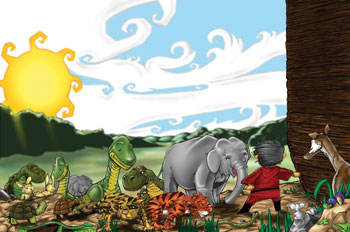
The announcement about the juvenile/adult transition of dinosaurs is useful to consider not only in relation to the numbers of dinosaurs aboard the Ark, but also what the Ark’s dinosaurian cargo looked like. For example, Noah didn’t need to take a Dracorex pair and a Pachycephalosaurus pair onto the Ark, but rather just the two Dracorex. That’s because, as we’ve earlier pointed out, it makes much more sense that God brought juvenile dinosaurs to Noah, rather than ‘grandma and grandpa’ dinos, given their purpose was to repopulate the earth post-Flood.11 And similarly, creationist artist depictions of Noah watching his dinosaur passengers boarding the Ark should no longer be drawn to show T. rex, but something more like its juvenile form, Nanotyrannus.
Update, 4 August 2010: Triceratops on trial?
The famous dino Triceratops and the less well known Torosaurus share the three horns, but the latter’s skull is much bigger—one of the biggest of all land animals—and has two large holes, hence the name, meaning ‘perforated lizard’ (Greek τορέω toreō, to pierce or perforate (not ‘bull lizard’, which would be Taurosaurus, from Greek ταῦρος tauros). (Triceratops means ‘three-horned face’, is derived from the Greek tri/tρι– three, keras/κέρας horn, and –ōps/ωψ face.) Not surprisingly, their discoverer, Othniel Marsh (1831–1899), classified them as different genera. But now, John Scannella and Jack Horner at the Museum of the Rockies in Bozeman, Montana, argue that they were the same species: Torosaurus was just a mature form of Triceratops.12
They noted that the skulls comprised metaplastic bone, a spongy blood-rich bone that changes length over time. By counting growth rings, an age indicator somewhat like tree rings (but see Tree ring dating (dendrochronology)), they found that Triceratops specimens were younger animals, while Torosaurus was much rarer and only adult speciments were known. Also, the older Triceratops specimens had thinned regions of the frill corresponding to the Torosaurus holes, suggesting that they were transforming.
This also means that the frills would not have been very good shields—the bone was too thin, and would bleed profusely.
This means that Torosaurus must be abolished as a separate taxon, since by the naming rules, the first published name stands. Furthermore, the researchers argue that previous classifications presumed that juvenile dinosaurs were just miniature adults, but now we know that shape can change radically. So there are likely many more dinosaur ‘genera’ that were really juveniles of other named genera. So the Ark cargo was even lighter than previously thought.
References
- Handwerk, B., A third of dinosaur species never existed?, National Geographic News, http://news.nationalgeographic.com/news/2009/10/091009-dinosaur-species-never-existed.html, 9 October 2009. Return to text.
- Edwards, L., Researchers claim a third of dinosaurs might never have existed, http://www.physorg.com/news174634964.html, 13 October 2009. Return to text.
- Fangrad, R., Dracorex—the dinosaur that looks like a dragon, 12 January 2007. Return to text.
- Williamson, T. and 3 others, Early ontogeny of pachycephalosaurine squamosals as revealed by juvenile specimens from the Hell Creek Formation, eastern Montana, Journal of Vertebrate Paleontology 29(1):291–294, 2009. Return to text.
- Dalton, R., In search of Thingummyjigosaurus—There are errors in almost half the names given to dinosaurs,
, 17 September 2008. Return to text. - Benton, M., Fossil quality and naming dinosaurs, Biology Letters 4(6):729–732, 23 December 2008. Return to text.
- Benton, M., How to find a dinosaur, and the role of synonymy in biodiversity studies, Paleobiology 34(4):516–533, December 2008. Return to text.
- Catchpoole, D., Too many dinosaur names, 15 January 2009. Return to text.
- Amos, J., Will the real dinosaurs stand up? BBC News,
, 17 September 2008. Return to text. - For more on this, see Sarfati, J., 2004, Refuting compromise, chapters 7–8. Return to text.
- Skeptics who claim Noah couldn’t have fitted all the dinosaurs on board the Ark are wrong, as the Ark was easily big enough (Genesis 6:14–16) to accommodate 55 kinds of dinos (along with all the other kinds of created animal and birds). Noah didn’t need to take full-grown dinosaurs, but juveniles. Juveniles of even the largest dinosaurs were less than 1 metre tall (about 3 ft)—see chapter 19 of The Creation Answers Book; also see Dr Jonathan Sarfati’s article about dinosaur growth rates. Return to text.
- Scannella, J. and Horner, J.R., Torosaurus Marsh, 1891, is Triceratops Marsh, 1889 (Ceratopsidae: Chasmosaurinae): synonymy through ontogeny, Journal of Vertebrate Paleontology 30(4):1157–1168, 2010 P-I-P-E doi:10.1080/02724634.2010.483632; Lawton, G., Morph-osaurs: How shape-shifting dinosaurs deceived us, New Scientist 2771, 28 July 2010. Return to text.


Readers’ comments
Comments are automatically closed 14 days after publication.