
Dragonfly design tips
This is the pre-publication version which was subsequently revised to appear in Creation 32(2):51.
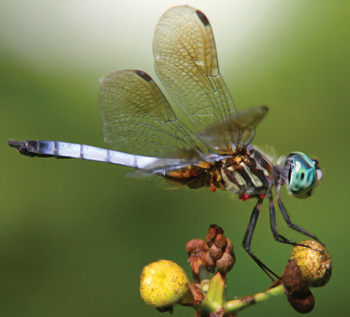
Just how can the dragonfly perform its energetically-demanding aerial acrobatics—flying backwards or forwards, fast, slow or hovering—and remain airborne for such extended periods?
The answer, in part, is that it has four wings.
While many flying insects use only a single pair of wings (and very well, too1), dragonflies have ‘unusual musculature’ that allows them to move each of their four wings2 independently, which is a key factor in their ability to perform “astonishing acrobatics”.3
It had been thought that such out-of-phase flapping comes at a cost, i.e., reducing the amount of lift the insect can generate.
However, bioengineers have built a robotic version of a dragonfly, attaching sensors at the base of the robot’s wings to record lift and drag forces, allowing researchers to calculate aerodynamic efficiency.4,5 And it turns out that in out-of-phase flapping, the hind wings can extract extra energy from the wake of air sent by the front wings, reducing aerodynamic power requirements by up to 22% compared with a single pair of wings. This mechanism, the researchers explained, “is directly analogous to that exploited by coaxial contra-rotating rotors, exemplified by helicopters such as the Kamov Ka-50.”4
What’s more, dragonflies have the flexibility to switch between out-of-phase flapping and in-phase flapping as appropriate. When taking off, for example, real dragonflies synchronise their wing beats, thus they are able to lift and accelerate better than if they used only two wings or four out-of-sync wings.
With this new insight into the aerodynamic efficiency of out-of-phase flapping, engineers hope to apply it in the next generation of flapping micro air vehicles.
As one bio-engineer explained, battery life limits how long micro air vehicles can stay aloft, so “any tips or tricks which enhance aerodynamic efficiency will be warmly welcomed.”5
It defies reason to suggest that an energy-efficient aerial acrobat such as the dragonfly was not intentionally, and intelligently, designed.
In fact, the researchers involved in this aerodynamic efficiency study apparently recognized the difficulty their finding presents to the widely-accepted evolutionary scenario, which posits that four-winged dragonflies arose long before (i.e., are “more primitive” than) the two-winged Diptera:
“Caution must be applied when interpreting the biological significance of the above observations. Suggesting an evolutionary advantage to either two-winged or four-winged forms is unwise, considering the success and diversity of the true flies (Diptera), and yet the maintenance of the four-winged form by dragonflies since the Carboniferous.”4,6
Surely it makes much more sense to say that four-winged dragonflies and two-winged flies were each designed to do what they do do, and what they do do, they do do well!
References and notes
- See: Wieland, C., Why a fly can fly like a fly, Journal of Creation 12(3):260–261, 1998; creation.com/fly. Return to text.
- Only damselflies and dragonflies have four wings capable of being moved independently. Certain other insects, such as butterflies, bees and cicadas, have four wings but they synchronize the motion of the two pairs so that the effect is akin to having just two wings. Return to text.
- Sarfati, J., Astonishing acrobatics—dragonflies, Creation 25(4):56, 2003; creation.com/dragonfly. Return to text.
- Usherwood, J. and Lehmann, F., Phasing of dragonfly wings can improve aerodynamic efficiency by removing swirl, Journal of the Royal Society Interface, doi:10.1098/rsif.2008.0124, 13 May 2008. Return to text.
- Tatalovic, M., Lord of the wings, ScienceNOW Daily News, <sciencenow.sciencemag.org/cgi/content/full/2008/514/4>, 14 May 2008. Return to text.
- The fact that living and fossil forms are the same despite the supposed “millions of years of evolution” in the meantime is a major challenge to evolutionists, though they don’t always admit it. See Bell, P., Evolutionary stasis—Double-speak and propaganda, Creation 28(2):38–40, 2006; creation.com/stasis. Return to text.

Readers’ comments
Comments are automatically closed 14 days after publication.