

Journal of Creation 17(1):11–13, April 2003
Browse our latest digital issue Subscribe
Extrasolar planets suggest our solar system is unique and young
More extrasolar planets discovered
The claims that more planets have been discovered in orbit around nearby stars continue to make the news,1,2 with over 100 now documented.3 A recent report in Sky & Telescope discloses
‘The new discoveries, like most of the previously known exoplanets, generally follow eccentric (elongated) orbits and are closer to their stars than the giant planets in our solar system are to the Sun.’2
Much excitement concerns the star 55 Cancri. Apparently, it has a Jupiter-like planet orbiting further out—at about 5.9 AU with a mass about 4.05 M_Jupiter. (AU, stands for astronomical unit, the unit of length for solar-system-scale measurement, and equals the average distance of the Earth from the sun. The mass unit, M_Jupiter, is based on the mass of the planet Jupiter, about 318 times the mass of the Earth.) Because this exoplanet with 55 Cancri exists, so the thinking goes, other exoplanets must exist much farther out from their host stars. If so, our solar system would not be unique.
Evolutionists hope that many stars will be discovered with habitable Earth-like planets and gas-giant planets orbiting far from their host stars—similar to our solar system configuration. It’s interesting that this latest speculation has arisen from extrapolating a single observation with both mass and measured orbital eccentricity (e = 0.16) much greater than Jupiter’s (e = 0.05). The reports also reveal that 55 Cancri apparently has two other Jovian-mass planets orbiting much closer (< 0.3 AU). Obviously the planetary system for 55 Cancri is not particularly similar to our solar system.
Many of the stars reported to have extrasolar planets3 range from spectral class K2 to F7 (typically red to white) and luminosity class IV–V (subgiants to main sequence stars). A few spectral class M stars are listed as well as Gliese types. Our sun plots on the Hertzsprung-Russell (H-R) colour-brightness star diagram as spectral class G2V. The distances from Earth of parent stars range from 3 to 60 pc4 (10–200 light-years) with spectral class G stars common and 25–35 pc (80–115 light-years) distance common. Almost 1/3 of the exoplanets listed have orbits less than 0.4 AU from their parent stars—inside Mercury’s orbit if placed in our solar system.
Our solar system is different
A simple statistical analysis of some of the data for the exoplanets listed to date3 yields the following averages:
- Mean semimajor axis, a = 1.24 AU
- Mean eccentricity, e = 0.274 (larger than Pluto’s e = 0.244, the most eccentric of our solar system)
- Mean mass = 3.295 M_Jupiter
If this average gas-giant planet were orbiting in our solar system it would have a perihelion, (q) of 0.90 AU and aphelion, (Q) of 1.58 AU and continually cut across Earth’s orbit. We need to keep in mind that the masses reported are a minimum estimate, not a maximum.
In our solar system, the average values of the nine planets for the same three properties are:
- Mean semimajor axis, a = 11.902 AU
- Mean eccentricity, e = 0.081
- Mean mass = 0.156 M_Jupiter
The ‘average’ perihelion, q is 10.938 AU and the aphelion, Q is 12.866 AU, which is well removed from the Earth’s orbit.
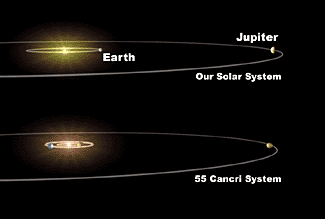
This makes an interesting comparison. First, the extrasolar planets have much larger masses than our gas-giant planets. The 4.05 M_Jupiter gas giant at 55 Cancri is an example. Then, the extrasolar planets orbit much closer to their host stars and have a greater orbital eccentricity than the planets in our solar system. In fact, the exoplanets seem to be more similar to double stars, visual binary systems, and spectroscopic binary systems, than to the planets in our solar system.5 For binary stars the mean eccentricity, e is 0.28 and the orbital period ranges from 1.0 to 10,000 days.6 It is worth remembering that, for the extrasolar planets reported so far, the method of detection may favour large gas-giant planets orbiting close to their parent stars.
It is surprising that the characteristics of the extrasolar planets are so different from the gas-giant planets of our solar system. Surprising because it has been claimed for decades that the naturalistic evolution model thoroughly explains our solar system. According to evolution, the rocky, terrestrial planets formed because the inner solar nebula was hot, while the outer regions of the solar nebula were cold, forming the gas giants.2 The same characteristics were expected for the planetary systems of other stars since they supposedly formed the same way. However, gas-giant planets orbiting less than 0.4 AU from their parent stars explode this belief. Somehow, evolutionists have avoided publicizing this issue.
How to explain?
The extrasolar-planet data suggests our solar system is special, which is difficult to explain from a naturalistic evolutionary perspective. For some reason, when our solar system formed, the sun managed to avoid the more common ‘fate’ of other star systems. Specifically, we do not have gas-giant planets orbiting from 0.1 to 3.0 AU from the sun, like 75% of the stars with planets so far listed.3 The other planets in our solar system are well clear of the Earth’s orbit.
Nearby stars of spectral class G, similar to the sun, are expected to be of a similar age (as determined from the H-R diagram). In fact, 55 Cancri is a spectral class G8 star and considered to be 4–7 billion years old on the H-R diagram.2 Stars of similar age would have completed a similar number of galactic rotations7 since their origin. So, although our sun would have completed some 20 galactic rotations (assuming the astronomical age of the galaxy is correct), it has somehow managed to avoid interactions which produced gas-giant planet configurations with orbits near 1.0 AU, the Earth’s location. That’s pretty significant for the survival of life on earth.
The data is easy to understand from a young-earth creation model. Since Creation Week ended (Genesis 2:1–3) some 6,000 years ago as measured on earth, the sun and nearby spectral class G stars have completed much less than one galactic rotation. Certainly, since Creation Week, these nearby star systems have experienced little stellar evolution. The creation interpretation affects our understanding of the origin of our solar system and of extrasolar planets.
I wonder if evolutionists thank their lucky stars and random particle collisions for the unique configuration of our solar system and our habitable earth. Modern secularists cannot consider that the Creator had anything to do with it. Such thinking would violate a central tenet of modern science—methodological naturalism.8
From a creation perspective, God, during the Creation week, predetermined the initial conditions of our solar system to provide a habitable earth. We know from Genesis 1:31, that at the end of Creation Week God’s creation was ‘very good’. It is hard to imagine that gas-giant planets orbiting near the Earth and gravitationally interacting with it would fit the description of ‘very good’. Such interaction would cause the Earth to become as volcanically active as Jupiter’s moon Io, even if the orbits were stable.
Thus, the gas-giant planets were created in the outer orbits of the solar system and the smaller rocky planets in the inner orbits. This has ensured that the earth has remained stable and habitable because, as explained in Isaiah 45:18, the Creator formed the earth to be inhabited. Because of its naturalistic evolutionary philosophy, modern science does not want to recognise that our solar system is specially created, and so it has problems explaining the data for exoplanets, which show that our solar system is special, and young.
References
- AstroNews, Opening the new-planet floodgates, Astronomy 30(9):20–22, 2002. Return to text.
- NewsNotes, The first exo-Jupiters, Sky & Telescope 104(3):20, 2002. Return to text.
- Masses and orbital characteristics of extrasolar planets, <exoplanets.org/almanacframe.html>, 24 September 2002, maintains a growing database on extrasolar planets. Return to text.
- pc stands for parsec, the unit of stellar distance. One pc is the distance to a star that produces a parallax of one second of arc on a base line 1 AU long. One pc is 206,265 AU or 3.26 light-years. Return to text.
- Cox, A.N. (Ed.), Allen’s Astrophysical Quantities Fourth Edition, Springer-Verlag, pp. 424–425, 2000. Return to text.
- Cox, Ref. 5, p. 424. Return to text.
- Bernitt, R., Globular clusters and the challenge of blue straggler stars, Journal of Creation 16(2),5–7, 2002; p. 6. Return to text.
- Rennie, J., 15 Answers to Creationists Nonsense, Scientific American 286(1):78–85, 2002; p. 84. Note, this article was rebutted; see 15 ways to refute materialistic bigotry: A point by point response to Scientific American. Return to text.

Readers’ comments
Comments are automatically closed 14 days after publication.