

Focus: News of interest about creation and evolution
Alligator heavier than tyrannosaur

Bones of an alligator which was as long as a house and as tall as its ceilings have been found on the banks of the Amazon River in South America. Scientists estimate from the alligator’s 1.5 metre skull that it was about 2.5 metres (eight feet) tall, and about 12 metres (40 feet) long. Professor Carl Frailey, from Overland Park, Kansas, said the creature probably weighed around 12 tonnes. ‘This would make it about a tonne heavier than Tyrannosaurus rex . . . the mightiest of dinosaur predators’, he said. A spokesman from The Guinness Book of Records said this alligator would have been the largest predator yet known. It would appear in the next edition as such.
The Sunday Mail (Brisbane), November 17, 1991 (p. 3).
Walking? That’s cool, man
Humans began to walk upright and shed their apelike fur because it was cooler to do so, a British scientist suggests. Walking on two legs instead of knuckle-walking like a chimp exposed less body surface to the sun and allowed air to circulate around armpits and the upper body, says Dr Peter Wheeler, lecturer in evolution at Liverpool Polytechnic. The origin of bipedalism has long puzzled evolutionary anthropologists. ‘The single most stressful feature of the environment at the time was strong solar radiation and the lack of drinking water’, Dr. Wheeler said. ‘We estimate that a knuckle-walker would need about 2.5 litres of drinking water a day. A biped would need about 1.5 litres.’ With a tighter control on body temperature, man wouldn’t need thick fur on his skin, and his brain could increase in size, Dr. Wheeler said.
The West Australian, November 27, 1991 (p. 3).
It must be pointed out that there is no evidence that man has ever had thick fur or that he was a knuckle-walker. All the evidence agrees with Genesis that humans were created as humans.
Dinosaurs … gone with the wind!
Fossilized dinosaur dung shows that flatulence from the giant reptiles may have warmed earth’s climate, some scientists have proposed. Researcher Simon Brassell, from Indiana University, said the new study found signs of bacteria and algae in dinosaur droppings. This indicated that plant-eating dinosaurs digested their food by fermenting it—a process that gave off methane.
‘The methane produced could have contributed to ancient climate warming’, Brassell said.
He said the study didn’t imply that dinosaur wind was the initial cause or the major contributor to global warming in ancient times. Extensive volcanic eruptions and other causes that increased atmospheric carbon dioxide levels were major factors, he said.
LaFayette Journal and Courier, October 23, 1991
Other scientists have said they doubted that dinosaur gas would have contributed to any significant global warming.
Ear in rear ‘explains’ right-handedness
Humans and other vertebrates look generally symmetrical (which means that a line down the centre of your body gives a mirror image on each side). But there are differences between the two sides of our brain, and our internal organs are not all arranged symmetrically about the central point (e.g. the kidneys are, but the liver is not).
Fossil experts from London’s Natural History Museum looked for an answer to this. They have seized upon a small creature called Cothurnocystis, which allegedly lived 500 million years ago.
They claim that this creature with a boot-shaped head is one of the ancestors of all vertebrates. And they believe they have detected the ‘first’ signs of asymmetry: ‘a primitive left ear, in or near the animal’s anus’. From this, the following gems of wisdom have emerged:
- We are all asymmetrical because our ancestor Cothurnocystis ‘toppled onto its right side to live and move around on the sea-bed’.
- In evolutionary terms, your left ear is older than your right.
- The reason most of us are right-handed is because Cothurnocystis flopped on to its right side. If it had been its other side, most would be left-handed.
The Melbourne Age, November 1, 1991, (p. 7).
If the last point were true, it follows that all left-handers evolved separately, from a line of Cothurnocystis that flipped on to the other side! Small wonder the article refers to left-handedness as a ‘mystery’. The real mystery is why such fanciful explanations (funded by taxpayers’ dollars) are presented as serious science.
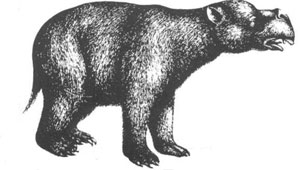
Huge Marsupial
A complete fossilized skeleton of the biggest marsupial to have lived, the diprotodon, has been found in the Pilbara region of Western Australia. A team from the West Australian Museum is excavating the rhinoceros-sized skeleton.
The diprotodon was a plant-eater which stood two metres high and weighed 1.5 tonnes. Museum curator Dr. Ken McNamara said the skeleton was found close to the sea. He said fossil mollusc shells found nearby suggested the animal had been trapped in mangrove mud at a time when sea level was much higher than now.
The West Australian, December 4, 1991 (p. 3).
Human bones in coal?
Skulls and other human bones allegedly found in anthracite coal are on display in a museum in Pennsylvania. [Anthracite is a hard form of coal that burns with little flame and smoke.]
Evolutionists believe this find is impossible because humans had not yet evolved when coal seams were formed.
The display was reported in a newspaper in eastern Pennsylvania. The report said the Greater Hazelton Historical Society Museum had an elaborate display of petrified bones which were found between coal seams.
Science Frontiers, September-October, 1991, (p. 3).
‘Nebraska mouse’ excites some
A fossil tooth about the size of a pinhead has been found in clay near Murgon, Queensland (evolutionary age 55 million years). Dr. Michael Archer, from the University of New South Wales, has hailed the tooth as tremendously exciting. He insists that it could only be from a placental (non-marsupial) mammal, and maintains that it should revolutionize our ideas about marsupials (pouched animals, like opossums, koalas and kangaroos).
The traditional view is that marsupials are inferior mammals, and have flourished in Australia only because the ocean protected this island continent from placental mammals, at least until the relatively recent arrival of the dingo. Now, it is claimed, this tooth shows that placentals were in Australia, and were out-competed by Australia’s marsupials. A reconstruction of this allegedly mouse-like mammal was shown on television. The show also made the statement (of great interest to creationists) that marsupial fossils have been found on every continent in the world.
Quantum, Australian Broadcasting Commission, November 6, 1991.
Sydney Morning Herald, November 7, 1991, (p. 6).
The idea of Australia’s marsupials’ having ‘kicked out’ the placentals has a certain appeal to Down-Under chauvinism (and will certainly do the reputations of these evolutionists no harm), even to the extent that people will probably overlook the extremely speculative nature of a hypothesis based on one tiny tooth.
Whales with ‘non-feet’
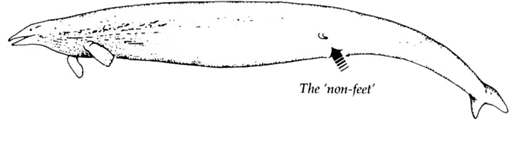
The creature called a ‘whale with feet’ which was found in north-central Egypt (see Creation magazine, vol. 12 No. 4, p. 5) now has many counterparts. Hundreds of skeletons of Basilosaurus isis have been found in Egypt’s Zeuglodon Valley. The creature was in fact long and serpent-like, very unlike what we know as a whale. It had some tiny rear appendages with a limb-like bone structure. Once again, these appendages have been announced to the public as ‘hind legs’ or ‘feet’ by evolutionists hoping for something like a ‘walking whale’ to convince people that whales evolved from some land mammal which re-entered the sea. The facts are that:
- These appendages are incredibly tiny (about 3 per cent of the animal's length).
- Their anatomy suggests that they had some function, so they cannot be argued to be ‘useless leftovers’ (vestigial organs).
- They were almost certainly ‘useless for swimming’, and ‘could not have supported its weight out of water’. Hence to call them legs or feet is misleading. Evolutionists believe they evolved from legs/feet, but their reasoning is simply based on homologous (parallel design) construction.
- They are generally believed to have been used as positioning guides during reproduction in view of the animal’s unusual shape.
Australian Natural History, vol. 23 No. 10, Spring 1991 (p. 754).
The argument from homology in the bony patterns is equally an argument for common design. Only the eye of a preconceived evolutionary faith could see these designed and useful structures as ‘legs’ or ‘feet’.
Not a pretty faith
The modern hagfishes (Myxine and Epatretus) have long been regarded as a ‘primitive’, though still living, group. They do not easily fit into either the jawed fishes group or the group represented by modern lampreys. It was thought that they were probably degenerate descendants of either of these two.
Now a hagfish fossil has been found which has been labelled Myxinikela siroka and dated by evolutionary assumptions at 300 million years old.
Not only does this hagfish show no sign of any significant evolution in those alleged 300 million years, but it shows ‘no trace of any character that might link it with the lampreys or the jawed vertebrates’.
Nature, vol. 354, November 14, 1991 (p. 108).
In other words, a hagfish has always been a hagfish, with no evidence that it evolved into, or degenerated from, anything else.
Saturn’s puzzling rings

The massive rings of Saturn could not have lasted nearly as long as the proposed evolutionary age of the planet, calculations show. So long-age enthusiasts are forced to explain the rings as having formed long after Saturn. Similar, but lesser rings, have now been detected around Jupiter, Uranus and Neptune. These also could have been there for only a fraction of the assumed evolutionary life-time of those planets.
The rings are too massive, it seems, to be easily explained by break-up of a previous moon of Saturn. Trying to explain them by tidal disruption of a passing comet runs into problems too—the rings seem to be made of the wrong material, and calculated probabilities are extremely low, especially because the rings rotate in the same direction as the planet.
A recent article by astrophysicist Larry Esposito calls Saturn’s rings ‘rare’ and ‘unlikely’. After reviewing various arguments for their origin, he concludes that ‘the existing observations leave the origin of Saturn’s rings undecided’.
Nature, vol. 354, November 14, 1991 (p. 107).
If the belief in vast ages were removed as a starting point, much less effort would be wasted on puzzling over such matters. More resources could be put into understanding the nature of our wonderful solar system, spoken into existence on the fourth day of Creation week.
Readers’ comments
Comments are automatically closed 14 days after publication.