

Focus: news of interest about creation and evolution
What good is part of a snake?
A univerity professor from Canada has expressed amazement at how the many intricate workings of a snake could have evolved.
Former professor of neurobiology at the University of Sherbrooke Medical School in Quebec, E. Ramón Moliner, noted that the fangs of a viper have a canal in them. An adjacent gland secretes the poison. There is a reservoir to store the poison, and a duct connecting this to the canal in the fang.
The viper also has an intricate system to erect the fangs before they strike, a muscle system that contracts the poison reservoir—at the right time—and a nervous system that signals it’s time for contraction. And of course the animal has the instinct to use the fangs against prey and not against mates.
‘What would have been the selective advantage of the rest of the poison system if just one of its components had failed to evolve?’ Professor Moliner asked.
‘To claim that it can be achieved through unbiased evolution is like expecting that nine independent miners can attack the core of Mount Everest from various points at the foot of the Himalayas and meet exactly in the middle without the guidance of a surveyor.’
New Scientist,
11 November, 1995 (p. 48).
A boy named Lucy?
Perhaps the most famous fossil alleged to be a human ‘ancestor’ is that called ‘Lucy’, labelled Australopithecus afarensis.
There are many well-respected anatomists who deny that any of these ‘australopithecines’ qualify as human ancestors. However, there has been heavy promotion and a lack of any more convincing candidates. Thus, most of the scientific press regularly refers to Lucy as being a definite early human ancestor, rather than the extinct pygmy-chimp-like creature it really was.
A recent embarrassing controversy underscores just how ‘authoritative’ and ‘certain’ the interpretation of fossil ‘hominid’ bones really is. Two Swiss anthropologists who re-examined the Lucy fossils 20 years after their discovery are now making a strong case for their claim, based on pelvic anatomy, that ‘she’ was almost certainly a male. Others just as strongly disagree.
Science Vol. 270,
24 November, 1995 (p. 1297).
Giant sea louse find
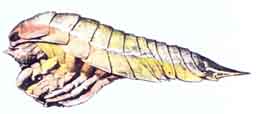
Dubbed ‘Big Boy’, a giant species of ‘sea lice’ has been discovered living on the seafloor under a kilometre of water off Australia’s east coast.
Grouped with the common slater beetles found on land in rotting wood, this crustacean is 30 centimetres (one foot) long, whereas most family members are only about 1–2 centimetres ( inch). It lives off the dead creatures that fall to the bottom in a region where most fish are unable to venture.
According to Australian Museum scientists, Bathynomus, as it is properly called, has ‘remained much the same for at least 80 million years’.
The Sydney Morning Herald,
October 4, 1995 (p. 3).
There are discoveries all the time of living things which are little or no different to fossils that are claimed to be millions of years old. This supports the creation model—that the alleged vast ages are not real, and that no major evolutionary change occurs anyway.
Rare fossil mushroom
The ‘oldest’ known fossil mushroom (according to evolutionary reasoning) has been found in New Jersey amber. It is believed to be 90 million years old (on the evolutionists’ time-scale).
It has gills, and is of the group which includes puffballs, polypores and stinkhorns. Such fossils are ‘exceedingly rare’.
The Times (London),
October 12, 1995 (p. 12).
The Guardian (London),
October 12, 1995 (p. 9).
Nature,
October 12, 1995.
Not surprisingly for creationists, the find is very similar to modern mushrooms, suggesting that the fungi have not altered much in 90 million years, or that they are not that old!
Is ‘Lucy’ alive and well and living in Sumatra?

Businesses, academics, and a major conservation group are backing a British journalist’s attempts to find a mysterious ape-like creature in the jungles of Sumatra.
Local villagers have long reported seeing the creature around the slopes of Sumatra’s Mount Kerinci. Dr David Chivers, from Cambridge University, said he is convinced that the creature, known as Orang Pendek, is real.
The creature is described as a tail-less, short-haired, ape-like creature, up to 1.4 metres (4 feet 6 inches) tall, and which walks upright. London journalist Debbie Martyr says she has sighted it briefly several times and has made casts of its footprints.
The creature has banana-shaped feet, and each foot has four toes in an almost straight row, with a fifth, big toe, jutting to one side.
Sunday Express (London),
October 8, 1995 (p. 2).
The descriptions and sketches of this creature bear a striking resemblance to those of the australopithecines—the fossil ‘chimps’ which evolutionists believe link ape-type creatures with humans. Evolutionists believe the australopithecines died out millions of years ago. If the Orang Pendeks in Sumatra turn out to be australopithecines, it will cause chaos in evolution’s ranks.
Star problem for ‘BIG BANG’
How can the universe be younger than the stars in it? This is a problem evolutionary scientists have faced recently.
Results from the Hubble Space Telescope have suggested that the universe is ‘younger’ than some of the stars in our galaxy, according to evolutionary beliefs. How can this be?
John Maddox, editor of the science journal Nature, said: ‘The obvious answer is that the result, the third of its kind in under a year, makes a nonsense of the standard Big Bang view of how the Universe began.’
Maddox does not think the new measurements herald the death of the ‘big bang’ theory, but are ‘merely a further sign of its fragility’.
Nature Vol. 377,
14 September, 1995
(p. 99).
Evolution’s ‘big bang’ theory will always have problems because it has the wrong starting point, and is thus the wrong explanation. The true explanation for the origin of the universe is found in the Book of Genesis.
New fossil ape
Fossils of a creature supposedly older than the famous ‘Lucy’ have been found in Kenya.
For two decades ‘Lucy’ and other fossils of its genus have been regarded by most evolutionists as ancestors of humans. ‘Lucy’ is said to be 3.5 million years old on the evolutionists’ time-scale.
New fossils of ape-like teeth and jaw fragments found near Lake Turkana have been pooled with ‘human-like’ teeth and limb bones found in 1965 to make what Meave Leakey and her colleagues say may be an ancestral species, Australopithecus anamensis, which is said to be 4 million years old.
Not all evolutionists accept that the fossils from the two sites should be combined.
Science Vol. 269,
18 August, 1995 (p. 918).
Science News Vol. 148,
August 19, 1995 (p. 119).
Discoverer Meave Leakey has been reported as saying that the new jaw and teeth are more ape-like than ‘Lucy’. But ‘Lucy’ is almost identical to some modern chimps, so if this new creature is more ape-like it shouldn’t be considered a human ancestor at all.
Chinese ape-man evidence looks slim
A team of Chinese and Western scientists now claim that early man-like ancestors of the genus Homo reached China around 1.8 million years ago, 800,000 years earlier than evolutionists had previously thought. In fact, some say it supports the claim that Homo erectus evolved in China, not Africa.
The claim is based on a few fragments of jaw and teeth found in Sichuan province, which even some evolutionists admit are ‘pretty scrappy’ (presumably because it contradicts their particular version of evolution).
There are also some simple round stones, alleged to be tools used by the owners of the teeth. However, other evolutionists think these are just naturally occurring objects, and not tools at all.
Evolutionist Milford Wolpoff, of the Univerity of Michigan, has seen the fossils and believes that these new ‘ape-man’ fragments are actually from ‘an orangutan or other Pongo [ape].’
Science Vol. 270,
17 November 1995
(p.1116–7).
Bigger than T. rex!
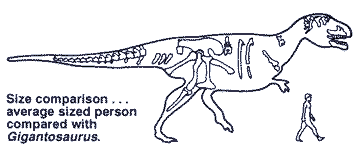
Fossils of a huge, allegedly meat-eating, dinosaur, bigger than the largest known tyrannosaur, have been found in Argentina.
The dinosaur, Gigantosaurus carolinii, is believed to have been almost 13 metres (42 feet) long, and to have weighed almost nine tonnes. This is longer and heavier than the largest Tyrannosaurus rex so far found.

Gigantosaurus is one of a string of new-found dinosaur fossils which are said to be forcing evolutionary palaeontologists to revise theories about how dinosaurs evolved in ‘separated Cretaceous lands’.
Science News Vol. 148,
September 23, 1995 (p. 199).
Curator of palaeontology at the Museum of the Rockies, in Montana, Jack Horner, cautioned that comparing the sizes of Gigantosaurus and T. rex is tricky because dinosaurs grew continuously until they died, rather than stopping at some adult length. (Also see our special article in this issue about how to catch a T. rex.)
Readers’ comments
Comments are automatically closed 14 days after publication.