

Focus: news of interest about creation and evolution
Dino soft tissue find

A research team led by Mary Schweitzer of North Carolina State University has discovered ‘the remarkable preservation of soft cellular tissues’ inside several T. rex and other dinosaur bones. They observed dinosaur blood vessels ‘still flexible and elastic after 68 million years’ and ‘apparently intact cells’.
Science journal recaptured the evident excitement and disbelief of the researchers at the time of their discovery: ‘Back in the lab, Schweitzer and her technician demineralised the [dinosaur skeleton] fragments … . As the fossil dissolved, transparent vessels were left behind. “It was totally shocking,” Schweitzer says. “I didn’t believe it until we’d done it 17 times.”’
Science, 25 March 2005, pp. 1835, 1852, 1952–1955.
Unfortunately, such is the dominance of the long-age paradigm that facts alone won’t readily overturn it. Their discoveries are actually immensely powerful evidence that dinosaur fossils are not millions of years old at all, but were mostly fossilized under catastrophic conditions a few thousand years ago at most. Note that Dr Schweitzer and her team justifiably identified the flexible branching structures (photo left) in the T. rex bone as ‘blood vessels’. But such soft tissue should not be there if the bones are as old as they claim.
Sadly, some Christians who accept long ages are allying with antitheists in seeking to undermine biblical creationists’ proclamation of this discovery. (See ‘Squirming at the Squishosaur’)
Rapid petrification
A team of researchers from the Pacific Northwest National Laboratory in the US claimed to have created petrified wood in just a few days. They soaked poplar and pine wood in a silica solution and transformed the wood into mineral by cooking it in the absence of oxygen. The report said the process mimics the natural petrification process that ‘normally takes millions of years’.
BBC News, <http://news.bbc.co.uk>, 25 January 2005.
If the researchers can do it in a few days, why do they think the natural process takes millions of years? Rapid burial during Noah’s Flood would quickly isolate the wood from oxygen. Also, water and volcanic heat and ash were abundant—ideal conditions for rapid petrification.
 |
Euthanasia escalation
Dutch doctors are campaigning for legal euthanasia of healthy people who are ‘suffering through living’. At present, legal euthanasia is restricted to those having a ‘classifiable physical or mental condition’. But the Royal Dutch Medical Association, after a three-year enquiry, could find no good reason to exclude ‘suffering through living’ from the list of motives for euthanasia.
BioEdge, <http://www.australasianbioethics.org/Newsletters/147-2005-01-11.html#healthy>, 2 March 2005.
It’s not surprising that, when people are disconnected from the Bible, they can find ‘no good reason’ not to ‘terminate’ life (i.e. to murder).
Spinach power
Scientists have long sought (so far unsuccessfully) to duplicate photosynthesis—a plant’s ability to convert sunlight into energy. Now a team of electrical and biomedical engineers, nanotechnology experts and biologists has managed to incorporate a protein complex derived from spinach chloroplasts (in leaf cells) into a solid-state electronic device that they hope may one day power laptop computers and mobile phones.
But why a ‘spinach sandwich’ device rather than a conventional solar cell? A press release explained: ‘Plants’ ability to generate energy has been optimized by evolution, so a spinach plant is extremely efficient, churning out a lot of energy relative to its size and weight.’ Certainly, the photosynthetic protein complex is tiny, as around 100,000 of these protein complexes would fit on the head of a pin—‘the smallest electronic circuits I know of’, observed one researcher.
Massachusetts Institute of Technology, <http://web.mit.edu/newsoffice/2004/spinach-0915.html> 24 November 2004.
Such amazing circuitry is evidence of a Designer (Romans 1:20), not evolution.
Eggs inside dinosaur fossil
A dinosaur fossil with two eggs still visible in the body cavity has been discovered in China’s Jiangxi Province. The dinosaur, identified as oviraptorosaurian, died just before it was about to lay the eggs.
BBC news, <http://news.bbc.co.uk/1/hi/sci/tech/4446769.stm>, 19 April 2005.
Science, 15 April 2005, p. 375.
The dinosaur was most probably buried rapidly, before the eggs could decay. Well-preserved fossils all around the world point to rapid burial in a global catastrophe—consistent with the biblical account of the Flood of Noah’s day (Genesis 6–9).
Stretching credulity
New Scientist reports that: ‘A bacterium that sat dormant in a frozen pond in Alaska for 32,000 years has been revived by NASA scientists.’
Incredible as that is, it pales against an earlier claim by other researchers that they had revived a bacterium from a 250-million-year-old salt crystal [reported in Creation 23(4):15, 2001]. Many scientists have hotly disputed that bacteria could be so very old. They said that the salt crystals must have been contaminated more recently, e.g. by bacteria brought in later by fluid moving through the underground salt deposit.
But recent research published in Geology journal rules out such contamination. The researchers say the chemistry of the fluid in which the bacterium was found inside the salt crystal fits with that of Permian seawater, i.e. it is indeed [they say] 250 million years old.
NewScientist.com, 25 February 2005.
Geology, April 2005, pp. 265–268.
Of course the bacteria are not as old as claimed. The ‘250-million-year-old’ bacterium is no older than the biblical Flood (around 4,500 years ago) and the one from the frozen pond dates from the subsequent Ice Age (which ended about 500 years after the Flood).
(See Oard, M., An Ice Age caused by the Genesis Flood, ICR, California, 1990—available addresses p. 2.)
Photo by Ian Buchanan |

‘Dino tree’ planted in London
The Wollemi pine, long thought to have been extinct for 200 million years until its discovery in Australia in 1994 [Creation 17(2):13, 1995; 23(1):6, 2000; 23(3):56, 2001], is now on display in London. Internationally-renowned wildlife expert Sir David Attenborough recently planted the tree at Kew Gardens.
‘How marvellous and exciting that we should have discovered this rare survivor from such an ancient past,’ Sir David said. ‘It is romantic, I think, that something has survived 200 million years unchanged.’
The head of the arboretum at Kew, Tony Kirkham, agrees. ‘In botanic terms, it is like a zoologist going out and finding a live dinosaur somewhere, a Tyrannosaurus rex,’ he said.
ABC News,<www.abc.net.au/news/newsitems/200505/s1364665.htm>, 11 May 2005
Evolutionists’ romanticising of this tree is understandable, given that their interpretation of the fossil record puts it as extinct for millions of years—which it obviously isn’t. Note, too, that the Wollemi pine is unchanged, i.e. no evolution has taken place.
From a biblical standpoint, Wollemi pine and other ‘living fossils’ most likely date from the Flood, around 4,500 years ago. So when ‘extinct’ fossil species from the so-called ‘dinosaur age’ are found to be living today—including even a dinosaur if ever discovered alive in some remote area of the world—it’s no surprise to creationists.
Wholphin gives birth again
At Sea Life Park Hawaii, the 19-year-old offspring from a ‘surprise coupling’ between a false killer whale and a dolphin—known as a wolphin—has recently given birth again.
The newborn female calf is ¼ false killer whale and ¾ Atlantic bottlenose dolphin. Her skin is a blend of a dolphin’s light grey and the black colouring of a false killer whale.
The Courier Mail (Australia), 22 April 2005, p. 13.
As we reported in Creation 22(3):28–33, 2000, dolphins and false killer whales are classed as different species—even different genera—but the hybrids show that the biblical ‘kind’ here is broader than the genus
Creation teaching is ‘dangerous’?
Michael Majerus’s work famously demonstrated the flaws in evolutionary accounts of the peppered moth story, but he passionately continues to defend textbooks’ use of the peppered moth to support evolution (Creation 26(3):9, 2004, see ‘Goodbye peppered moths’ Creation 21(3):56, 1999). Now he wants to make a public stand against the teaching of creation and ‘intelligent design’ in biology classes.
‘To have people believe the biology of the planet is controlled by a Creator, I think that’s dangerous.’
Science, 25 June 2004, pp. 1894–1895.
Stalin, Mao and Pol Pot would have agreed!
Photos/montage for illustrative purposes, NASA |
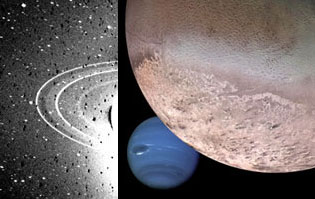
Neptune’s rings disappearing
Neptune’s rings are fading away, reports New Scientist. A comparison of recent photographs with images taken in 1989 by the Voyager 2 spacecraft shows that some parts of Neptune’s outer rings have ‘dramatically deteriorated’. Indeed, if the trend continues, one section—the Liberté arc in the outermost ‘Adams’ ring—will disappear within the next hundred years.
‘The system is not in equilibrium,’ said one researcher. ‘Our whole understanding is up in the air.’
New Scientist, 26 March 2005, p. 21.
Rapid deterioration of Neptune’s outer rings does not ‘prove’ that the solar system is young. But it is consistent with what we would expect to find from a biblical perspective, so is no surprise to creationists.
Tropical hibernation
While bears (and other animals) are known to resist the cold winter months by hibernating, researchers have reported that hibernation is not limited to animals living in chilly climates.
In tropical Madagascar, the fat-tailed dwarf lemur Cheirogaleus medius (pictured) hibernates in tree holes for seven months each year, even though daily temperatures regularly exceed 30ºC (86ºF). It is the first tropical mammal (and the first primate) found to display such behaviour.
Nature, 24 June 2004, pp. 825–826. New Scientist, 26 June 2004, p. 16.Animals might have hibernated for extended periods while on the Ark (although the Ark could easily have had enough food and water anyway—see: How did all the animals fit on the ark? Creation 19(2):16–19, 1997. Body reserves would likely have been at peak levels (Genesis 6:21) and there was no reason to move around.
Readers’ comments
Comments are automatically closed 14 days after publication.