

Focus: creation news and views
Media bias on stem cells
Last year, there was much propaganda about the need for embryonic stem cell research
(ESCR), which results in destruction of newly conceived human beings, although it
has produced no useful cures. Conversely, ‘adult’

And there was much tugging at heart strings. For example, the late quadriplegic Christopher Reeve begging for embryonic stem cell research that would supposedly cure him. Ironically, he and his supporters ignored that umbilical cord stem cells enabled a 37-year-old woman in South Korea to walk after 19 years of paralysis. Such stem cells have also grown a small artificial liver, which should greatly help drug testing.
Other 2006 successes involving adult stem cells include: SCs from fatty tissue forming into smooth muscle cells—the involuntary type essential to movement of the intestine, blood vessels and urinary tract; SCs from blood that can be directed to turn into five types of cells, including bone, blood vessel and nerve cells; SCs from bone marrow producing the insulin-producing cells which could cure diabetes; SCs from small blood vessels growing new muscle tissue, ideal for treating muscular dystrophy; heart valves have been grown from SCs extracted from amniotic fluid; and heart tissue damaged by an attack has been repaired by SCs extracted from a tiny amount of heart.
SC medical research that involves the killing of unborn human beings is not only totally unethical, it is also totally unnecessary. See creation.com/stem_cells for original sources and much more information.
Atheists vs Christians
Various antitheists are fretting that homeschooling and Christian universities are destroying the secular monopoly on education by actually providing an alternative. But despite implying that reason and faith are incompatible, they have to admit that the biblical creationist Patrick Henry College (US) ‘boast[s] high academic standards’. That college has out-reasoned even the prestigious University of Oxford (UK)—beating them twice in debating competitions. And: ‘For the past two years, the college has won the moot court national championship, in which students prepare legal briefs and deliver oral arguments to a hypothetical court.’
So despite telling us for ages that creation would lower standards, the antitheists admit that some creationist schools have the highest standards—and that is why they are so worried. The idea of Christians actually being salt in the world, defending the faith and demolishing arguments, is a threat to their atheistic faith (Creation 28(4):6, 2006; <creation.com/mind>).
That’s why they don’t want to relinquish their monopoly, so they can fail Christian students for refusing to write homosexual propaganda, (creation.com/intolerant) or cut off the microphone of the valedictorian (dux) giving her speech when she thanked Jesus Christ (see creation.com/christfree.) Make no mistake—they did not remove ‘faith’ from schools, just replaced the Christian faith with the atheistic one. As these and many other cases show, there is no such thing as ‘neutrality’—their ‘neutral’ position is an unstable equilibrium that has turned into hostility.
New Scientist 192(2577):20–23, 11 November 2006.

‘Fresh-faced’ moon
The moon has long been thought to be geologically inactive, with the last of its volcanoes erupting nearly a billion years ago.
But researchers studying images and spectrographic readings from recent space probes have found some areas have a ‘freshness’ which they say indicates gas emissions have occurred more recently.
This is not the first time that lunar observations have defied previously-accepted long-age ideas of the moon’s history. For further reading on the real age of the moon (6,000 years), see <creation.com/moon and Journal of Creation 17(1):5–6, 2003.
New Scientist 192(2577):18, 11 November 2006.
Nature 444(7116):184–186, 9 November 2006.
Leading evolutionist criticises fellow evolutionists
Renowned evolutionist Lynn Margulis (President of Sigma Xi—The Scientific Research Society), musing in American Scientist as to why the teaching of evolu tion ary theory is so controversial, admitted, candidly:
‘Evolutionary biologists act certain that they know how new life forms originate and complexify. But they don’t.’
Dr Margulis is no doubter of evolution, as she makes clear in her article. However:
‘But many biologists claim they know for sure that random mutation (purposeless chance) is the source of inherited variation that generates new species of life and that life evolved in a single-common-trunk, dichotomously branching-phylogenetic-tree pattern! “No!” I say.’
Margulis goes on to criticise those evolutionists who proclaim with ‘dogmatic certainty’ the ‘tree of life’—she says they are ignorant of ‘alternative topologies’ such as ‘webs’.
American Scientist 94(3):194, May–June 2006.
Sick? Fever helps
When you are ill, an elevated body temperature helps the immune system identify the cause of an infection and then eradicate it. A higher-than-normal temperature somehow activates cells in the lymph nodes, resulting in rapid multiplication of lymphocytes that can combat infection.
Of course, there was no sickness in the ‘very good’ world before Adam sinned. But even today, it appears that God in His mercy has provided His created beings with features apparently pre-programmed to ameliorate the effects of the Curse.
New Scientist 192(2577):17, 11 November 2006.
Super sniffer

New research has shown that rats can use their two nostrils to localize the source of an odour. This is similar to the way that having two ears enables us to locate the source of a sound.
Although rat nostrils are only three millimetres apart, these animals can detect whether an odour source is to the left or right using time-of-arrival differences or concentration differences. That is, which nostril received the smell first or is receiving the stronger odour. (When one nostril was covered, the rats could no longer identify the direction of an odour, confirming that ‘rats smell in stereo’, say researchers.)
What’s more, rats can locate an odour source in just 50 milliseconds—i.e. within a single sniff.
Surely the designers of odour-tracking robots (Creation 26(4):9, 2004) should be impressed (Isaiah 55:9).
Science 311(5761):666–670, 3 February 2006.
Dinos had stomach worms

A duck-billed dinosaur fossil found in Montana, USA, is so well-preserved that researchers have been able to study great detail of the animal’s insides. The fossil revealed chewed-up plants in its gut (useful for helping to identify what duck-billed dinosaurs ate) and also more than 200 suspected parasite burrows. The researchers say the burrows were most likely made by tiny worms similar to stomach parasites that infest animals today.
Note that such a degree of preservation, where the carcass was not divided and scattered by scavengers but ‘apparently buried before it had a chance to fall apart’ is consistent with having been buried in an unusual event (Genesis 6–9).
Note, too, that such a find shows the indefensibility of long-age compromise positions such as that espoused by Hugh Ross (see creation.com/plant_death)—did stomach worms afflict this dinosaur in the ‘very good’ world before Adam sinned, or after? (No-one would describe stomach worms as ‘very good’ today, so the obvious answer is: after.) See also our earlier articles on cannibal dinosaurs (creation.com/grotesque) and cancer-afflicted dinosaurs (creation.com/dinotumour).
ABC NewsOnline, www.abc.net.au/news/newsitems/200610/s1772272.htm, 25 October 2006.
Different colours, same species

Genetic analysis has revealed that lemurs that had been thought to be three separate species because of their strikingly different coat colours actually belong to the same species (Microcebus griseorufus).
This demonstrates the fluidity and subjectivity of the definition of ‘species’—a human construct which does not usually equate to the biblical ‘kind’. A common skeptics’ objection against the Bible is to claim that Noah’s Ark could not possibly have carried all the different species in the world. In fact, it was only male and female representatives of each kind of air-breathing land animal and bird that needed to be taken on board—probably only around 8,000 pairs in total. (See also How could Noah get all the animals on the Ark?)
BMC Evolutionary Biology 6:98, 16 November 2006, www.biomedcentral.com/1471-2148/6/98.

Star ‘old before its time’
Astronomers are puzzling over a neutron star that ‘behaves like it is millions of years old’ yet which they say couldn’t possibly be that old. They estimate the neutron star (identified as 1E161348-5055) is only 2,000 years old, based on the size of the shell of gas and dust around it. But that doesn’t fit with measurements suggesting it is rotating just once every 6.7 hours, because: ‘It would normally take a neutron star millions of years to slow down that much.’
In reality, man’s attempts to ‘measure’ the age of things will likely fall wide of the actual age—assumptions can never match the accuracy of an eyewitness account. The Bible’s eyewitness account says the stars were made on Day 4 of Creation Week, around 6,000 years ago.
NewScientist.com news service, www.newscientistspace.com/article/dn9495-bizarre-neutron-star-is-old-before-its-time.html, 6 July 2006.
People link ‘startling’
Analysis of DNA from living people and of DNA from ancient human remains is ‘startling US anthropologists by linking people thousands of miles and years apart’.
From a biblical perspective, they should not be so startled. All people today share ancestry from Adam and Eve, created only about 6,000 years ago. And all people today also share ancestry from Noah, whose descendants have multiplied and spread out across the earth since the Ark landed somewhere in ‘the mountains of Ararat’ just 4,500 years ago.
PHYSORG.COM, www.physorg.com/news77213798.html, 14 September 2006.
Who really cares?
When Syracuse University professor Arthur C. Brooks set out to investigate charitable giving in the USA he did not anticipate what he would find—that religious conservatives are more generous than secular liberals.
His findings are documented in a book titled Who really cares: The surprising truth about compassionate conservatism. Brooks cites extensive data analysis to demonstrate that values advocated by conservatives—e.g. church attendance, two-parent families, ‘the Protestant work ethic’—result in conservatives donating far more money than secular liberals to all sorts of charitable activities, irrespective of income.
Ironically, as Brooks writes: ‘For too long, liberals have been claiming they are the most virtuous members of American society. Although they usually give less to charity, they have nevertheless lambasted conservatives for their callousness in the face of social injustice.’
Professor Brooks writes in the Introduction that, before he embarked on the study, ‘I have to admit I probably would have hated what I have to say in this book.’
Compare our article ‘You should be feeding the hungry’, <creation.com/hungry>.
The Post-Standard (Syracuse, NY), www.maxwell.syr.edu/news/online_clips/061029_PS_brooks.asp, 20 November 2006.
Fossil lamprey ‘modern’

The discovery of a fossil lamprey (Priscomyzon riniensis), which evolutionists describe as looking ‘surprisingly modern’, is forcing a ‘reassessment’ of ideas about lamprey evolution. That’s because it’s said to be 360 million years old, i.e. before lampreys were thought to have evolved. In the words of one evolutionist, ‘lamprey morphology has been astonishingly stable’ [our emphasis].
Christians, however, can take a different view. The fact that lampreys today are just the same as fossil lampreys is no surprise—God created all the various kinds of land animals, birds and aquatic creatures to reproduce ‘after their kind’. And the millions-of-years ideas ignore the biblical account of history—all things were created only around 6,000 years ago. This recently-discovered fossil lamprey dates from the Flood of Noah’s day, around 4,500 years ago—the fact that such soft-bodied (boneless) creatures can be so well-preserved as fossils right around the world speaks of that unusual, global, event (Genesis 7:11).
Nature 443(7114):921–924, 981–984, 26 October 2006.
Joining with the enemy

Under the headline ‘No creationism please’, the popular weekly magazine New Scientist reported in October that: ‘Christians and atheists joined forces last week to urge the British government to prevent creationism infiltrating school science classes.’
Specifically, it was the British Humanist Association that wrote a joint letter with ‘the UK Christian think tank Ekklesia.’
Can a professing Christian organisation be yoked to antitheists in that manner? Not according to Scripture, e.g. Psalm 1:1 and 2 Corinthians 6:14. And one would think that the atheistic bias behind evolutionary thinking would alert Christians of the need to oppose it.
Sadly, however, large sections of the Church have tried to reconcile Christianity and evolution by denying a plain reading of Genesis. And doubting Genesis has, in many cases, led to doubt of the rest of the Scripture. As we have previously written (creation.com/iscast): ‘No wonder that many churches that started by rejecting biblical authority in “science” areas now have ministers who actually reject the Resurrection and Virginal Conception of Christ, and even have floats in the Gay Mardi Gras!’
It turns out that Ekklesia is a prime example of that. Their website reveals that their activities include sponsoring a conference ‘organised by the Lesbian and Gay Christian Movement, which will look at the links between religion and homophobia.’
New Scientist 192(2572):7, 7 October 2006.
Ancient man had modern mind
The widely-held assumption that the ‘characteristic features’ of the ‘modern’ human mind first evolved between 50,000 and 40,000 years ago needs to be pushed back much earlier, according to Lawrence Barham, of the University of Liverpool.
Dr Barham told the British Association for the Advancement of Science that accumulating evidence of early art—which he says indicates symbolic thought and language—points to the evolution of ‘modern’ mental capacities at least 100,000 years before the earliest accepted date. And with the discovery of mixed paints found at the Two Rivers cave complex in Zambia, he even suggests that the ancestors of modern human beings may have been practising art up to 300,000 years ago.
Of course all such dating, which presupposes evolutionary origins, is wrong. From the first (i.e. Creation Week, around 6,000 years ago), people were endowed with language and intelligence. There’s an important message here for ‘progressive creationists’ such as Hugh Ross who compromise with secular long-age dates and therefore have had to stretch the biblical timeline past breaking point to place Adam at 60,000 years ago.
So, now that those same secular dating methods place ingenious human behavior even earlier, what now?
It’s far more logical to trust the Bible’s dates and recognize that secular dates are based on assumptions.
See also, Neandertals were fully human in thinking, <creation.com/article/4611/>.
The Times, 9 September 2006.
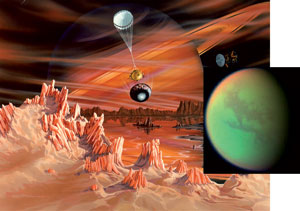
Titan lifeless
The Cassini–Huygens space probe to Saturn’s moon Titan has given no joy to those who had hoped to find life there.
Larger than the planet Mercury, Titan has long been a popular setting for science-fiction tales of human colonization and exploration. But its atmosphere lacks oxygen, its surface temperature is minus 180ºC (-356ºF), and there’s no liquid water on the surface because it’s too cold. NASA researchers say the data show it was unlikely Titan could support life.
Red Orbit, www.redorbit.com/news/space/317813/life_on_saturns_moon_titan_unlikely/, 9 March 2006.
Jellyfish poison a lifesaver?

Toxins from several species of deadly jellyfish will be the subject of a world-first study by Dr Jamie Seymour and his colleagues from James Cook University in Cairns, Australia, to extract compounds to treat heart ailments.
‘Given that the venom is predominantly a heart venom, so it kills the heart, it wouldn’t surprise me if there’s compounds in there that we can use for various heart complications,’ Dr Seymour said. ‘We’ve isolated a compound from the box jellyfish venom which actually kills bacteria that’s [sic] resistant to a lot of the medications presently used.’
A commonly-asked question is: ‘If God is good, and God created everything, then why does nature [including jellyfish—see Creation 25(4):28–31, 34–35, 2003; <creation.com/jellyfish>] have so many poisons?’
Virtually all chemicals, even poisons, have an important function in life or human society. For example, Vitamins A and E are critical for life, but highly toxic if taken in high dosages. Nothing is toxic in very tiny amounts, but all chemicals are toxic at sufficiently high levels—i.e. ‘the dose makes the poison’.
Compounds which are highly toxic in some situations can be life-saving in others. For example, the most poisonous substance known is botulin. It is six million times more toxic than rattle-snake venom. Yet, this toxin is a miracle drug for those suffering from dystonias and other health problems (as well as temporarily curing wrinkles—botox).
See also Jerry Bergman’s article, Understanding poisons from a creationist perspective, Journal of Creation 11(3):353–360, 1997, <creation.com/poison>.
The Courier-Mail (Brisbane), 7 November 2006, p. 12.
Readers’ comments
Comments are automatically closed 14 days after publication.