
From frog to prince?
… Not all scientists are right!
Translation by Loek and Linda de Vette2
The following article was published as the cover story in the June 10th edition of Visie, the largest Christian magazine in Holland. One of several publications by the Christian organisation EO, Visie has a distribution of 180,000 and is read by around 500,000 Dutch and Belgian Christians each week.
CMI is grateful to EO for permission to use this article. Note that the few endnotes (not in the original article) have been added for clarification.
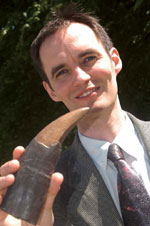
According to Englishman Philip Bell, it seems that evolutionists believe in miracles even more so than Christians do. At a college in Amersfoort (the Netherlands) he explains what has and what has not been proven. His findings, which changed him from an evolutionist to a creationist, fascinate his audience of teenage schoolchildren.3 He challenges them to think hard and to have a critical mind, for not all scientists are right.
‘Already in the days of Noah, the majority of the people thought the idea of a flood was ludicrous,’ says Bell to the school kids. Sometimes a small group, not the majority, is correct. Right from the start the students seem to appreciate their guest tutor and look captivated by what he has to say. With funny cartoons and lots of illustrations in a modern presentation, Bell makes his arguments come alive. This young scientist is clear and to the point in what he has to say and he speaks with a well-known British humour.
Unpredictable
Although he grew up in a Christian family, Philip Bell began to accept the evolution theory while at secondary school, because of what was taught during biology lessons. While a student, he experienced a crisis of faith, but in the end he discovered that the Word of God is 100% trustworthy, both in a scientific sense as well as historically.
He explains that God led him all the time and that those experiences have made it possible for him to do his work now and to do it well. ‘When I finished my degree, research did not appeal to me much and to teach was about the last thing I wanted to do,’ he admits with a smile. Although he wanted to become a missionary when young, he has now been given a unique task in this unpredictable way. He is now speaking in schools and at conferences all over Europe, speaking to audiences varying from scientists to ordinary people. In this way he has become a ‘missionary’.
Bell states that criticism of the infallibility of the Bible is usually directed at the first few chapters of the book of Genesis. ‘Recognition of Genesis as proper history seems old-fashioned and our way of thinking has been saturated with the evolution theory,’ he says. Pupils in Europe hear how the world has come into being, not why or by whom it was created. Bell acknowledges that it is risky for academics to turn their back on the theory of evolution, ‘for then you must accept that there is a purposeful design and … a designer or architect.’
Besides non-church goers, there are also theologians who reject the story of creation. The fact that, within the church, there are also those who question the truth and correctness of God’s Word leads to confusion among Christians. Bell regards the beginning of Genesis as the foundation of the Bible. ‘For if this is not taken literally, then what is? How then would we regard other events which we cannot explain scientifically, like the virgin birth of the Lord Jesus or His resurrection? A building collapses when the foundation is gone and the same applies to Christian teaching.’
Different glasses
According to Bell everyone has preconceived ideas. Because of that it becomes impossible to let evidence speak for itself, because we all view evidence through certain coloured glasses, by which we can see the very same things differently. The question is not whether we are prejudiced, but how? To end up with [believing in]4 evolution, one uses certain evidence. But the same facts can also be used to confirm the biblical story of creation. The conclusion does not depend on the available facts but depends on the framework in which those facts are being placed.
Darwin said that the complexity of the eye made him shiver. He said that his theory could be swept away if every stage of development was not viable. Now we know that the eye is so complex that it cannot be simplified. Nothing works if even one part is missing. [One of] Darwin’s favourite argument[s] for evolution was the theory that all embryos of vertebrate creatures are almost identical [at the early developmental stage]. This theory has been long out-of-date. We now know that embryos of people and different animals differ greatly and that they give no evidence of a common ancestor. On the other hand, there are similarities in the structure of living beings. However, Bell asked the question of whether these similarities in structure are proof for evolution or for a common designer. For example: The same gene within different animals like sea-urchin, mouse, [velvet worm, polychaete worm] and butterfly ensures the beginning of development of those very different ‘legs’.5 Bell knows of different atheists and scientists who are having difficulties to maintain the evolution theory. Atheist Dawkins, for example, admits that living beings look too beautifully ‘designed’ to have come about by chance. And according to Bell there are more scientists who really should try another pair of glasses in order to find out whether it ‘works’. ‘Most [atheistic] scientists who I have met are not really atheists. They are angry with the God in whom they do not believe.’
Power in our own hands
‘At many schools you hear little about the beginning of the world during lessons in biology,’ says Linda Doornenbal after Bell’s lecture. She finds his arguments for creation interesting to hear at school. On top of that she thinks it is important to hear arguments for both theories. ‘Everyone thinks they know what the evolution theory implies, but arguments and strong evidence which back up the theory of creation are unknown to most people.’ During Bell’s presentation, a cartoon shows a scientist who is trying to close a door with all his strength, in order to shut out divine light. When asked why people are putting so much effort into minimising the possibility of a purposeful design, Machiel Natzijl answers: ‘People prefer to keep power in their own hands. To recognise a Creator, means that you are accountable to Someone.’ He says that ‘design’ in nature appeals to him and that, one day, he would like to study zoology.
Linda thinks that people want to reason every subject. But Bell says that evolutionists are not always so rational: ‘When you hear a discussion between a creationist and an evolutionist, it is easy to come forward with arguments based on facts and research that speak in favour of creation. Strangely enough, the evolutionist, when confronted with these arguments, often answers with unfounded assertions, not based on facts but on ideology.’ According to Bell, assertions and theories are often accepted without any form of criticism, just because people do not dare to answer back or contradict a specialist. ‘Data in scientific books becomes out-dated every year but the Bible is still topical and up-to-date. Natural selection can only select from what the genetic information that is already present and it cannot add any new information. You cannot become a millionaire by losing some money, week in week out.’
According to the well-known evolutionist and scientist Carl Sagan, the complexity of a single cell would amount—in computer terms—to 125 gigabytes.6 This exceeds our human comprehension. Bell makes a comparison between DNA and software: ‘Is it possible for a computer programme to programme itself?’ It is perhaps obvious that a creationist accepts what he observes in creation, as the greatest proof for a Creator. ‘Some view creation as the 67th book of the Bible. Yet, creation is something different from the Divine revelation of God’s Word. You see straight away that something has gone wrong. Nature, in all its beauty, has fallen and has become a weakened testimony compared to God’s perfect revelation.’
Adam and Steve
‘People do not like to hear that they need help. Actually, everyone is born as a humanist,’ is the opinion of Philip Bell. He compares the way in which people can be reached with the Gospel with the two different kinds of approach used in the book of Acts. In the second chapter of this book we read how, during Pentecost, thousands of Jews repented in Jerusalem and were baptised. The message of Peter was clear for them because the foundation was there. Jews accepted Genesis and creation as a fact. Later when Paul arrives in Athens, he speaks to people who were influenced by philosophies that rejected the idea of a Creator. In order for him to be able to talk about this ‘unknown god’, he had to lay the foundation first.
For many people in western society, many fundamental truths have become uncertain. The importance of Genesis is being drowned by other opinions. Even for Christians, Genesis can be a stumbling block. Here in Genesis, God locates, in the creation [account], the foundation of the relationships between Him and mankind and between mankind and nature, but also between people themselves. With a smile Bell says that: ‘God created Adam and Eve, not Adam and Steve.’ ‘There is a serious implication to this, for immediately from the beginning we see that heterosexual relationships are the norm. When we accept the opinion that homosexuality is an alternative which is just as good, we are not taking seriously the foundation of the Bible. Jesus often referred to Genesis and took it to be true history. In Mark 10:6 He says: ‘But at the beginning of creation God made them male and female.’ Who are we to reject His example?’
Maybe it would be nice if we could change a frog into a prince. There are enough frogs but not so many princes. And why is this stranger than the supposition that an ape can evolve into a human being? A natural upward development sounds more appealing than a broken, self-destructing world. Bell finds it striking that people who do believe in an ‘intelligent design’, without recognising a Creator, [nevertheless] receive many hostile reactions. ‘People just do not want to be forced to be held accountable.’ And when there is no intelligent design, there is no Creator and no one necessary to clear up our mess. Jesus’ sacrifice would then have been in vain because you cannot restore contact between people and their Creator if He does not exist. In this way they found an effective means to get rid of the necessity of forgiveness of sins and the second coming of Jesus.
References
- The original article can be found on the web at <http://www.eo.nl/tijdschriften/visie/2004/page/Van_kikker_naar_prins_/articles/article.esp?article=5389551>. Return to text.
- Christians whom Philip Bell met on the return ferry to England after the tour. Return to text.
- The audience consisted of around sixty, 17-year-old biology students. Return to text.
- Square brackets here and elsewhere indicate an addition to the printed article for the purpose of clarification. Return to text.
- The Distal-less gene is involved in the development of the appendages (‘legs’) of all these different creatures but no evolutionist would claim they are homologous (i.e. similar due to a close common ancestor). See: Panganiban, G. et al, The origin and evolution of animal appendages, Proc. Natl. Acad. Sci. USA 94:5162–5166, 1997. In many cases, very similar (‘homologous’) structures in creatures that are allegedly descended from a common ancestor have very different genes coding for them! This problem for evolutionists is the exception rather than the rule. Return to text.
- Sagan actually said ‘1012 bits of information’ but Philip Bell had calculated this to be 125 GB for his talk. Return to text.
Readers’ comments
Comments are automatically closed 14 days after publication.