

Rooted in God’s truth
David Catchpoole and Don Batten chat with plant physiologist Gina Mohammed
Dr Gina Mohammed is a research scientist and international science consultant in plant physiology. Her specialties include non-traditional (non-timber) forest products, botanical medicines, remote sensing of plant stress, and plant biotechnology. Gina holds a Ph.D. in plant physiology from Canada’s Simon Fraser University, and a B.Sc. in biology (Honours) from the University of Toronto. A scientist for over 25 years, she has led research programs in both government and private-sector institutions. She has authored dozens of scientific publications, plus numerous technical articles in popular magazines. Her work has been featured on Canadian TV, radio, and in newspapers. Gina and her husband, Dan Pernokis,1 own a science and information technology consultancy2 based in Sault Ste. Marie, Canada.
An unlikely scientist

Gina Mohammed wasn’t supposed to be a scientist—at least, according to a teacher who gave her a lowly ‘D’ grade in her first biology class at age 13. ‘Obviously, she will never be a biologist,’ he wrote on her report card.
However, when Gina got to high school, a different science teacher with an infectious enthusiasm made it all seem such fun. Her marks morphed into ‘A’s, paving the way for this ‘unlikely biologist’ to end up doing exactly that for a living—and loving it!
An unlikely Christian
If Gina was an unlikely scientist, she may have seemed an even less likely Christian. Born into a Muslim family in Trinidad, she had no formal instruction in the truths of Christianity. ‘But we had a few Christian neighbours and friends, and some exposure to the Bible in school. So we heard of the name of Jesus Christ. And yes, for us there really was something special about that name, even though we didn’t fully know its Owner yet. A lady who babysat me taught my mother Psalm 91, then the 23rd Psalm. We respected Muslim practices, but we always had an open ear to what the Christians were saying. My mother says those Psalms gave her the faith and courage to emigrate with my father and us four children to Canada. Over the years, one by one, our whole household began attending church and “officially” became Christians.’
God’s light show in plants
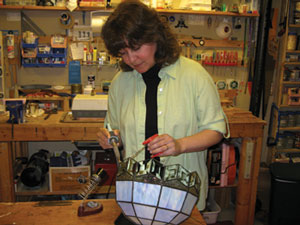
Dr Mohammed studies the physiology and uses of plants. She’s especially interested in the interplay of light with plants. Gina is co-inventor of a seed viability test that assesses whether seeds are alive or dead based on whether they ‘glow’ upon contact with a compound called fluorescein diacetate (FDA). ‘Live seeds (or other plant tissues) metabolize FDA to release fluorescein which emits a bright yellow-green fluorescence when viewed under ultraviolet or blue light,’ she explains. ‘Nurseries producing seeds for reforestation or agriculture can therefore test a small sample of a seed batch before they plant the whole lot and possibly risk an expensive failure.’
Gina has studied a different sort of fluorescence called chlorophyll fluorescence. The green colour of plants comes from the pigment chlorophyll, which produces a ruby red light when sunlight hits it. But this light is too faint to be detected by the naked eye, so scientists use filtered sensors to measure it. The fluorescence signature can reveal whether the plant is healthy or stressed. Dr Mohammed has researched this phenomenon for over two decades, helping other scientists and plant growers to use it in their work. She is now involved in an international effort to evaluate this tool for use from space satellites, to assess the health and vigour of large areas of land vegetation on Earth. (It is already used to study algal physiology in the oceans.)
Beliefs in action

For Gina, science draws her closer to God through revealing His incredible creative genius. ‘I think it’s a great privilege to be able to study His handiwork,’ she says. So how do Dr Mohammed’s beliefs influence her research?
‘My understanding of God informs the kinds of topics I address,’ she explains. ‘For example, the Bible makes it clear that God is always purposeful and not wasteful in His actions, so I expect His plants and their internal processes to have useful purposes in their natural environments—and for people. Even so-called “weeds” can be useful—many are sources of medicines and other health products, and numerous patents have been developed from them.’
For the past 10 years, Dr Mohammed has been assembling a comprehensive database of uses for about 1500 of Canada’s forest species, one of her goals being to help individuals and families to launch small businesses in non-timber forest products and services. ‘Plants are rich in potential because their Maker has an infinite capacity for inventiveness. The fact that God’s purposefulness is so evident in His creation is totally antithetic to the mindless wastefulness that defines evolution. Death and waste are the results of man’s fall, not instruments of development.’
Working among peers

Gina’s enviable publication record includes journal papers,3 book chapters,4 and popular magazine articles. Moreover, Dr Mohammed is a peer reviewer for science journals in forestry and plant physiology. ‘When I review a paper, I like to know the assumptions behind the study. But it’s surprising how many authors do not state their assumptions, thus impeding their ability to think critically about their work and its conclusions. For instance, many scientists have so internalized the assumptions of evolution that they don’t realize these beliefs are actually limiting the quality and impact of their research.’
Gina recalls making that mistake herself as an undergraduate student steeped in evolutionary biology training. Studying plant nectaries (nectar-producing organs in flowers), she compared their anatomy to that of the leaves, and finding similarities, interpreted them as evidence that nectaries could have evolved from leaves. (She received an excellent grade on the project.) ‘What I totally missed was the alternative explanation: the similarity between the organs spoke of a common pattern adapted for their individual functions—a pattern supplied by the Master Designer, God. Our universities and schools should encourage students to explore various options for interpretation if they truly wish to inspire critical thinking.’5
Evolution abandoned
So how and when did Gina abandon evolution—was it before or after she became a Christian?

‘It wasn’t until my 20s—years after I became a Christian—that I fully abandoned evolutionary ideas. Through high school and my undergraduate years at university, evolution more or less seemed reasonable to me as a working platform to organize and order life. It made a rather tidy packet if you didn’t think too deeply about its many shortcomings. But it was a concept that I eventually found very easy to abandon for several reasons, e.g. it couldn’t begin to explain the wonderful design of creation that is clearly evident in the many life forms around us. For example, as a plant physiologist, I can say that the whole photosynthetic apparatus in plants shouts ‘design’!6 Also, as I began to study the Bible more faithfully and thoughtfully, I saw that evolution was totally incompatible with the Bible’s central messages of the reality of sin, man’s consequent fall, and redemption through Christ.’
We asked Gina if she’d struggled over the ‘age of the earth’ issue—i.e., at what point did she accept a 6,000-year-old universe? Did Dr Mohammed let go of evolutionary ideas and millions-of-years notions at the same time?
‘I wouldn’t say I struggled with it, but I did have an open mind to an old earth for as long as I tolerated evolutionary ideas in my own thinking. But then I learned about the false assumptions underlying our current geological dating methods. I also learned that long periods are not necessary for the production of fossils and even fossil fuels. And I came to understand that even millions of years cannot account for the sophistication of even the “simplest” living cells. And as I studied the Bible more closely, I could see that millions-of-years timescales just didn’t fit with what God has said.’
Planting ‘seeds’ for Christian growth
‘I think one of the best ways to honour God is to share our enthusiasm for His creation,’ says Gina. She and her husband Dan work together in that regard. They launched a children’s website which offers Christian devotionals inspired by God’s creation.7 And they’ve also published inspirational books authored by Gina.8
Such ‘seeds’ can have enormous impact, says Gina. ‘Often we think we can’t bring much to God’s work—but He can use the smallest gesture, and the most “unlikely” people!’
References and notes
- Mohammed is Gina’s maiden name, which she says she ‘retained for professional reasons and the fact that my husband liked the name!’ Return to text.
- P&M Technologies, <www.pmtech.ca>. Return to text.
- E.g., Mohammed, G.H., Binder, W.D. and Gillies, S.L., Chlorophyll fluorescence: a review of its practical forestry applications and instrumentation, Scandinavian Journal of Forest Research 10:383–410, 1995. (For a full listing of Gina’s 35 peer-reviewed journal papers to date, see: <www.pmtech.ca/Gina/GM_JournalPapers.htm>.) She has over 130 publications including textbook chapters, technical reports, magazine articles and books. Return to text.
- E.g., Mohammed, G.H., Zarco-Tejada, P. and Miller, J.R., Applications of chlorophyll fluorescence in forestry and ecophysiology, chapter 3, in: J.R. DeEll and P.M.A. Toivonen (Eds.) Practical Applications of Chlorophyll Fluorescence in Plant Biology, Dordrecht: Kluwer Academic Publishers, pp. 79–124, 2003. Return to text.
- Evolutionary ideas that the incredibly intricate flower structures we see today, complete with ovary (female) and pollen (male), exist because evolution has modified leaves into ‘a shoot specialized for reproduction’ just don’t stand up to scrutiny. See: Williams, A., Kingdom of the plants defying evolution, Creation 24(1):46–48, 2001, <creation.com/plants>; Bergman, J., The evolution of plants: a major problem for Darwinism, Journal of Creation 16(2):118–127, 2002, <creation.com/plants2>; and Holding, J.P., Not to be used again : Homologous structures and the presumption of originality as a critical value, Journal of Creation 21(1):13–14, 2007, <creation.com/homologous>. Return to text.
- See Sarfati, J., By Design: Evidence for nature’s Intelligent Designer: The God of the Bible, Creation Book Publishers, Queens land, Australia, 2008, chapter 9: ‘Plant power’. Return to text.
- <www.SONbeamZ.com>. Return to text.
- Gina says her latest book, Miracles & Mustard Seeds—Little Things You Can Do To Serve The Lord, ‘offers hundreds of ideas for Christian ministry that take surprisingly very little time yet can be powerful in God’s hands’, Candlenut Books, 2007, <www.candlenutbooks.com>. Return to text.


Readers’ comments
Comments are automatically closed 14 days after publication.