

God and the electron
A talk with physicist Keith Wanser
Dr Keith Wanser, B.A., M.A., Ph.D. is Professor of Physics at California State University, Fullerton. His research interests lie in fibre-optic sensing techniques, experimental and theoretical condensed matter physics, and basic theories of matter.
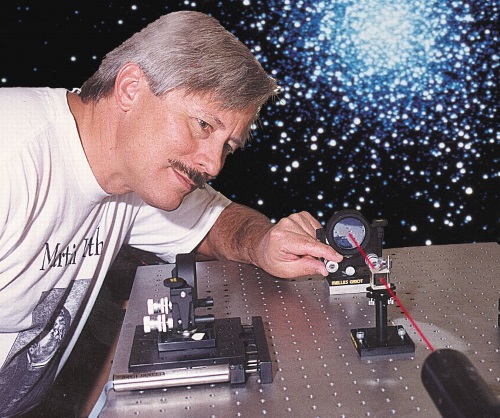
With over 30 refereed and 18 other technical papers and seven U.S. patents in his track record, Keith Wanser would be justified in chuckling at the common accusation that ‘creationists don’t publish’, or ‘creationists don’t do real science’ [see Do Creationists Publish in Notable Refereed Journals?—Ed.]. A full Professor at a major U.S. university, we were immediately struck by his warmth and humility.
In this age of physics superstars writing bestsellers, claiming to know the precise state of the universe billions of years ago, and even saying that physicists will soon know ‘the mind of God’, it was refreshing to hear Prof. Wanser bring things back to reality. ‘We don’t even know how to calculate, from first principles, something as basic as the speed of light, or Planck’s constant, the mass of the electron — things like that,’ he said. ‘These seem to just be “givens” from a Lawgiver. It was thought there should be only two or three such “basics” from which we could derive the rest, but it appears that there are vastly more — something like 28 at least.1
‘For every spectacular leap forward, like finding new particles,’ he continued, ‘there’s usually been a price to pay —more and more unknown parameters, with unknown relationships between them. It seems the more we find out, the more we realize how little we really know. Like Ecclesiastes 3:11 and 8:17 say, we can never find out all that God has done. I like what Einstein said, that it would be enough if we just understood the electron. In fact, when I get to Heaven, I’d like to get the chance to ask the Lord to tell me how the electron is held together.’ (Keith told us that, given our current understanding, there is nothing to hold the electron together. It should fly apart under its own electrostatic self repulsion).
Keith Wanser doesn’t talk of Heaven in some vague metaphorical way; for him it is a sure and certain hope. His trust is not in his intellect, nor in his good deeds, but in the shed blood of God the Son, the Lord Jesus Christ. Having received God’s forgiveness of his sins, Keith knows he can anticipate joy and peace with God throughout eternity.
The conservative church in which Keith grew up believed in a literal, six-day creation — and so did he until he went to college. ‘All those professors, who seemed to know so much, told me it couldn’t be that way. So I gradually became a theistic evolutionist. That led to my becoming morally adrift for some years, till I recommitted my life to Jesus Christ in 1976. Since then, I have studied a great deal of scientific evidence, and I am convinced there is far more evidence for a recent, six-day creation and a global Flood than there is for an old earth and evolution.’
Keith Wanser knows how vitally important this issue is. ‘The foundation for the whole Gospel is in Genesis — the Lord Jesus Christ clearly believed in a young earth, a literal Genesis,’ he said. ‘If we mess with these foundational truths, when do we start taking the words of Jesus seriously? Recently someone said to me, “I believe the Bible is the inerrant Word of God, but I don’t believe it can be taken literally.” I was shocked. Maybe we can have a non-literal Virginal Conception, or a non-literal Resurrection, or … where does it end?2
‘It’s desperately sad,’ Keith went on, ‘that so many church leaders have given their flocks a false sense of security, either by downplaying the issue, or by unscriptural dead-ends such as “progressive creation”.3 I believe the Lord will bring these leaders to account. Even churches that believe in Genesis often don’t equip their people with the answers available through ministries such as yours. They don’t understand that kids today are being hit by these supposedly “scientific” beliefs that totally undermine Christianity.’
What did he see as the biggest difficulty for promoting creation today? ‘Because the church in general failed to understand and confront this huge issue, it helped these beliefs to “take over”,’ said Keith. ‘So there is now such a bias against literal Genesis and for evolution/old earth, that people have stopped thinking for themselves. Phrases like “evolution is fact” or “everybody knows the world is old” are repeated like mantras — it’s like a mindless thing that people have had beaten into their heads, so one has to undo years of conditioning by our culture.’
A father of two young children, Keith sees it as crucial to shield them from the anti-biblical conditioning coming from TV and elsewhere. Referring to a popular new ‘cute monsters’ game, he said, ‘Even there, you have this insidious evolutionary brainwashing going on all the time — “Look how this one can evolve into something else”, and the like.’ But he also thinks it is vital to give them positive creation materials like A is for Adam, to train them in thinking in a biblical framework from the earliest age.
‘Parents who ignore the extreme importance of this issue are often taken by surprise when their children grow up and abandon their faith — I see it often and it grieves me that so many people are unaware of the sad consequences of evolutionary thoughts and beliefs.’
Was it tough being a creationist at a secular university? Dr Wanser said, ‘Well, now that I’ve got tenure, that means I can’t be fired for simply believing in recent six-day creation and the world-wide Noahic Flood. If I had been outspoken on the issue before, I doubt I would have obtained tenure. But if you’re doing good science, it makes it harder for your critics.’
Radiometric ‘ages’
Knowing that Keith was part of the creationist RATE4 group, we asked him about radiometric dating. He said, ‘There’s been some good work done by creationists lately, like revealing a fatal flaw in the assumptions behind K-Ar dating.5 I’m currently working on some very interesting stuff involving radiometric decay being non-exponential —at the level of things like quantum tunnelling. It’s still in the early stages, but already I can say that over time periods that are short compared to the half life, the decay is not exponential, despite what is taught.6 This decay thing is actually very complex; there’ve been all sorts of assumptions made to keep it simple, some of which may not be valid.’
What arguments did evolutionists have with his work, we asked? ‘Well, it’s very hard to argue when the maths is there, and it comes out right,’ he said. ‘Actually,’ he went on, ‘it turns out that when you get the nucleus “excited”, decay is going to be much quicker, making things look vastly “older”. People have been talking recently about magnetic stars giving off big bursts of gamma rays; there are all sorts of ways that radiometric “clocks” could have been reset catastrophically, during the Flood for example.’
Professor Wanser made frequent reference to the work of the creationist physicist Dr Russell Humphreys, of Sandia National Laboratories, for examples of fruitful creationist science. An example is Humphreys’ fulfilled written prediction, based on his model of the earth’s magnetic field, that volcanic rock would be found showing that past reversals of the field occurred extremely rapidly.7 He was also very impressed by the way in which Humphreys’ creationist model of planetary formation predicted the strengths of the planets’ magnetic fields.8 He said, ‘There’s no evolutionary model that has come anywhere close in that department.’
Keith Wanser also pointed to Russ Humphreys’ creationist alternative to ‘big bang’ cosmology (explained for the layman in the book Starlight and Time, which also has a technical appendix) as a good example of productive creationist thought. (Humphreys uses the distortion of time in general relativity theory to explain how light could have reached the earth from distant stars in a young universe.)
Changing light speed
Actually, light is a major specialist area for Dr Wanser. So what did he think of proposals that the speed of light has changed, affecting radiometric dating as well as starlight travel-time? He replied, ‘It’s not really widely known that standard quantum electrodynamics predicts that the speed of light (c) is a function of the field strength, thus changeable in principle. I’ve been playing around with this for years, and while it’s still heretical, some are starting to accept that c may not be some eternally immutable thing.’9
Keith was familiar with the theories (including recent work) of Australian creationist Barry Setterfield, which have c declining from a huge initial value. He said, ‘I don’t go along with Barry’s statements on this; he’s well-meaning, but in my opinion he’s made a lot of rash assumptions. For instance, he has a whole sequence of things that have to be held constant just because his theory needs it, and he’s certainly not come up with any real equations explaining anything. There is not a lot of mathematical and physical theory in his work, and there’s a misunderstanding of many of the things that would have happened if c had been 1010 higher than what it is today.’10
From what Keith told us in more detail, it appeared that the vocal humanist/sceptic critics of the Setterfield theory also needed some lessons in high-level physics. He went on to say, ‘There are other reasons to believe that the speed of light is changing, or has changed in the past, that have nothing to do with the Setterfield theory. It’s an exciting field — a very bright colleague of mine at the University of Colorado in Boulder has just completed some little-known but fascinating work in this area.’11
Keith affirmed that the confident public image of the ‘certainty’ of the latest physical theories was a far cry from reality. He cited the ‘big bang’ as an example, particularly lately with ‘quantum cosmology’. ‘They have to get matter out of energy,’ he said. An experimentally established physical principle12 shows that the only way you can do that is to end up with equal amounts of matter and antimatter. But all around us in the universe there is a huge preponderance of matter over antimatter. Instead of abandoning the “big bang”, they conveniently hypothesized a way to violate scientific law, a fudge factor if you like. But this would make protons unstable, so for years they’ve been looking in vain for even one proton to decay. They haven’t found it, and all indications are that the proton must be stable for a period of time much larger than previously thought possible, more than 1,000 billion billion times the assumed evolutionary age of the universe.13 This makes it completely impossible for the “big bang” to work.
‘The problem hasn’t been pointed out much; it’s there, but it’s ignored in the hope that it will go away. The sad thing is that the public is so overawed by these things, just because there is complex maths involved. They don’t realize how much philosophical speculation and imagination is injected along with the maths — these are really stories that are made up.’
Professor Wanser continued, ‘People look at the sort of science that put men on the moon, and they put these “big bang” theories in the same basket. They’re unaware of all the speculation and uncertainty (even rule-bending) there is in physical theories of origins. It’s a tragedy that evangelicals are being urged to “re-interpret” the Bible because of the so-called “certain facts of science” in this area. It is even more tragic that there are professing Christians who are promoting evolutionary notions of the “big bang” and galactic and stellar evolution as supporting the Bible and belief in God, while at the same time denying literal six-day creation and the global nature of the Genesis Flood.’
References and notes
- Keith said, ‘Many of these are associated with the masses of various ‘elementary’ particles, such as quarks, W and Z bosons, and the coupling constants associated with strong and weak interactions.’ Return to text.
- Both Dr Wanser and this ministry are aware that some parts of the Bible are plainly intended to be taken non-literally. However, Genesis is plainly historical narrative, meant to be taken literally, like the Resurrection. See Grigg, R., Should Genesis be taken literally?, Creation 16(1):38–41, 1993. Return to text.
- [This position is most commonly associated today with Dr Hugh Ross and his followers, with billions of years of death, disease and bloodshed before human sin — Ed.] Return to text.
- Radioisotopes and the age of the earth — this continuing project initially involved the Institute for Creation Research, the Creation Research Society, and Creation Ministries International. Return to text.
- Snelling, A.A., Proceedings of the Fourth International Conference on Creationism, Creation Science Fellowship, Pittsburgh, pp. 503–525, 1998. Return to text.
- Keith said, ‘In this context, “short” can extend to hundreds of millions or even billions of years for some long-lived radioisotopes.’ Return to text.
- Humphreys, D.R., Proceedings of the First International Conference on Creationism, Creation Science Fellowship, Pittsburgh, 2:113–126, 1986. Also Creation 15(3):20–23, 1993. Coe, R.S. and Prévot, M., Evidence suggesting extremely rapid field variation during a geomagnetic reversal, Earth and Planetary Science 92(3/4):292–298, April 1989. Also Creation 13(3):46–50, 13(4):44–48, 1991. Coe R.S., Prévot M. and Camps P., Nature 374(6564):687–692, 1995. Also Snelling, A.A., J. Creation 9(2):138–139, 1995. Return to text. Return to text.
- Humphreys, D.R., The Creation of Planetary Magnetic Fields, CRSQ 21(3):140–149, 1984. The Voyager measurements were 3.0 and 1.5 x 1024 J/T for Uranus and Neptune respectively. Science 233:85–89, 1986; Nature 319:174–175, 1986; Science 245:1450–51, 1989. Dr Humphreys had predicted field strengths of the order of 1024 J/T — see also Humphreys, D.R., CRSQ 27(1):15–17, 1990. The fields of Uranus and Neptune are hugely off-centred (0.3 and 0.4 of the planets’ radii) and at a large angle from each planet’s spin axis (60o and 50o). A big puzzle for dynamo theorists, but explainable by a catastrophe which seems to have affected the whole solar system — see Spencer W., Revelations in the solar system, Creation 19(3):26–29, 1997. See also Sarfati, J.D., The earth’s magnetic field: Evidence that the earth is young, Creation 20(2):15–17, 1998.Return to text.
- ‘In fact,’ said Keith, ‘there are good reasons to believe that c might be drastically altered in the near vicinity of an electron; recognition of this might help to develop a viable theory for this particle.’ Return to text.
- As examples, assuming electron and proton mass and charge had remained the same, Keith cited ‘the almost complete disappearance of electromagnetic radiation, magnetism, and magnetic effects, including nuclear magnetic moments, Faraday’s law, and the Lorentz force. Such drastic effects would surely give a far different display of past events recorded in starlight than we see today.’ Return to text.
- Barrow, J.D., Is nothing sacred?, New Scientist 163(2196)29–32, 24 July 1999. Return to text.
- The Law of Conservation of Baryon Number. Return to text.
- Matthews, R., Rock solid, New Scientist 162(2187):48–52, 22 May 1999. Return to text.


Readers’ comments
Comments are automatically closed 14 days after publication.