
Feedback archive → Feedback 2009
Leave Darwin alone!
Is creationist focus on Darwin “out of touch”?
Has science left Darwin so far behind that it is a complete red herring for creationist writers to analyze, discuss or rebut his views? When creationists do that, does it, as one email put it, show that such authors must be “out of touch”?
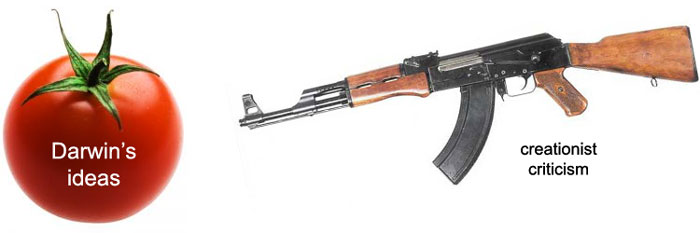
We often hear such comments from our detractors in this “year of Darwin”, but with an increasing frequency the last few weeks. Hence this weekend’s feedback will respond to such charges in general.
The usual emailed comments one sees about this seem to imply not only that referring to Darwin’s views is completely inappropriate, but that creationists somehow choose to do that as some sort of a deliberate “soft target”—perhaps to avoid having to deal with the “real” evolutionary arguments.
In reality, the increased attention to Darwin in our publications, both print and internet, is not some self-concocted scheme to attack outdated science, but is a rational response to what is coming from the secular evolutionary establishment themselves. In 2009, the Darwin year, adulation of the “patron saint” of evolutionism is nothing short of overwhelming.
In short, it is evolutionists themselves who have set the agenda, and most creationist organisations have responded accordingly. One could say that to fail to respond is what would be inappropriate, especially when the occasion is being used to cement belief in evolution more firmly in the public mind.
What about the suggestion that Darwin’s science was so far behind today’s, that it’s unfair to attack his views? It would indeed be unfair not to take such things into account, and CMI’s Darwin documentary, The Voyage that Shook the World, does just that. At one point the narration itself cautions: “But it may be unfair to judge Darwin by today’s standards of science.” However, the reality is that it is evolutionists themselves who are continually reinforcing the fact that on the whole, Darwin’s theory has remained essentially intact. A cursory Google search revealed the following link to the website of the respected journal Nature, pasted here, and the red bolded font is self-explanatory.
The double anniversary of Darwin’s bicentenary and 150 years since publication … formulate a theory that has survived essentially unchanged for 150 years. … 1
The following extracts are copied from an interview with perhaps the world’s leading Darwin evangelist, retired Oxford Professor, Richard Dawkins, with our emphasized portions again in bold red font.2
Dawkins says at one point:
RD:“Everything we know about life, Darwin essentially explained.”
And for evolutionists, that remains true—Darwin may not have known about DNA and so on, but the big picture story he constructed is one still held to by the overwhelming majority of the world’s evolutionists. This is that natural selection acting upon random heritable variations transformed an ancestral life form into the entire variety of life on Earth today. This was by definition an unguided process, excluding any hint of supernatural design or interference or creative power.
When the interviewer asked, Dawkins agreed that Darwin made mistakes, specifically, that he “got genetics all wrong. Nobody in the 19th Century knew much about genetics, and so naturally Darwin got that wrong. But given that, it’s remarkable how much he got right.”
The exchange that follows right after this is important.
INTERVIEWER: “But people say modern discoveries in genetics, actually confirm what Darwin was saying…?”
RD:“Very much so, yes, and it’s amazing how far ahead of his time he was.”
Dawkins explains correctly that, “In Darwin’s time people thought it was a bit like mixing substances—you’ve got some male substances and some female substances and you mix them together, and you got child substance. It’s not like that at all. It’s digital. You either get a gene or you don’t.”
His next comment is revealing, and highlights the point that creationists have been making for a long time about the “information argument”. He says that today, with our knowledge of DNA, “we know that it’s [genetics, inheritance] really like computer code, it’s like reels and reels of computer tape.”
Exactly. In the words of fellow evolutionist Professor Paul Davies, “Most of the workings of the cell are best described, not in terms of material stuff—hardware—but as information, or software.”3 And the consistent Darwinist needs that first cell to arise somehow, with all of its required codes and machinery before you can even have reproduction—and you need reproduction to have any natural selection. So Davies asks the question,
“How did stupid atoms spontaneously write their own software … ?” 4
To which he answers in the same publication, “Nobody knows … .”
But why does nobody know? Is it perhaps that scientists have not yet discovered some simple thing to explain how this happened? Davies has identified elsewhere that the problem is that software involves information, and in his own words in the same article, he tells us why nobody knows, namely:
“There is no known law of physics able to create information from nothing … ”.
In short, what is needed is some new natural law capable of doing this.
Scientific laws have been called “formalized common experience”, things which happen every time, without exception. As information scientist Werner Gitt points out in his In the Beginning was Information, all our experience from observation confirms that a coded message, such as is present on DNA, requires an intelligent message sender.
Returning to Dr Dawkins, he goes on to say in the BBC interview, about Darwin and genetics,
“But nevertheless he [Darwin] got it astonishingly right. So you could almost say he nearly forecast digital genetics”
This confirms once more that leading Darwinists do not see Darwin as some has-been hack whose ideas have largely been overturned. In fact, far from it—they point to his theories as having largely stood the test of time.
Thus, it is perfectly legitimate for us to use the platform of “all things Darwin” presented to us in this year—particularly to expose huge, glaring scientific problems and inconsistencies in the midst of the rush to push the religion of materialism/atheism down the throats of everyone.
Thus, when CMI’s Darwin film The Voyage that Shook the World ventures onto the specifics of Darwinian ideas, the content, despite the historical context, is totally relevant and up-to-date where it questions evolutionary ideas. For example, Dr Matti Leisola, a Finnish Professor of Biochemistry, who is also the Dean of his Faculty, tell us of his skepticism about evolution, and points out that random changes, like mutations, decrease the information in enzymes. The context within the film is as follows: The audience gets to see (out of the mouths of evolutionist experts themselves) that the natural selection observable in the beaks of Darwin’s finches on the Galápagos Islands adds no new information—the beaks are large, then small, then large again, with nothing new added. The narrator explains that today, most believe that mutations add this information. No suggestion is made that Darwin knew about mutations. The context is Darwin-historical; the argument is up-to-date.
In short, because prominent evolutionists believe most of Darwin’s arguments are still valid today, creationists are responding in kind, and the occasional suggestion that this is inappropriate may itself reflect that the person raising it is somewhat ill-informed, or is such a “true-believer” that they will just not countenance any criticism of their Darwinist belief system, or indeed the “hero of the faith”.
Recommended Resources
References
- Web editor: Under the section: How do Darwin’s ideas stack up today? www.nature.com/ncb/journal/v11/n2/full/ncb0209-111.html Return to text.
- The interview is at http://news.bbc.co.uk/2/hi/science/nature/7885670.stm Return to text.
- The Guardian, 11 December 2002 Return to text.
- New Scientist, 163 (2204):27–30, 18 September 1999 Return to text.
Readers’ comments
Comments are automatically closed 14 days after publication.