

Saving the other patient
Lita Sanders chats with prenatal medical researcher Dr Larry Thaete
Dr Larry Thaete received a Ph.D. in Molecular and Cellular Biology and Pathobiology from the Medical University of South Carolina in Charleston. He works as a medical research scientist researching treatments for fetal growth restriction at NorthShore University Health System and is on the research faculty at Northwestern University Feinberg School of Medicine in Chicago.
Medical research on the unborn patient
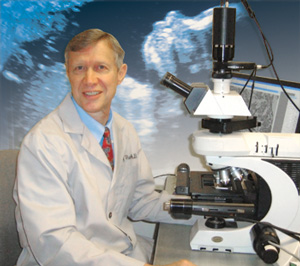
Dr Thaete’s medical degree equipped him “to investigate the molecular and cellular biology of pathologic processes”. Fifteen years ago, he decided to specialize in high-risk obstetrics after being approached by a medical obstetrician who was also a deacon in his church. This deacon was establishing a laboratory to investigate fetal growth restriction, where the baby inside the womb fails to grow normally.
This research is specifically focused on “treating fetal growth restriction when it occurs too early in the pregnancy for the baby to be delivered safely.” Dr Thaete explained the significance of this research: about 5% of pregnancies are affected by fetal growth restriction. Sometimes this happens too early in the pregnancy for the baby to be delivered safely and is fatal for the baby. Even in cases where the baby survives, sometimes long-term complications affect the child into adulthood.
Dr Thaete’s research may produce the first treatment for fetal growth restriction. He says, “I have maintained enthusiasm for this work because there is real hope that what we are learning and developing could for the first time provide an answer for this serious health problem.” This will help both the mothers and babies, since currently there is no treatment for fetal growth restriction.
His research is significant because “what we are developing could save the lives of some babies who would not otherwise survive.” These babies would normally be miscarried or sometimes aborted to save the mother’s life. Sometimes when a fetus is suffering from fetal growth restriction, the mother also experiences symptoms that are occasionally life-threatening. When this happens, the mother must choose whether to risk her life to try to bring her baby to sufficient maturity so the baby can survive outside the womb (which is not always successful), or to abort the baby to save her life. The development of a treatment for fetal growth restriction would make it possible to save both the mother and the baby. Thus it would prevent the tiny fraction of abortions (still a considerable number) performed to save the mother’s life.
Christian faith
Dr Thaete became a Christian at the age of 8 when his father explained that Jesus Christ’s death paid for his sins, although he does not remember a time when he did not know about salvation. He says, “I have reaffirmed this faith in the finished work of Christ at various times in my life as I have grown in understanding and in my ability to think through some of the spiritual issues raised by our culture.”
Assumptions and interpretations
But isn’t biblical creation intrinsically opposed to scientific research like that which Dr Thaete is involved in? Quite the opposite, he says:
“Scientific understanding is always dependent on the assumptions that are made at the outset, because that makes a difference on how observations are interpreted. Take for example the observation that cellular proteins are observed to be similar across certain types of creatures. If origins are assumed to be a matter of chance, then these protein similarities are interpreted as ‘proof’ that these creatures evolved from a common ancestor. Further, their similar structure is explained as being ‘conserved’ by natural selection. But if the existence of the biblical God is assumed, and that He designed life, the question may be ‘What particular features of the organisms and their cellular processes required this particular design?’ Creationists still make comparisons between similar life forms, but with the idea that these similarities result from purposeful design rather than common descent.”
Dr Thaete explains that evolutionist scientists assume that any view that incorporates a higher intelligence is false, because it implies, “that there is someone who is much greater than I am. This in turn leads to the possibility that I am accountable to him and cannot simply determine my own destiny.” Scientists “cling to the theory of evolution” not because of any lack of evidence for creation, but because “spiritual blindness is preventing them from seeing the truth.”
Evidence for design
In fact, Dr Thaete believes that his biblical creationist stance enables him to understand irreducibly complex systems, which evolution does not predict or explain. One of these is the focus of his research. “The hormone endothelin, a vasoconstrictor (this is a chemical that narrows blood vessels), is not coded directly by DNA. It originates as a much larger molecule (212 amino acids long) and that molecule does absolutely nothing! An enzyme has to be there to cut a portion of it off and make a smaller molecule—which also does absolutely nothing! Yet another enzyme reduces the molecular size of the protein, producing another inactive molecule. A different and very specialized enzyme has to be present to reduce the size of this third molecule even further to its final size (only 21 amino acids long)—the active form of the molecule.” While this system is not nearly as complex as the miniature motors of the bacterial flagellum or ATP synthase, it still strongly indicates design. Natural selection would tend to eliminate the inactive forms of the molecule before the appropriate enzymes arose to transform the molecule into its active form.
Creation motivates research

While some professing Christians leave their faith outside the lab, Dr Thaete says that his faith gives his scientific research real meaning:
“A biblical view of creation begins with God. He is the One who determined to bring everything into being. This gives all that exists a deeper meaning than it can have if it all came about by mere chance. Faith in the eternal God gives my research value beyond just an understanding of mechanical processes that occur in cells and tissues.”
In particular, creation gives Dr Thaete a basis of assigning intrinsic value to human life, right from conception, since humans are created in God’s image. “This knowledge brings hope to us in a sin-saturated world where purpose is elusive if not anchored to something bigger than we are (the overall message of the book of Ecclesiastes). By contrast, consistent evolutionists value life only as long as it serves a useful purpose. Many of the conclusions from my and others’ research may be similar, but the primary difference is in the perception of an ultimate purpose or its absence.”
Reducing effects of the Curse
Dr Thaete sees this research as a small part of combating the effects of the Fall. “Frailty, disease, and death are results of the fall into sin of our common ancestor, Adam. However, some of the results of the presence of sin can be opposed by us as Christians. Although we live in an imperfect world that we cannot make perfect, we can bring a redemptive presence into our sphere of influence and turn away some of sin’s effects.”
“My work allows me to glimpse a bit of God’s design and to see how my meagre efforts can contribute to the much larger picture of redeeming creation by using my God-given intelligence to combat some of the effects of sin. Specifically in my research, when a baby may be born with serious long-term deficiencies, some people assume that it would be better to end the baby’s life through abortion. If I can successfully develop ways of bringing that baby to a healthy maturity and normal birth, then some of the effects of sin (handicaps or untimely death) can be averted.”


Readers’ comments
Comments are automatically closed 14 days after publication.