
Monarch manoeuvre
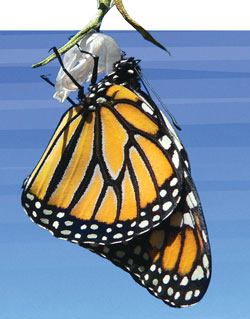
Many times we have watched the Monarch develop from egg to butterfly, yet we always marvel at the amazing transformations that take place. Probably the most critical manoeuvre is when the Monarch sheds its caterpillar skin to reveal the chrysalis.
After the cater pillar has finished eating and growing, it fastens a silk pad, made with its mouth, underneath a suitable surface. Then it turns around, clamps its rearmost legs onto the silk, and hangs in a ‘J’ shape for approximately 24 hours.
When the caterpillar straightens, its skin splits along its back and starts to shed. The chrysalis wriggles and writhes, forcing the skin up, towards the rearmost legs. The skin still encircles the emerging chrysalis, and looks like a concertina as it moves.
While hanging by just part of the skin, the chrysalis pulls a small black stalk, the cremaster, down from within the skin, and reaches around the outside. It then presses the end of the cremaster onto the silk pad next to where the legs are attached. Velcro-like hooks on the tip of the cremaster entangle with the silk.
The chrysalis wriggles violently and the skin eventually comes free and falls away. As the writhing continues, the chrysalis settles into its distinctive shape, awaiting its transformation into a beautiful butterfly.
It is inconceivable that this precarious process could have developed through mindless, trial-and-error evolution. One small slip while it was trying to perfect the method would spell the end of the species.
The survival and continuation of the Monarch depends upon the success of this hazardous manoeuvre, yet it is performed successfully millions of times a year across many countries of the world. This is a testimony to an amazing God, as Designer and Creator.

1. The caterpillar hanging in a ‘J’ shape from the
silk pad by its rear legs.
2. The caterpillar straightened out, and the skin about to split
along its back.
3. The skin has split and is being worked upwards.
4. The skin is now all the way to the top, but still encircling
the chrysalis.
5. The critical stage, moving the cremaster around the outside
of the skin.
6. The cremaster has been attached to the silk pad next to the
rear legs.
7. The skin has fallen away from the chrysalis, which is still
soft and sticky, and is hanging by the cremaster alone.
8. The chrysalis is now firm and in its final shape.

Cremaster 2. The cremaster entangled in the silk pad.
Hooks. Microscopic view showing hooks on the end of the cremaster. (Photos by Dean Farrow)
Note
See also, Devine, D., Inexplicable insect metamorphosis, Creation 29(3):31–33, 2007.
Readers’ comments
Comments are automatically closed 14 days after publication.