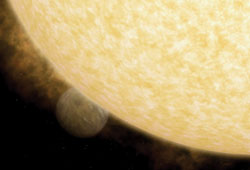
NASA NASA’s Spitzer space telescope has captured the light from what appear to be two planets orbiting a sun. The above artist’s conception illustrates a fiery hot star with its nearby planetary companion.
The solar system we live in is not the only one that exists. Over the last several years, astronomers have discovered over 130 planets orbiting stars other than the sun.1,2 You might expect that very little could be known about planets so far away, and you would be right. Nevertheless, astronomers have been able to coax a few details about these worlds from the meagre data available, and it turns out that these extrasolar planets, as they are called, are a serious challenge to evolutionary ideas.
A planet too ‘old’ for evolution
According to the accepted evolutionary theory, planets form by accretion. That is, bits of dust orbiting young stars collide and stick together to form clumps of dust. These stick together, or accrete, to form larger objects, until eventually a planet is formed. But there is a problem with this idea.
Scientists have discovered a planet in the globular cluster M4.3 (A globular cluster is a very tight, spherical grouping of hundreds of thousands of stars.) The problem is that, according to the accretion model,4 grains of dust are needed to form planets. But globular clusters, like M4, are made primarily of hydrogen and helium, and are practically a dust-free environment.5 For this reason, most evolutionists had not expected to find any planets in globular clusters.6
Evolutionists generally believe that globular clusters are very old, around 12 billion years. According to their evolutionary scenario, there would not have been much dust in the universe when these clusters formed, which is why, they believe, they are still so dust-poor today. Thus, one might say that this planet is too ‘old’ for evolutionary ideas.
A planet too ‘young’ for evolution
This planet is too ‘old’ for evolutionary ideas [while] this planet is apparently too ‘young’ for evolutionary ideas—by the dating methods that evolutionists themselves use
Another extrasolar planet has posed just the opposite problem. Astronomers found a gap in the disk of dust and gas around the star CoKu Tau 4. This gap, the astronomers say, was most likely cleared out by a planet orbiting within the disk. There are other ideas that could explain the gap, but they do not fit the data as well.7
Secular astronomers estimate the age of the star CoKu Tau 4 to be ‘only’ one million years. The planet had to form after the star, according to evolutionary theories, so it should be even younger. The problem is that it would take about four million years for such a planet to form by accretion.8 If the planet observations are accurate, then this planet is apparently too ‘young’ for evolutionary ideas—by the dating methods that evolutionists themselves use. Astronomer Dan M. Watson said that this planet ‘really causes problems for the standard model of planetary formation.’9,10
Another evolutionary theory?
NASA/JPL-Caltech An artist’s conception of the planet orbiting the star CoKu Tau 4. This planet seems to be too ‘young’ for evolutionary ideas.
Some evolutionary scientists have recognized that the accretion model does indeed have very serious problems, but they are not giving up on a naturalistic explanation.
Extrasolar planet researcher Alan P. Boss has suggested a different way for planets to form. The gas in the disk of matter around a young star becomes unstable, according to this theory, and a clump contracts due to gravity, eventually forming a gas giant.11 This way, planets condense directly from the gas, and can therefore form much more quickly. Boss’s scenario also does not need dust grains, so it does not have the problems discussed above.
But extrasolar planets do not conform to Boss’s theory, either. If this theory were correct, planets should be able to form either with or without dust grains. But it turns out that extrasolar planets are found mostly in environments that are dust-rich.12,13
This observation contradicts Boss’s theory, which says dust has almost nothing to do with planets. On the other hand, the observation that planets are occasionally found in dust-poor places is a problem for the accretion model, which says that dust has everything to do with the origin of planets.
Is our solar system special?
NASA and G.Bacon (STScl) An artist’s conception of the planet in the globular cluster M4. This planet is apparently too ‘old’ for evolutionary ideas.
The other solar systems that have been discovered are not like ours, nor would they be very hospitable to life. In most cases, there are gas giants, sometimes much larger than Jupiter, in eccentric, or oblong orbits.14 If a planet like Earth were in one of these solar systems, these eccentric giants would destabilize its orbit. Their gravity might even fling it out of the system completely—not a good thing for living organisms that might inhabit that planet! Only about a third of the known solar systems could have a planet like Earth in a stable orbit.15
NASA and G.Bacon (STScl)
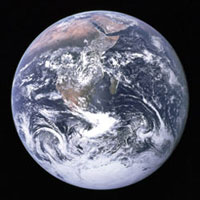
Earth, our beautiful planet. Astronomers have discovered other solar systems. However, none has been shown to have a planet anything like ours.
Astronomers have also discovered recently that the star Tau Ceti has a disk of debris orbiting it. They inferred that there are 10 times as many small objects such as comets and asteroids orbiting this star as there are in our solar system.16 There may or may not be any planets orbiting Tau Ceti, but if there were, they would be continually bombarded by impacts from these comets and asteroids.17 Such an environment would be very destructive to any supposed evolution of life.
Astronomers already knew that habitable planets were not easy to form.18 But extrasolar planet discoveries are showing astronomers even more ways in which a world could be unsuitable for life.
Distant solar systems support creation!
As more is learned about the universe, more problems appear for evolutionary ideas. These discoveries about extrasolar planets also suggest that our solar system, and especially planet Earth within it, is a very special place in the universe—evidence that fits beautifully with Creation as God has revealed in the Bible.
Posted on homepage: 2 October 2006
References and notes
Astronomers usually cannot see these planets directly, but they can detect them indirectly in a number of ways. The key is to measure the minute effects of the planet on the star it orbits. For example, the gravitational pull of an orbiting planet will cause the star to wobble slightly, and this wobble can be studied to learn a little about the planet causing it. Or it can block the star’s light. More recently, astronomers took what may be the first photograph of an extrasolar planet, but there is still some uncertainty. See <www.eso.org/outreach/press-rel/pr-2004/pr-23-04.html>.Return to text
For an updated number, visit <planetquest. jpl.nasa.gov>. Return to text
MacRobert, A., The oldest, weirdest planet, Sky & Telescope106(4):18–19, 2003. Return to text
Scientists often use the words ‘model’ and ‘theory’ interchangeably. Return to text
Mullen, L., Young planet challenges old theories, http://astrobio.net/news/modules.php?op=modload&name=News&file=article&sid=993&mode=thread&order=0&thold=0, 7 August 2004. Return to text
Kerr, R.A., Youngest extrasolar planet reported, Science304:1423, 2004. Return to text
Evolutionary astrophysicist Richard Durisen believes the problem may not be that serious. He points out that the age of the star is not known precisely, and thus it might be a little older. But even then, it would take a ‘somewhat improved version’ of accretion to account for this planet. See ref. 9.Return to text
Boss, A.P., Formation of gas and ice giant planets, Earth and Planetary Science Letters202:513, 2002. Return to text
Stated more precisely, planets are found preferentially in metal-rich environments. When astronomers use the word ‘metal’, they mean any element heavier than hydrogen and helium. It is these heavy elements that form the dust grains needed by the accretion model.Return to text
Schilling, G., Metals hint at how planets form, Sky & Telescope106(3):23, 2003. Return to text
Chaisson, E. and McMillan, S., Astronomy: A Beginner’s Guide to the Universe, fourth ed., Pearson Education, Upper Saddle River, New Jersey, USA, p. 480, 2004. Return to text
Di Cicco, D., Exoplanets and habitable zones, Sky & Telescope106(3):27, 2003. Return to text
Greaves, J.S., Wyatt, M.C., Holland, W.S. and Dent, W.R.F., The debris disc around Ceti: a massive analogue to the Kuiper Belt, Monthly Notices of the Royal Astronomical Society351(3):L54, 2004. Return to text
Comments are automatically closed 14 days after publication.
Feedback Guidelines
Be constructive & courteous. Don't attack individuals, denominations, or other organizations.
Stay on-topic. We're not here to debate matters like eschatology, baptism, or Bible translation.
Links to external sites and articles will be removed from your submission.
Privacy & Content Ownership
Comments become the property of Creation Ministries International upon submission and may be edited for brevity and clarity.
CMI may choose not to publish your comment depending on how well it fits the guidelines outlined above.
By submitting your comment you are agreeing to receive email updates from Creation Ministries International. You may unsubscribe at any time.
CMI records your real name, email address, and country as a sign of good faith. Privacy Policy
If your comment is published, your name will be displayed as ""
Cancel
Accept & Continue
Close
You are leaving CREATION.com
We have supplied this link to an article on an external website in good faith. But we cannot assume responsibility for, nor be taken as endorsing in any way, any other content or links on any such site. Even the article we are directing you to could, in principle, change without notice on sites we do not control.





Readers’ comments
Comments are automatically closed 14 days after publication.