

Exploding into life!
Here’s nothing simple about a starfish. It has hundreds of tiny feet which it uses to move along by pumping water through a system of tubes. This is a method we call hydraulics, and which humans use in machinery. But the starfish, still alive today, yet found as fossils in the Cambrian rocks, had it right there in the beginning.
There is no evidence the starfish has evolved. When we look at fossils in Cambrian rocks, we find that not only did these animals have no ancestors, but all the main kinds of living creatures were already there. There were animals with backbones (fish), as well as those without backbones, like shellfish, crinoids (sea lilies), and starfish. Some of these Cambrian creatures have died out, but many types are still alive, and have changed little if at all. The ‘Cambrian explosion’ destroys the idea that all living things evolved from simple ancestors. This evidence makes it much easier to believe in creation than in evolution.
Believing in creation makes sense!
In the Bible account of creation we read that all living things, including plants, fish, birds and land animals, appeared at God’s command. Yet many people believe they have come through gradual evolution over many millions of years. What is the truth?
What would we expect to find if the Bible record of creation is true? The Book of Genesis tells us: ‘God said “Let there be … ” and there was’. So we would expect to find evidence that various kinds of life appeared suddenly on earth, without having evolved from anything simpler. And this is exactly what we find! In what most scientists believe are some of the oldest rocks on earth (called ‘Cambrian’) we find fossils of complicated creatures. These appear fully formed, with no evidence they derived from simpler ancestors.
Scientists who believe in evolution are puzzled about this sudden appearance of life, and they call it ‘the Cambrian explosion’. To those who believe in creation though, it is the evidence they expect.
Too soft to fossilize?
Not this jellyfish!
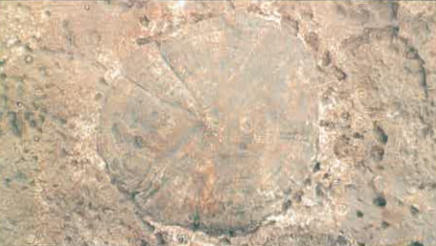
Why don’t we find fossils of the ancestors of Cambrian animals?
Evolutionists often say it is because the creatures they evolved from were too soft to fossilize.
But this excuse will not do. Jellyfish are some of the softest creatures of all, and yet they have been found as fossils!
The most sensible reason why we don’t find fossils of the ancestors of the Cambrian creatures is that they had none! They did not evolve from anything, but were created by God in the beginning.
Tom and Jenny
by Esmé Geering
During their stay with their cousins, on the tenth level of a high-rise flat, Tom and Jenny discovered they had marvellous views of the clouds.
After watching a spectacular sunset one evening, they woke to find the sky barred with fluffy clouds like flocks of sheep. These are called cumulus clouds. Mackerel sky, their aunt called it. She chanted an old weather rhyme:
‘Mackerel sky, not 24 hours dry.’
By late afternoon, great billowing cumulonimbus clouds were piling up like fairy castles with dark purple bases.
‘I know it’s just like mist in a cloud’, said Jenny. ‘But they look so solid’.
‘Clouds are made of water drops, not vapour, so a big cloud like that can contain a thousand tonnes of water’, said Uncle Jo.
‘Wow!’ said Tom. ‘What holds all that weight up till it falls as rain?’
‘Rising warm air currents, just like a hot-air balloon, are piling the cloud higher and holding it. As the warm air rises, it cools to the point where the water vapour condenses into water droplets, and cloud forms. When this happens, the air in the cloud gets hotter and rises even more strongly, so sucking in more air from below and holding all the water up in the sky.’
‘Let’s take a look at Job chapter 28’, said Uncle Jo, getting out his Bible. He read verses 25 and 26: ‘God makes the weight for the wind and he weigheth the water by measure … he made a decree for the rain, and a way for the lightning of the thunder’. (av)
‘So God knows exactly what the clouds weigh and the force needed to keep them up’, mused Tom. ‘The top of that one is flattening out.’
‘That cloud may be up to six miles high and three miles across,’ said Uncle, ‘so its top is in the part of the atmosphere where it is freezing. This explains how hail can form. If enough warm moist air is available to suck into the cloud, it will keep building until a storm results when the droplets of water or hail become too big for the air currents to hold up any longer and they fall to the ground.’
By now it was growing dark as the lowering clouds drew near, and distant thunder rolled.
‘I’m not afraid, because I can trust God’, said Jenny. ‘But doesn’t lightning strike tall things like these flats?’
‘We have a metal lightning conductor on the roof, with a wire to take electricity safely down to the earth’, explained Uncle Jo. A bright flash and roll of thunder followed.
‘Count five seconds between the flash and the roll of thunder. That’s about a mile [1.5 kilometres] away.’
From their high windows, they watched lightning strike high ground about two miles away.
‘It’s wonderful to see it from here’, said Tom. ‘Why does the flash make such a noise?’
‘The spark heats air as it flashes down between 100 and 1,000 miles a second. The temperature can be higher than on the sun’s surface. The hot air along its path expands rapidly, making a partial vacuum, and the air around it rushes in to fill it. This rush is thunder. A flash may be as much as four miles long.’
By now they were in the storm, with flashes and thunder almost together. One brilliant crack made them jump, as torrential rain thudded on the windows. It was glorious! Jenny remembered that when God spoke to the Israelites at Mount Sinai, His voice sounded like thunder.
As the storm passed over, and the purple black centre rolled away, Uncle Jo picked up their cousins’ children’s Bible, and read them some more verses from Job chapter 37, verses 3 to 5:
‘He turns his lightning loose under the whole sky, and he sends it to the farthest parts of the earth. After that you can hear the roar when he thunders with a great sound. He does not hold back the flashing when his voice is heard. God’s voice thunders in wonderful ways. He does great things we cannot understand.’
‘But we can understand that God loves us and cares for us, can’t we!’
Weird and Wonderful
by Geoff Chapman
Have you ever moved to a new house? Many people have. But have you ever heard of the crab that moves house? It is called the hermit crab. Before it can move house, though, it has to find a house. Although most of the different kinds of crab have shells to protect them, the hermit crab doesn’t have a shell of its own. So it looks for a shell which once belonged to some other creature.
When it finds what seems to be a suitable shell, it crawls inside — backwards. The hermit crab’s body is twisted in the same way as the shell, to give a good fit. Even its legs are specially designed for living in its second-hand home. Only two of them are used for walking — the others grip the shell.
Its right-hand claw is much larger than the left, and is used as a ‘door’ to close behind it. When the crab grows too big for the shell, it leaves and finds a larger one to live in.
Occasionally, a hermit crab will choose an old coconut shell, or even a piece of garbage.
Hermit crabs often carry ‘passengers’ with them — sea anemones. They are found sticking to the outside of the crab’s shell. They are covered with stinging cells, which burst if touched, so they help protect the crab from its enemies. As a reward, the anemone gets small pieces of food left by the crab. Quite often, a hermit crab will pick up a sea anemone and ‘plant’ it on its shell. When it moves to a larger shell it takes the sea anemone with it to its new home!
The hermit crab is a puzzle for those who believe it evolved from ancestors which had shells. Why on earth should its ancestors lose their shells, when it would mean going to the trouble of finding another? How did the hermit crab evolve its specially shaped body, and extra-large, right-hand claw which acts as a ‘door’ for its home? And how did it find out that it would be good to have a sea anemone living on it?
These things are much easier to explain if we accept that the hermit crab did not evolve, but was created by God to live the way it does.
God’s two books
God has given us a book called the Bible, where we can read all about the history of our world from the time God created it to the time the first Christians began to take the Good News about Jesus to the whole world. But God has also given us another ‘book’ — the book of nature. We can read this book by looking around us at the world God created.
We would expect these two ‘books’ to agree with one another, and they do. In the Bible we read that the world and everything in it were created at God’s command, and as you have read in this Our World, the evidence we see shows this to be true. Living things came into existence suddenly; there is no evidence they evolved from ‘simple’ ancestors. What we see with our eyes agrees with what we read about creation in the Bible.
The ‘book’ of nature shows us how great and powerful God is, but in the Bible we learn something even more important: that God loves us! ‘This is how God showed his love to us: He sent his only Son into the world to give us life through him’ (1 John 4:9). That life can be yours! Believe it — and receive it!
Readers’ comments
Comments are automatically closed 14 days after publication.