
Feedback archive → Feedback 2012
Paleoenvironments and the Bible
The role of assumptions and worldview in geological interpretation
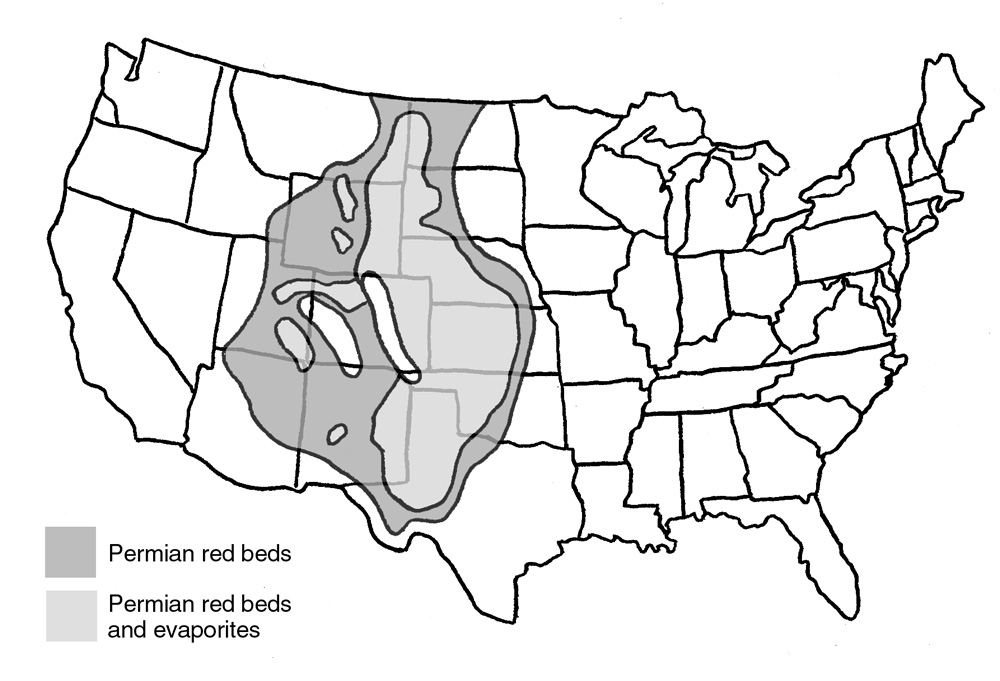
Dr Kathleen Benison, geologist at Central Michigan University, USA, writes in response to Michael Oard’s article Beware of paleoenvironmental deductions (1999). Dr Benison was the principal author of the study that Michael Oard was commenting on, and this exchange presents a penetrating look at the influence of worldview on how geology is interpreted.
Dr Benison writes:
As author of the paper referenced here, I am flabbergasted with the interpretations this article makes and I disagree with them. First of all, this paper was published in Nature, a journal that allows only 2 pages for a research letter. Details about the study are published in several other, lengthier journal articles (Benison and Goldstein, 1999, 2000, 2001, 2002). Second, more recent work in southern Western Australia has documented many similarities between the modern acid saline lakes there (with pHs measured as low as 1; Benison et al., 2007, Bowen and Benison, 2009, etc.). Little work had been done on the acid lakes in Western Australia previous to the publication of the Benison et al., 1998 paper, but now we have lots more data that supports the concept of “comparative sedimentology” (the sedimentologist’s version of uniformitarianism). Third, some of the facts of the research study were misrepresented. For example, the original paper claims that there were likely numerous lakes during the Permian in this midcontinent area, but your web site here describes it as one big lake. Finally, I suggest the concept of actualism be considered, as well. Actualism states that Earth processes occurring today likely occurred in the past, but perhaps at different rates and different intensities (easy to understand in terms of changes in atmospheric chemistry, ocean chemistry, and life through time).
I doubt if you will publish this comment on your web site. However, if you truly are a critical thinker, you will.
Creationist researcher Michael Oard replies:
I am not surprised that Dr. Benison disagrees with my article on paleoenvironments. We have different frameworks of natural history which drive our differing interpretations. Having published the article in 1999, it obviously could not have incorporated information from her cited works, several of them that I have since read. I do find it interesting how these acidic saline lakes in Australia are related to the huge ‘evaporites’ seen in the rock record.
It is true Nature is just a summary of research, but the main points of her study were published there, which were: (1) the Permian evaporites may have covered 200,000 km2 in the central USA; (2) the evaporites were earlier interpreted to be in an alkaline environment; (3) fluid inclusions indicate the water was highly acidic at a pH of less than 1 contrary to the traditional uniformitarian model; (4) that ephemeral, acid lakes with a pH of 2–4 in southern West Australia could be a modern analog of the Permian evaporites, and (5) we need to re-examine the paleoenvironmental interpretation for evaporites.
One of my main points is that uniformitarian scientists simply assumed that the paleoenvironment was alkaline because evaporites are very commonly deposited in such environments. Dr. Benison’s analysis added a new variable that significantly changed the paleoenvironmental interpretation. But, it remains true that much interpretation relies on models derived from uniformitarian methods and assumptions, and they often miss important differences between the present and the rock record.
Dr. Benison claims that I misrepresented some of the facts of the study, citing the mention towards the end of the article of one lake. I appreciate her catching the mistake, but it was no misrepresentation, since I had already stated that there were multiple lakes, twice:
“But not bashful about other paleoenvironmental interpretations, the researchers now state that the evaporites were deposited in the same environment over a 200,000 km2 area in very acidic lakes. Furthermore, the ‘paleolakes’ were shallow, based on salt crusts and desiccation cracks (emphasis mine).”
None of this changes the fact that traditional uniformitarian paleoenvironments and interpretive models are typically both speculative and simplistic because the extreme actualistic method, diagnostic of uniformitarianism, forces the rock record to fit modern analogs. But despite early enthusiasm in uniformitarianism during the past century, few facies models are good predictors of the rock record. This has been one of the reasons for the resurgence of neocatastrophism in recent years. Rocks and fossils often seem to defy uniformitarian interpretations, especially those biased toward low-energy environments. The fact remains that sedimentary layers often occur on scales unlike any seen today. Even Dr. Benison’s Permian ‘evaporite’ example occurred in an environment greater than 200,000 km2.
I would suggest that the modern analogs in Australia fit poorly with the huge Permian deposit in the Midwest, such as the big differences in the areal extent, thickness, purity of evaporites, and the problem of maintaining and depositing such evaporites in the rock record over millions of years.
A second main purpose of my article was to encourage creationist earth scientists to test secular paleoenvironmental interpretations in the context of biblical history. Some of these models may be good investigative tools; many are not.
But an even more important difference is not the paleoenvironmental interpretations but the framework of assumptions that drives them. Creationists operate within a Christian worldview; secular scientists within that of naturalism. Uniformitarianism is the secular approach to the past; a logical derivative of metaphysical materialism and epistemological positivism. These are opposed to the metaphysical theism and epistemological revelatory view of Christianity.
Given these axiomatic inconsistencies, it is not surprising that Lyell’s gradualism, which proved so effective in arguing against the Flood, has proven much less so in actually understanding the rocks. Of course, creationists adopting aspects of uniformitarianism contrary to their framework are no less inconsistent, which was the original reason for my 1999 paper.
These worldviews affect geology. For example, shallow water marine fossils would be interpreted as being buried in a shallow water paleoenvironment by uniformitarians, but Flood geologists would have to consider the role of Flood transport, in other words allochthonous deposition. The same would be true of terrestrial fossils. Furthermore, time has shown the inadequacies of traditional uniformitarianism. The more I learn about geology, the more I discover that uniformitarianism does not explain much.
Returning to the subject of evaporites; there are many instances where uniformitarianism is not a good basis for interpretation. Many evaporites cover huge areas, such as the Messinian rocks which cover much of the Mediterranean Sea and 3-km thick ‘evaporites’ in basins along the North Atlantic continental margin. The Messinian salts were deposited over an area greater than a million km2, average over 1 km thick, and reach 3.5 km thick. Simply put, the scale of these deposits (and many others) is not explained by modern depositional environments. Yet the scale of deposits in the rock record, as well as the evidence for continuous deposition across stratigraphic boundaries, fit well with the Flood paradigm.
Another example is found in the uplifted sedimentary rocks on the north and south sides of the Teton Mountains. Geologists have noted:
“The regularity and parallelism of the layers in well-exposed sections suggest that all these rocks were deposited in a single uninterrupted sequence. However, the fossils and regional distribution of the rock units show that this is not really the case.”1
As in many cases, there is conflicting field evidence, and the final interpretation is thus driven by the uniformitarian view of earth history of these geologists. Flood geologists argue that large-scale deposits showing little or no erosion between strata in a vertical sequence fits well within what would be expected during the Genesis Flood.
Finally, Dr. Benison raises the issues of “actualism” and neocatastrophism. It is worth noting that the method of actualism is not restricted to a gradualist or static view of history, despite the claims of Lyell and his disciples for many years. In fact, it could be argued that these terms have generated more confusion than clarity, and that the concepts are poorly understood.2 Furthermore, there is much data in the rock record and in geomorphology that defies the actualistic principle, unless it is considered as a weak analogy. An argument can be made that it is better to let the rocks speak for themselves than to force them into any particular interpretive straitjacket, especially one like Lyellian gradualism. Instead, excising religious or cultural biases, we should allow and respect different working hypotheses, understanding that the rock record has proven more complex.
As to Dr. Benison’s remark that I do not understand these concepts, I add the following footnote to my geological articles of why I continue to call mainstream geologists “uniformitarians”:
“Many geologists have recently converted to neocatastrophism or ‘actualism’, where they have rejected the slow, steady processes observed today for all Earth events. They admit to a few large catastrophes in Earth history. Also, the increased acceptance of neocatastrophism has involved no wholesale reconstruction of geology as a discipline, and no weeding out of the many decades of strict uniformitarian assumptions that influenced the methods, assumptions, and conclusions of geology. The unstated major assumption of neocatastrophists, as in all of modern geology, is that of naturalism, that nature is all there is, there is no supernatural, which of course is not scientific and cannot be justified by science. Furthermore, neocatastrophists do not address the implications for Flood geology inherent in their rejection of strict uniformitarianism. I will continue to refer to secular scientists as uniformitarian scientists for sake of simplicity, realizing that the situation is more complicated today.”
I am finding a wealth of data in the earth sciences that is compatible with a worldwide flood in Noah’s day and a post-Flood rapid Ice Age.
References
- Love, J.D., Reed Jr, J.C. and Pierce, K.L., A Geological chronicle of Jackson Hole & the Teton Range, Grand Teton Association, Moose, WY, p. 42, 2007. Return to text.
- Reed, J.K., Untangling uniformitarianism level 1: a quest for clarity, Answers Research Journal 3:37–59, 2010. Return to text.

Readers’ comments
Comments are automatically closed 14 days after publication.