

Peacock poppycock?
How did the peacock get such a spectacular fan-like tail, complete with patterns that look like eyes?
The difficulties of explaining this by evolution evidently weighed heavily upon Charles Darwin’s mind. In 1860, the year after his Origin of Species was published, Darwin wrote: ‘The sight of a feather in a peacock’s tail, whenever I gaze at it, makes me sick!’1
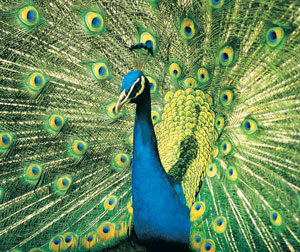
Nevertheless, in 1871 Darwin proposed his ‘theory of sexual selection’ which basically says that the peacock evolved its exotic tail because it would be easier to attract a mate, and this would help peafowl to survive.2 Most evolutionists accepted this idea, despite the many problems with sexual selection theory, which creationists have long pointed out.3
But a remarkably candid review, written by evolutionists and published recently in Science journal, refers to the accumulated ‘fatal problems’ of Darwin’s sexual selection theory, and that case studies show it ‘is always mistaken’4 and therefore ‘needs to be replaced’.5
In other words, Darwin’s attempt to explain the peacock might be a lot of poppycock.
As you might expect, some evolutionists have rushed to defend Darwin’s sexual selection theory from their fellow evolutionists’ attacks, objecting fiercely to any suggestion that ‘the theory of sexual selection is a wholesale failure’ or that it is ‘fatally flawed’. They also point out that the review’s authors ‘fail to provide … a genuine alternative to sexual selection theory.’6 (By which they mean a genuine naturalistic theory.7)
It’s hardly surprising that these evolutionists would rally to defend Darwin’s ideas from reasoned criticism, even when it comes from within their own ranks. Because in the absence of any evolutionary mechanism to explain the design of the peacock’s tail, there’s only one rational explanation—that it was, in fact, designed. By a Designer. To whom all must give account (Hebrews 4:13).
References and notes
- Darwin, F., (Ed), Letter to Asa Gray, dated 3 April 1860, The Life and Letters of Charles Darwin, D. Appleton and Company, New York and London, Vol. 2, pp. 90–91, 1911. Return to text.
- Darwin, C., The Descent of Man, John Murray, London, 1871. Return to text.
- See, e.g., Burgess, S., The beauty of the peacock tail and the problems with the theory of sexual selection, Journal of Creation 15(2):94–102, 2001; creation.com/peacock. Return to text.
- We would agree, in the context of origin of new features. Return to text.
- Roughgarden, J., Oishi, M. and Akcay, E., Reproductive social behavior: cooperative games to replace sexual selection, Science 311(5763):965–969, 2006. Return to text.
- Various authors: Letters—Debating sexual selection and mating strategies, letters to Science 312(5774):689–697, 2006. Return to text.
- Wieland, C., The rules of the game, Creation 11(1):47–50, 1988; creation.com/rules. Return to text.

Readers’ comments
Comments are automatically closed 14 days after publication.