

Sea monsters … more than a legend?
Tales of unknown creatures make sense in a biblical framework of history.
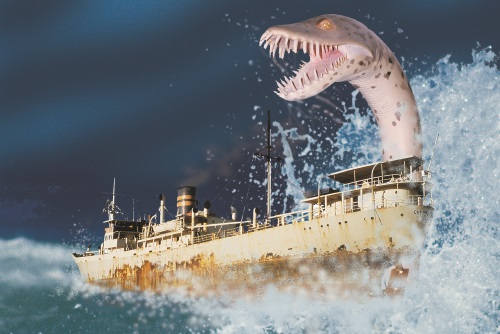
Reports of unknown monsters of the deep have been a part of sea lore for hundreds of years, but very little attention has been paid to such tales until recent years.
With more and improved scientific methods of investigation, there is growing evidence that they are more than just a product of early sailors’ imaginations, according to even some secular researchers.
Monsters in the Bible
More fascinating still is the apparent connection between fossils of prehistoric marine reptiles, and the monsters described in the pages of the Bible. ‘… leviathan, that wriggling, twisting dragon …’ is mentioned in the Old Testament four times.
Leviathan is described in detail, in Job chapter 41, as a creature of immense strength. In the Hebrew text, he has ‘terrifying’ teeth and scales like rows of shields, closely fastened together and hard as stone. He is a resident of the sea, knowing no fear and apparently immune to all man’s weapons.
Many scholars identify this animal as a crocodile, but as other experts have pointed out, there are several problems with this idea.
Although some crocodiles do venture into the coastal areas and can swim out to sea, the deep ocean is not their normal habitat. They are found mainly in inland waters, where they live in lakes, rivers, swamps and estuaries, and breed on the shores. Therefore they would not be described as great beasts of the sea (Psalm 104:25–26). Nor are crocodiles so terrifying that no one dares tackle them—crocodiles are regularly trapped and killed by native tribes with simple technology.
Submarine report
A number of ‘sea serpent’ reports describe a large marine animal resembling a crocodile but much larger—15–18 metres (50–60 feet) long—and occurring far out at sea.
For example, one sighting of such a creature occurred in the North Atlantic during World War I with the sinking of the British steamer Iberian by the German U-boat U28.1
Some seconds after the Iberian had been torpedoed and sunk, there was an underwater explosion. The submarine commander and some of his officers reported:
“A little later pieces of wreckage, and among them a gigantic sea-animal, writhing and struggling wildly, were shot out of the water to a height of 60 to 100 feet [18 to 30 metres] …
“We did not have the time to take a photograph, for the animal sank out of sight after 10 or 15 seconds …
“It was about 60 feet [18 metres] long, was like a crocodile in shape and had four limbs with powerful webbed feet and a long tail tapering to a point.”
One of the largest crocodiles ever caught was a 6.15 metre (20 foot) long specimen harpooned in 1960 near Borroloola in Australia’s Northern Territory. This is not even half the size of the monster as described by the U28 commander!
Leviathan identified?
The mystery might have been solved in June 1983, when a carcass was found on Bungalow Beach in Gambia, but was unavailable for analysis by those who tried to identify it.2 It was found and examined by Owen Burham who had no camera, and so was only able to bring back a description and measurements.
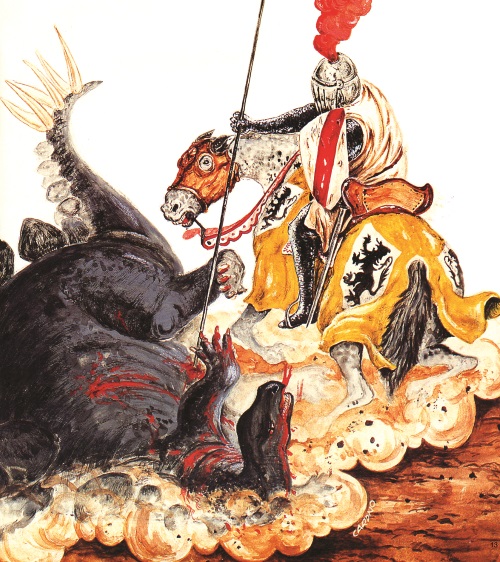
Working on these, noted zoologist Dr Karl P.N. Shuker short-listed six possible identities. Only one, the Shepherd’s Beaked-whale (Tasmacetus shepherdi), was a creature known to be still living in today’s oceans. However, he considers it as the least likely of them. The other five possibilities were prehistoric marine animals. Two of these bear out the description of the leviathan, and of the creature seen by the U28.
One was the mosasaur, a giant marine version of the monitor lizards, and the other was a thalattosuchian, a kind of sea-crocodile supposedly extinct for 110 million years! Dr Shuker believes the latter to be the most likely contender.
The behemoth
Then there is that other monster mentioned in the Bible, the behemoth. Job 40:15–24 describes him as a large grass-eating beast, with great strength in his loins and belly. He has a tail described as being ‘like a cedar’, and his bones are ‘like bars of iron’. The passages also reveal him to be a swamp-dweller.
“Biblical scholars, both Hebrew and Christian, have never come up with a satisfactory explanation for the meaning of these passages,” wrote non-creationist biologist Dr Roy P. Mackal in his book, A Living Dinosaur?3 “Most commentators attempt to identify the reference with the ox, the elephant, the hippopotamus, or the crocodile … More correctly, some Hebrew scholars have considered the creature to be a monstrous and unidentifiable animal.”
A discussion of the issue, originally published in 1691 in Latin and translated into English by Edmund Goldsmid in 1886, was privately printed in Edinburgh under the title ‘Un-natural History of Myths of Ancient Science’.
The original author of the section on the behemoth was George Caspard Kirschmayer, who was also the author of the first six sections of the book. He was a professor at Wittenberg and a Fellow of the Royal Societies of London and Vienna.
He attempted to identify the behemoth as the elephant, which as Professor Mackal writes, “Is only slightly less absurd than the attempts by scholars to explain the creature as an ox. Obviously, the only connection with the ox is that both animals are herbivorous.”
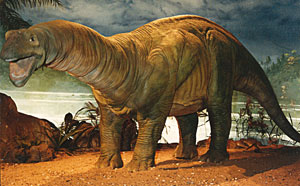
Even the hippopotamus doesn’t fit all the facts, as this animal does not have a tail comparable to a cedar tree. However, the description does fit many of the large herbivorous dinosaurs, one type of which certainly was the ‘chief’ (largest) of the created land animals. Such a dinosaur was therefore alive at the time the book of Job was written.
Could dinosaurs still be alive?

Some dinosaurs may still be alive today. For almost 100 years there have been reports from the Congo Basin in central Africa of a monster known to the natives as ‘Mokele Mbembe’, and which seems to look like a dinosaur. It reportedly varies in length from five to 10 metres (17 to 35 feet), much of this being made up by its long tail and very long neck. Its head and neck are compared to a snake, but it is much larger than any python.
Mokele Mbembe’s legs are described as short, with three visible claws on the hind foot, and the footprints are rounded and about 30 centimetres (one foot) in diameter. The body has been compared to that of an elephant or hippopotamus. It is said to feed on malombo, a tropical climbing plant with a milky sap and apple-like fruits.
Professor Mackal, who has led expeditions into the Congo in search of the elusive creature, believes it to be a small dinosaur. His research suggests it may specifically be a surviving Atlantosaurus.
Sighting by scientist
According to Mackal, African biologist Marcellin Agnagna, a trained scientist, gave a detailed report of seeing Mokele-Mbembe on 1 May 1983 in the shallow water of remote Lake Tele. Five metres (16 feet) of it was visible above the waterline.3
The idea of dinosaur survival is not at all unlikely in view of what the Bible teaches is the real history of the world (see Dinosaurs and the Bible …).
Africa is still a vastly unexplored continent, with ample suitable habitat for dinosaurs. Thousands of square kilometres of impenetrable swamps and thick jungle cover the Congo, and may have never been visited.
The same can be said concerning possible sea monsters. The world’s oceans cover over two-thirds of our planet and average a depth of 3,000 metres (10,000 feet)—more than twice that of the Grand Canyon. At their deepest—11 kilometres (7 miles), Mount Everest would be completely hidden.
There is plenty of room in these vast depths for animals still unknown to modern science as living specimens.
Finding a live dinosaurian creature gains feasibility when we realise that less spectacular creatures have been found which, like dinosaurs, were also believed to have been extinct for millions of years between their appearance as fossils and the present.
Not extinct after all
For instance, the coelacanth. In 1938 this one-and-a-half-metre-long (five-foot) fish was caught in the Indian Ocean off the coast of Africa. From fossils, scientists had declared it extinct for about the same time period as the dinosaurs, but it was actually quite well known to the Madagascan fishermen, who had been catching it for centuries.
A live tree was discovered, in an Australian wilderness, which was previously unknown except for its ‘dinosaur age’ fossils.4 Evolutionists must explain not only why such organisms as these documented finds have survived unchanged through millions of years of mutations and changing environments and predators, but why none of their fossils are found in the rock layers representing the alleged millions of years between then and the present.
The puzzle is solved, however, when the millions of years are seen as fiction, and the fossils are seen largely as the result of the global Flood described in the Bible. Although many creatures have become extinct in the thousands of years since the Flood, it is far less surprising for creationists than evolutionists when some of them, known only from the fossil record, turn up alive and well.
Dinosaurs and the Bible …

Many Christians are confused about dinosaurs. If we based our thinking upon the Word of God, rather than the fallible evolutionary ideas of men, such as seen in the films Jurassic Park and The Lost World, we would easily be able to see how they fit into the Bible.
Exodus 20:11 tells us that in six days God made ‘heaven and earth, the sea, and all that in them is’—which therefore must have included all now-extinct creatures, such as dinosaurs. On which day? Land dinosaurs, like all other land animals, were made on the sixth day of creation. When was that? Adam was also made on that sixth day, and we have a list of his descendants from then on, so it was thousands of years ago, not millions. In any case, dinosaur fossils, which show evidence of death, bloodshed and disease, could not have formed millions of years ago, since this would place them before the sin of Adam—thus putting the effects of the Curse before the Fall!
Thinking from a biblical foundation, it is easier to make the connection between dinosaurs and dragon legends—if people and dinosaurs once knew each other, we would expect that there would be left-over memories of when people knew of some of the more impressive ones. The many dragon tales from cultures across the world testify to a time when people lived with huge, fierce reptilian creatures, some with horns and armour-plated scales, and some which flew.5 Such cultural memories of dinosaur-like creatures do not fit the evolutionary idea that the last dinosaur died out 65 million years before the first human appeared, but they do fit with the Bible’s account of history. Evolutionists have to claim that the similarities of dragons to dinosaurs are a mysterious coincidence, since they believe that no man ever saw a dinosaur.
Because the Bible gives us the true account of earth history, it is no surprise to find that there is a distinct lack of evidence in the fossil record showing how dinosaurs evolved from non-dinosaurs, or one type from another.
It now also becomes clear why we find ‘dragons’ mentioned frequently in the Bible, and the Bible’s description of behemoth falls into place, as the largest plant-eating dinosaur (see main text, The behemoth). The implication that dinosaurs must therefore have survived the Flood is consistent with God’s command for at least two of all kinds of land-dwelling creatures to go on board Noah’s Ark, presumably juvenile forms in the case of the few very large dinosaurs.
With sound creationist resources now available for all ages, dinosaurs can actually be ‘missionary lizards’—a way of reaching the real ‘lost world’ with the truths of creation and the Gospel.
References and notes
- Bord, J. & C., Modern Mysteries of the World: Strange Events of the Twentieth Century, Grafton Books, London, 1989. Return to text.
- Shuker, K.P.N., In Search of Prehistoric Survivors: Do Giant ‘Extinct’ Creatures Still Exist?, A Blandford Book, United Kingdom, 1995. Return to text.
- Mackal, R., A Living Dinosaur? In Search of Mokele-Mbembe, E.J. Brill, Netherlands, 1987. Randles, J., The Unexplained Great Mysteries of the 20th Century, Anaya Publishers Ltd, London, 1994. Return to text.
- Sensational Australian tree … like ‘finding a live dinosaur’ Creation 17(2):13, March 1995; creation.com/woll. Return to text.
- Grigg, R., Dinosaurs and Dragons: Stamping on the Legends, Creation 14(3):10–14, June 1992; creation.com/dinolegends. Return to text.


Readers’ comments
Comments are automatically closed 14 days after publication.