

Standing firm (Raymond Jones interview)
A leading scientist’s life shows how ‘radical’ ideas can lead to the greatest breakthroughs.
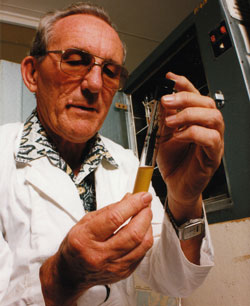
Leucaena, the shrubby tree introduced to Australia’s seasonally dry tropics to increase beef production, caused the cattle grazing it to became sick and thin. Dr Raymond Jones, who is now retired from Australia’s highly respected government scientific body, CSIRO, after 38 years of service, is best known for solving this problem.
This, combined with Dr Jones’ other achievements in improving the productivity of the tropical grazing industries, caused CSIRO Chief Dr Elizabeth Heij to describe him as ‘one of the top few CSIRO scientists in Australia.’ Among the awards he has received are the CSIRO Gold Medal for Research Excellence, and the Urrbrae Award, the latter in recognition of the practical significance of his work for the grazing industry.
Dr Jones was Officer-in-Charge of the CSIRO Davies Laboratory, Townsville, and Regional Research Leader. He is a Fellow of the Australian Institute of Agricultural Science, the Australian Academy of Technological Sciences and Engineering, and the Tropical Grasslands Society of Australia. He has published about 140 research papers.
Don Batten/Carl Wieland: ‘Dr Jones, you apparently met a lot of scepticism from other scientists about the rumen microbe idea to detoxify Leucaena’ (see box).
Raymond Jones: That was disappointing to me. Scientists, too, can be very parochial. I had lots of opposition. It was an accepted ‘fact’ that rumen bacteria were the same all over the world. Even though I had shown they were not, they said it was impossible. I had papers rejected without addressing the issues they contained.
‘How would you react to people who say that evolution must be right because most scientists agree with it?’
I don’t think it’s very sensible to say that. Major breakthroughs in science often occur when people don’t believe what the rest believe. Science progresses as new ideas replace old ones. It’s the radicals who often make the breakthroughs.

‘Are the microbes special to the ruminants?’
Yes, a ruminant couldn’t live on roughage without the bugs, because these digest the tough cellulose fibre in the plants the animals eat. And the bacteria are mostly highly anaerobic [do not like oxygen], and can only live in the rumen. The animal needs the microbes and the bugs need the animal. It’s a good example of design. Evolutionists would argue it’s ‘co-evolution,’ but I don’t believe the incredible ruminant digestion system is the result of countless accidental mutations which just happened to parallel each other in the bacteria and the animals.
Dr Jones is well known, and respected, for his stand for Christ in his profession. He became a Christian at the age of 17, before he went to university (‘fortunately,’ he says). His conversion was due to the faithful work of the town greengrocer, who ran a kids’ club. Raymond led his gang to break up the greengrocer’s meeting, but ended up (eventually) being converted.
Raymond believed in evolution before he was converted. Then he tried to believe that God directed evolution, but he realised that this contradicted the whole idea of evolution—that it’s due to chance mutations. As he studied the Bible’s teaching on redemption, he became increasingly sceptical of the evolutionary ideas being taught at university. This caused him to look seriously at the evidence. He said, ‘As I looked at the evidence—trying to be a dispassionate scientist—I could not find the evidence for the multitudes of intermediate forms which should exist if evolution was true.’
DB/CW: ‘Dogmatic statements are made that students must be taught evolution because without it science would fall apart. They even claim evolution has great practical value.’
RJ: In my experience, I’ve never seen that. Many scientists might speculate in their papers about how a certain result relates to evolution. But I don’t see that it’s the driving force that enables breakthroughs, or that it features much in most scientists’ daily work. Is having an evolutionary paradigm more enabling of research? I don’t think so. In fact, believing in an almighty all-knowing God, rather than chance, behind everything could be more of a driving force for your scientific work. It gives you confidence that something will be found when you search, because behind it all is a mind greater than your own—‘thinking God’s thoughts after Him’ [to quote Kepler].
‘How do you see the widespread indoctrination in evolution affecting society and people’s ability to respond to the Gospel?’
The Leucaena Story

Leucaena, a legume, is a shrubby tree which grows well in the seasonally dry tropics. It remains nutritious during the dry season, when most other plants lose much of their feed value. However, Leucaena contains a toxin which caused animals which grazed it in Australia to get sick.
Dr Jones discovered that goats in Hawaii ate Leucaena without problems. He suggested that perhaps the bacteria in the rumen (a special ‘stomach’ where the food is pre-digested by microbes in animals such as cattle, sheep and goats) were different in Hawaii. They were capable of breaking down the toxin, thus accounting for the lack of toxicity of Leucaena in Hawaii.
Other scientists scoffed at the idea that the microbes could be different and he could get no funding to check out his idea further. So Dr Jones was convinced he was right and paid his own expenses* to go to Hawaii to follow up on the theory.
Subsequently, with funding, Dr Jones took Australian goats and Australian grown Leucaena to Indonesia where some goats had been discovered which could eat Leucaena without problems. He and his colleagues transferred some rumen fluid from the Indonesian goats to the Australian goats. Within two days the amount of toxin in the urine of the treated goats declined dramatically and they thrived. The theory was proven!
Eventually the microbes, isolated from goats in Hawaii, were shown to be new to science and named Synergistes jonesii in his honour. Their introduction to Australian ruminants proved to be successful … and the rest is history. As Dr Jones says, ‘It turned ratbag animals into healthy ones.’ This discovery is worth millions of dollars per year to Australia, and is increasing as more Leucaena is planted.
* Subsequently reimbursed by CSIRO.
I think it’s a major factor. It’s a very powerful way of getting rid of God altogether because evolution is about chance, not purpose.
‘What about the widespread belief in millions of years of death and suffering before man appeared, sinned and caused the Fall?’
It is very difficult, if you can accept that, to relate it to the message in the Bible that through sin, death came into the world. Christ died because Adam brought death into the world. It’s difficult to see how that could fit the idea of millions of years of death and suffering before man sinned.
‘Do you have any advice for young budding scientists?’
If they are Christians, continue to go on with the Lord and trust that He will reveal His will to you. Honour the Lord in all things. I found that the Lord honours those who honour Him [1 Samuel 2:30].
My advice to young scientists is to observe, observe, observe. This is the big thing. When we have so much that’s done for us by computers, it’s very easy to lose observational skills. In my research it’s been observation on a wide scale that enabled me to understand the systems, and pick up leads to follow and reach solutions.
‘And not be blinded by the prevailing paradigms, or ways of thinking?’
True. It’s very easy to have paradigms that swamp you, but that are wrong and misleading.
‘What about the six creation days? There are many people who say, “I don’t believe in evolution, but I don’t know about six days.”?’
I accept the Biblical account of six ordinary days of creation. But humanly speaking, it’s over this time situation, in areas outside my own field, like geology for example, that I have the greatest difficulty reconciling the data. On the biological side of evolution, I’ve no qualms, no difficulties whatsoever. But I don’t believe it’s irreconcilable.
We need to remember that paradigms, frameworks of thought which dominate a particular area of science, have been known to mislead. God is all powerful, so He can do anything. So, yes, I believe in six days, as the Bible clearly says.
‘How long have you been receiving Creation magazine?’
Many, many years. I read it from cover to cover. I am delighted with its regular, updating information, shedding new light on various aspects of the debate. I recommend it to others. I enrolled a scientific colleague and friend in South Africa to receive the magazine. When he got the first one he immediately wrote to thank me for sending it, and said how much he was enjoying it.
‘Thank you, Dr Jones.’
Re-posted on homepage: 16 October 2013


Readers’ comments
Comments are automatically closed 14 days after publication.