
The biblical origins of science
A review of For The Glory of God: How Monotheism Led to Reformations, Science, Witch-hunts and the End of Slavery by Rodney Stark
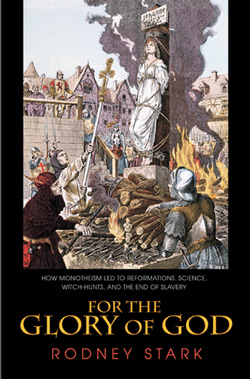
Stark is Professor of Sociology and Comparative Religion at the University of Washington. In For The Glory of God, Stark begins with Durkheim’s view (the ruling paradigm in sociology) that religion is an evolutionary innovation of man, but ends with the opposite conclusion—that it is inspired by gods. The book is volume II in a series on the sociology of monotheism, and in this one, he examines four ‘episodes’ in the development of Western culture. In the process, he debunks the modernist view that virtually all the ills of Western society can be traced back to religion.
In his book, Stark claims that the sociology of religion is today a remote account of the phenomena with little regard for the content. For example, we are introduced to Augustine of Hippo, not as the towering genius of orthodoxy theology, but the brutal persecutor of heretics (Donatists and Pelagians). But by the end of the book—on the very last page—he concludes that there really is a creator God, and science and Western civilization are God–given.
It is a long and scholarly book, and the author has done a great deal of primary research to reach his conclusions. The book expresses what we know in our hearts to be true—that God works through and often despite fallible humans—but it is good to see such scholarly support emerging from amongst the poverty of materialism. His agenda is partisan, however, clearly aimed at debunking the false justifications for atheism, and restoring the dignity of Christianity (he gives scant space to Islam and almost none to Judaism).
Dimensions of the supernatural
In his introduction, Stark defines terms such as religion, magic and monotheism. As a social scientist, Stark uses sociological theories to illuminate history. In this case, he is ‘illuminating’ atheistic revisionist histories of the role of religion in the development of Western culture, and showing up their weaknesses and falsehoods.
God’s truth: inevitable sects and reformations
Chapter 1 illustrates the rise of reformations (plural) in Christianity from the second century to the present day, majoring on the events of sixteenth century Europe. The difference between this and standard church history is slight, Stark offering us several extra anecdotes that are not usually included in college courses. And since he majors on the events, rather than the theology, it makes rather bland reading to an earnest Christian already familiar with church history. He concludes by claiming that the ‘simple mechanisms’ he identified make reformation inevitable in monotheism
His ‘simple mechanisms’ are basically that people are diverse in their religious interests (‘intense’ and ‘lax’ are his categories) and in the church there is always tension in governance between power and piety. Events in church history can thus be plotted (and thereby ‘explained’) on a two–dimensional surface somewhere between the ‘power’ and ‘piety’ poles of church governance, and the ‘lax’ or ‘intense’ poles of congregational and individual attitudes. On the other hand, in polytheism there is always room for the individual to move amongst such forces and find their place—and if necessary inventing or importing new gods to meet their needs. But in monotheism, there is only one God and so religious tensions inevitably lead to sects, schisms and reform movements. This is a simple conclusion, but one that might ease some of the anxiety experienced by Christians who are distressed by the lack of unity amongst the churches.
God’s handiwork: the religious origins of science
In Chapter 2, Stark hits the ground running and the change of pace may pinpoint his main agenda in writing the book. His words are worth quoting at length:
‘Even children know that in 1492 Christopher Columbus proved the world is round. They also know that he … [faced] years of opposition from the Roman Catholic Church, which ridiculed all dissent from the biblical teaching that the world is flat. … Andrew Dickson White, founder and first president of Cornell University, and author of the most influential book ever written on the conflict between science and theology, offered this summary: “… Columbus’ voyage greatly strengthened the theory of the earth’s sphericity [yet] the Church … stumbled and persisted in going astray
… But in 1519 science gains a crushing victory. Magellan makes his famous voyage. He proves the earth to be round, for his expedition circumnavigates it
… yet even this does not end the war. Many [religious] men oppose the doctrine for two hundred years longer.”
‘Like everyone else, I grew up with this story. It was retold in every account of Columbus’ voyage in my schoolbooks, in many movies, and always on Columbus Day. As for A.D. White’s immense study, A History of the Warfare of Science with Theology in Christendom (in two volumes) when I was young, it was required reading … and I cited it in my second published paper.
‘Trouble is that almost every word of White’s account of the Columbus story is a lie. Every educated person of the time, including Roman Catholic prelates, knew the earth was round. … So why didn’t we know they knew? Why do only specialists know now? … White himself admitted that he wrote the book to get even with Christian critics of his plans for Cornell. … many of White’s other accounts are as bogus as his report of the flat earth and Columbus. The reason we didn’t know the truth is that … for more than three centuries [the claim of inevitable and bitter warfare between religion and science] has been the primary polemical device used in the atheist attack on faith. From Thomas Hobbes through Carl Sagan and Richard Dawkins, false claims about religion and science have been used as weapons in the battle to “free” the human mind from the “fetters of faith”.
‘In this chapter, I argue not only that there is no inherent conflict between religion and science, but that Christian theology was essential for the rise of science. In demonstration of this thesis [I show that] not only did religion not cause the “Dark Ages”; nothing else did either—the story that after the “fall” of Rome a long dark night of ignorance and superstition settled over Europe is as fictional as the Columbus story. In fact this was an era of profound and rapid technological progress … the Scientific Revolution of the sixteenth century was the … result of [Christian scholarship] starting in the eleventh century… Why did real science develop in Europe … and not anywhere else? I find answers to those questions in unique features of Christian theology… The “Enlightenment” [was] conceived initially as a propaganda ploy by militant atheists and humanists [e.g. Voltaire, Diderot and Gibbon] who attempted to claim credit for the rise of science [through promulgating] the falsehood that science required the defeat of religion’ (pp. 121–123, emphases in original).
What is science? It is a combination of observation and theory that leads to testable predictions and prohibitions about the results of further observations. A great deal of knowledge was gathered by observation and by trial and error in all ancient cultures, but this is not science. Aristotle, for example, observed widely and theorized extensively, but he did not test his theories against his observations so he was not a scientist. Alchemy and astrology were highly developed in China, Islamic regions, India and ancient Greece and Rome, but only in medieval Europe did these become the sciences of chemistry and astronomy. ‘It is the consensus among contemporary historians, philosophers and sociologists of science that real science arose only once: in Europe.’ The leading scientific figures in the sixteenth and seventeenth centuries were overwhelmingly devout Christians who believed it their duty to comprehend God’s handiwork (pp. 123, 126–127).
What about the ‘Dark Ages’? The term was invented in the 19th century, and is now rejected by historians as being a pejorative incorrectly denoting it to be a period of intellectual darkness and barbarity (p. 129). The reason? Historians do most of their work with written sources, and few know much about horses. Many of the written sources from the ‘Dark Ages’ are written in rather poor Latin, so poor Latin must equal intellectual darkness. Curiously enough, it was not until 1931 that a retired French cavalry officer—who did understand horses—revealed the technological progress that occurred during the period. Roman and Saracen cavalry rode without stirrups and often bareback, but the Europeans invented the stirrup and pommelled saddle which, combined with a very long lance and full body armour, proved an irresistible force in battle. Further technical progress in harnessing and iron horseshoes led not only to greater prowess in battle but also to a doubling of plowing effort in the fields.
Long before any so–called ‘Renaissance’, Europe’s technology advanced far beyond anything achieved by the ancients, with examples like waterwheels, milling technology, camshafts, clocks and the compass. While gunpowder was invented by the Chinese they never developed the gun (so it is a misnomer to call their invention ‘gunpowder’—they only used it in fireworks); it was Europeans who developed the gun and by the early 14th century cannon guns were all over Europe. All this progress occurred before the ‘rediscovery’ of classical knowledge. By the late 13th century Europe was the world leader in technology, philosophy and science and this had come from centuries of interaction between Christianity and the ‘barbarians’ who had much more sophisticated cultures than generally acknowledged (p. 134).
And the ‘Scientific Revolution’? It, like the term ‘Dark Ages’, was coined to discredit the medieval church. The notion has been used to claim that science burst forth only when weakened Christianity could no longer prevent it, and as the recovery of classical learning made it possible. Both claims are as false as those concerning Columbus and the flat earth (p. 134). Classical Greek texts were translated into Latin in the 12th century Christian universities and were known long before the ‘Renaissance’. But classical learning was not science so it did not directly produce science. Science began in the Christian universities under the influence of the devout scholastics. Copernicus was described by the infamous A.D. White as ‘a simple minded scholar’ who ‘discovered’ that the Earth revolves around the sun. More fudging. Copernicus was an eminent Christian scholar who studied at the Christian universities of Cracow, Bologna, Padua and Ferrera. He was taught the fundamentals of celestial mechanics that led to his heliocentric model. A long series of scholastic developments, including the demolition of Aristotle’s view of mechanics, made way for the modern version (via ‘impetus theory’), and it was biblical reasoning that guided the process. Copernicus was taught that the Earth rotates on its axis and his sole contribution seems to be that he put what he had been taught into mathematical terms, calculating future positions for the dates of Easter and solstices, etc. His heliocentric model was no more accurate than the existing Ptolemaic system and virtually everything else in his book was wrong. ‘The idea that a Copernican revolution in science occurred goes counter to the evidence … and is an invention of later historians’ (p. 139).
Scholastics began the empirical tradition long before the ‘Renaissance’. Albert Magnus excelled in botany in the 13th century, putting Aristotle to the test with field observations and discarding his wrong ideas. Human physiology began at the same time using dissection of cadavers—something forbidden to classical scholars and Muslims. What allowed Christian dissection was the idea that the soul, not the body, was the essence of the human person. It began with post–mortem dissection in the 13th century and by the early 14th century it was taught in front of students. Yet our lying friend A.D. White said dissection began amid church opposition in the sixteenth century! It was this same tradition of dedication to careful and accurate observation that led Tycho Brahe and Johannes Kepler to formulate the first laws of astronomy.
But what was the Christian difference? India, China, Persia, Greece and Rome all had venerable traditions of scholarship but why did only Christian Europe develop science? Stark’s answer is simple but profound—the Christian God was rational, responsive, dependable and omnipotent and the universe was his personal creation in which his divine nature was put on display for man’s benefit and instruction. Among the passages most commonly cited by medieval scholars was: ‘Thou has ordered all things in measure and number and weight.’1 Christians believed that science could be done and should be done.
In China, the Confucian and Taoist philosophies did not contain the idea that a ‘science of explanations’ would be possible so they pursued personal enlightenment and social order. The Greeks pursued learning with great zeal but there remained always a gap between their speculative philosophy and their observation. The persistence of this gap can be traced to their view of the universe—it was seen as a ‘living organism’ with ‘motives’, influenced by a multitude of fallible gods. In the face of such arbitrary behaviour, they pursued speculative ideals that could not be subjected to empirical testing. The Islamic world embraced classical scholarship enthusiastically, and made significant progress in mathematics, astronomy and medicine, but they never developed science. Stark attributes this to their excessive zeal for the ancients—they adopted the Greek view of the universe as being inscrutable and it blocked further progress.
To illustrate the role of Christians in the rise of science, Stark researched ‘scientific stars’ from 1543 to 1680, the era usually designated as the ‘scientific revolution’, and came up with a list of the top 52. Of these, 26 were Protestant and 26 Catholic; 15 of them were English, 9 French, 8 Italian, 7 German (the rest were Dutch, Danish, Flemish, Polish and Swedish respectively). Only one was a sceptic (Edmund Halley) and one (Paracelsus) was a pantheist. The other 50 were Christians, 30 at least of which could be characterized as ‘devout’ because of their evident zeal. It is not until the time of Darwin that atheism appeared to accomplish anything significant in science2 (Halley’s work in astronomy and mathematics owed no debt to atheism). And the obvious flaw in Darwinism is that it ‘falls notably short of explaining the origin of species’ (p. 177). So atheism is left nakedly ideological, with all its attempts to wrap itself in science thwarted.
In an interesting illustration of the influence of modern creationism, Stark refuses to commit an opinion on the origins debate:
‘My reluctance to pursue these matters is based on my experience that nothing causes greater panic among many of my colleagues than any criticism of evolution. They seem to fear that someone might mistake them for Creationists if they even remain in the same room while such talk is going on’ (p. 176).
He goes ahead with his critique however, and roundly chastises evolutionists for their duplicity:
‘When Julian Huxley claimed that “Darwin’s theory … is no longer a theory but a fact,” he surely knew better. But just like his grandfather, Thomas Henry Huxley, he knew that his lie served the greater good of “enlightenment”’ (p. 185).
Duplicity abounds, apparently. The famous debate between T.H. Huxley and Bishop Wilberforce is widely reported to have ended in a farce when the Bishop asked Huxley whether it was through his grandmother or grandfather that he traced his ape ancestry. Huxley is reported to have replied saying he had no shame in ape ancestry but would be ashamed to be associated with a man who used his great gifts to obscure the truth. This cameo, repeated in all the recent biographies of Darwin and Huxley, is apparently the fabrication of a tabloid journalist thirty–eight years after the encounter (p.188). The historian J.R. Lewis also argued that this infamous Huxley riposte is a myth.3 On the contrary, Wilberforce was a first rate scholar with first–class honours in mathematics from Oxford, who published a sound critique of Darwin and was acknowledged by Darwin as making ‘a very telling case against me’ (p. 189).
Stark finishes the chapter by saying that not only did science begin from a religious foundation, it continues to work from the same foundation today. A huge survey in 1969 showed 55–60% of academics in the hard sciences in America embrace religious faith, with 30–50% in the social sciences (these figures are very dated and greatly overstate the real influence of biblical faith). Stark does not tell us his faith position, (he denies being a Roman Catholic) saying it is no one’s business but his own (p. 13), but we might reasonably conclude that perhaps he is a Protestant theistic evolutionist.
God’s enemies: explaining the European witch hunts
Chapter 3 jumps right into the horrors of a witch’s ‘sabbat’ to explain why they were so vehemently opposed. However, it seems that here too, the ground is littered with falsehood and exaggeration. For example, Stark does show how the Church sometimes hindered and halted witch hunts.
However, witch–hunts did take place and Stark offers a sociological explanation for them that appears quite rational (including, as it must, sporadic outbursts of irrationality). He paints a picture of widespread folk magic, overlain by Christianizing influences and social tensions, which in the face of the external threat of Islam and the internal threat of heresy caused the authorities to crack down on dissidents and deviants. The most notorious cases occurred largely in areas where the rule of law was already weak.
There is evidence that even the Spanish Inquisition was instigated to mitigate the excesses of mob violence, in particular the Cathar cult, and it had a civilizing influence.4 Amongst the 535 executions in Aragon between 1540 and 1640, for example, there were only 12 cases of ‘superstition or witchcraft’—the majority were for religious heresy. Magic was widely tolerated; only Satanism attracted the death penalty. But even in Spain, confession and apology was all that was required—only defiance was punished.
But why did witch hunts never develop in Islam? Stark suggests that Islamic society is held together primarily by political power and witchcraft was not a political threat. They also accepted magic as part of life and were ‘not nearly so committed to reason and rationality’ (p. 287). The irony for Christian Europe was that just as reason and rationality had brought science, it also brought witch–hunts.
God’s justice: the sin of slavery
Stark provides in Chapter 4 some balm for Europe’s self–inflicted wounds—Christian reason triumphed in the abolition of slavery. Slavery was widespread in all the great societies of history, but only in Christian Europe (and America) was it perceived to be a sin that must be abolished. Individual Christians publicly opposed slavery from the seventh century onwards, and official church moves against it began with St Thomas Aquinas in the 13th century. A series of popes upheld his position, beginning in 1435 and culminating in three major pronouncements against slavery by Pope Paul III in 1537. These edicts were widely flouted, but they remain an historic testimony to Christian social justice. And why did abolition not succeed in Islam (not until recently, and slavery still persists in some places)? One obvious answer is that Muhammad bought, sold, captured and owned slaves (p. 338).
Gods, rituals and social science
In the form of a postscript, Stark reflects upon why modern sociologists have abandoned gods in favour of rituals as the centerpiece of religion. For example, cultures are said to ‘discover’ rain gods as a result of performing rain dances; the god is thus considered to be the effect, not the cause, of the behaviour (p. 369). With obvious tongue in cheek he goes on: ‘One must be a highly trained social scientist to believe such things.’ He then puts forward contrary arguments to the traditional position proposed by Durkheim and concludes that:
‘Gods are the fundamental feature of religions … The ‘wisdom of the east’ did not give rise to science, nor did Zen meditation turn people’s hearts against slavery… science was not the work of Western secularists or even deists; it was entirely the work of devout believers in an active, conscious, creator God. And it was faith in the goodness of this same God and in the mission of Jesus that led other devout Christians to end slavery … Western civilization really was God–given’ (p. 376).
References
- (Wisdom of Solomon 11:20). This book is part of the Apocrypha—books that may be read for edification but are not inspired, as are the 66 books of the Bible, called the ‘canon’ of Scripture. Its influence on medieval Christian thought was enhanced by being included in the medieval Bible (the Vulgate), despite not having been regarded as inspired Scripture even by Jewish scholars. Roman Catholics still regard the Apocryphal books as Scripture. Return to text.
- By attributing the appearance of design to natural selection, Darwin replaced this argument for the existence of God with a naturalistic process. His argument was flawed, however, in that natural selection can only select from things that already exist so it does not explain the origin of the created kinds. Return to text.
- Lucas, J.R., Wilberforce and Huxley: a legendary encounter, The Historical Journal 22:313–330, 1979. Return to text.
- Kamen, H., The Spanish Inquisition: A Historical Revision, Yale University Press, 1999. Return to text.


Readers’ comments
Comments are automatically closed 14 days after publication.