
The Importance of Evidence
Editorial
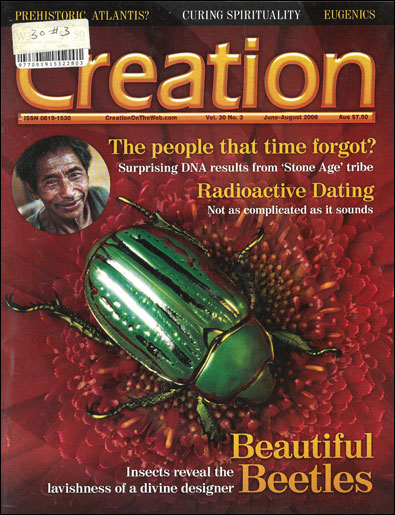
Someone told us recently, ‘A young man I know was converted through the Creation magazine photos of the dinosaur engravings on the bishop’s tomb.’
Many others too, confronted with evidence that dinosaurs lived alongside humans (and other evidence contradicting evolutionary theories, but consistent with the Bible), have come to trust in Christ.

Creation 25(4):40–44, 2003; creation.com/brass_behemoth.
However, many people say, ‘For me, creation is really not an issue. I just have faith.’
Just have faith. I can’t help wondering what the people saying those words think of those who apparently are unable to ‘just have faith’—people who need evidence that the Bible’s timeline of history can be trusted in the face of today’s widespread evolutionary teaching contradicting it.
Of course God’s Word praises those who can believe ‘all that the prophets have spoken’ without having themselves witnessed the events in question (e.g. 1 Peter 1:8 cf. 2 Peter 1:16; 2 Thessalonians 1:3–4,10). Also, ultimately ‘without faith it is impossible to please God’ (Hebrews 11:6). Note though that today’s often-nebulous definition of ‘faith’ includes notions outside of the way it is used in the Bible, where ‘faith’ was never divorced from the evidence.* What’s more, Scripture also says that we should ‘be merciful to those who doubt’ (Jude 1:22).
Our Lord Jesus demonstrated such by his own example. Thomas had said that unless he could see evidence of Jesus’ Resurrection, he would not believe it (John 20:25). A week later Jesus appeared to Thomas, dispelling his doubts, saying, ‘Because you have seen me, you have believed; blessed are those who have not seen, and yet have believed’ (John 20:29).
Thus was Jesus merciful to ‘doubting’ Thomas. His eyes had now seen (q.v. Luke 10:23) the evidence he apparently needed in order to believe. There are other examples in the Bible too, linking the ‘seeing’ of evidence to ‘believing’. When ‘the other disciple’ went inside the empty tomb, ‘he saw and believed’ (John 20:8).
Similarly, after Elymas became blind, Acts 13:12 records the impact upon the proconsul Sergius Paulus (described as ‘an intelligent man’—v.7): ‘When the proconsul saw what had happened, he believed, for he was amazed at the teaching about the Lord’ [emphasis added].
Dinosaur engravings and other evidence presented in Creation magazine over the past three decades have impacted many peoples’ lives. Dean W., of South Africa, wrote to us recently that ‘the apparent contradiction between the real world and the Bible had been a real barrier to my believing in the whole Bible as truth’. However, after being shown that there is no such contradiction—that the evidence available in the world today not only fits, but is best explained by, Genesis Creation, Flood, etc.—Dean underwent a dramatic ‘spiritual awakening’ (as he put it). ‘[T]here is a glorifying of His magnificent name and a healthy fear of the Lord which comes when the believer realizes there is undeniable evidence to support the fact that the Bible can be trusted.’
Dean gently rebuked those who say that the creation/evolution debate is not important to their faith:
‘The believers who say that the debate is unimportant to them ignore the fact that it may not be about them. Jesus commanded us to “love our neighbours as we love ourselves” and we therefore have a responsibility as intelligent human beings to make every effort to understand this debate for the benefit of others, many of whom are enslaved by humanistic philosophy and atheism. We should always be ready to give a reason for the hope that is in us with meekness and fear [1 Peter 3:15].’
We trust this magazine continues to help readers do exactly that.

Readers’ comments
Comments are automatically closed 14 days after publication.