
‘The oldest pregnant mum’—not!
Media headlines and scientific journals are proclaiming the discovery of ‘the world’s oldest mum’, a fossil named after Sir David Attenborough

The ‘Gogo formation’ is a famous fossil deposit in Western Australia’s Kimberley region,1 and worldwide news reports are proclaiming it has now yielded ‘a 380-million-year-old fossilised fish which was in the process of giving birth before it died’—the extinct placoderm dubbed Materpiscis attenboroughi (‘Mother fish of Attenborough’).2
In dramatic fashion, Nature journal drew attention to the researchers’ paper3 with the headline ‘The oldest pregnant mum’4—but, as we shall see, ascribing such an identity to this placoderm fossil named after Sir David Attenborough5 is misguided, as the evidence actually fits with biblical history, not uniformitarian evolutionary theory.
First, consider the high degree of preservation of this specimen (and other ‘Gogo fish’ fossils), consistent with it having been buried rapidly under multiple layers of sediment (as per the Genesis 6–9 Flood account):
-
‘remarkably well-preserved fish from the Devonian period’4
-
‘remarkably preserved in three dimensions’3
-
‘“Gogo fish are three-dimensional, uncrushed, perfect specimens—as if they died yesterday,” says Long.’4 (Paleontologist John Long, Museum Victoria, Australia) [Emphasis added.]
-
‘Soft tissues, including muscle and nerve structures, have been reported in Gogo specimens’4,6,7 [Emphasis added.]
-
‘the [Materpiscis attenboroughi] fish was giving birth to live young when it died, and shows evidence of an umbilical cord still attached to the offspring’2 [Emphasis added.]
-
‘intra-uterine embryo connected by a permineralized umbilical cord’3 [Emphasis added.]
-
‘the first maternal feeding structures preserved in any fossil ever found’5
All of which speak indeed of having been buried quickly and deeply—not the slow-and-gradual processes so often emphasized in uniformitarian-based evolution textbooks. So these fish would date from the Genesis Flood only around 4,500 years ago, not the claimed millions of years.
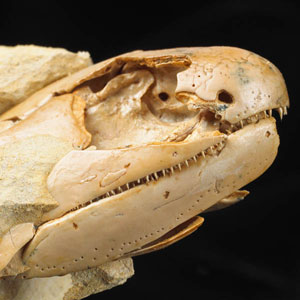
Second, consider how evolutionists’ ideas about millions-of-years ages leaves them puzzling over ‘advanced’ features found in organisms buried deep in the fossil ‘record’, such as this Materpiscis attenboroughi fossil, which now forces a revision of evolutionary thinking:
-
‘When you look down the microscope and there it was—an embryo inside a 380-million-year-old fish—and I was blown away by the very thought of this fish giving birth to live young almost 400 million years ago.’2 (Dr John Long)
-
‘Dr Gavin Young from the Australian National University says this reveals an advanced reproductive process to have evolved in such an ancient fish.’5 [Emphasis added.]
-
‘“It’s very significant because we always thought that egg laying was the primitive condition among fish,” [Dr Kate Trinajstic] said.’2
-
‘Indeed, one of the Gogo species from the current paper was first described by Long two decades earlier, but he had mistaken the embryos for an unusual cluster of external scales.’4
-
‘In earlier studies of placoderms, remnants of young have been observed inside adults and it was assumed to be cannibalism.’4
-
‘“These early primitive fish, which were thought to be big, slow, dull, armoured fish, probably had an amazing courtship ritual,” says Long.’4 [Which represents an amazing turnaround in thinking!]
‘Gogo-type’ fish were supposed to be transitional forms linking fish to tetrapods. One of the researchers above, Dr Kate Trinajstic, said:
‘Wonderful transitional fossils which are helping us get an understanding of how fish moved out of the water and onto the land.’2
Yet they have found no such thing. There is nothing transitional in Materpiscis’ reproductive method! Fish, amphibians and reptiles all lay eggs, yet the allegedly in-between form does not. It is far from the only ‘transitional form’ that might appear transitional when one or two characteristics are analysed, but not when the whole organism is considered. See Tiktaalik—a fishy ‘missing link’.
This is also another example of evolution impeding real science. Evolutionary expectations about this fossil’s ‘primitivity’ misled researchers about the true nature of the embryos. That is, because live birth should not have evolved so ‘early’, the developing embryos were mistaken for the victims of cannibalism.
No, Materpiscis attenboroughi, like all organisms living and that have ever lived, is not ‘primitive’. Rather it testifies to having been designed, just as the Bible says. The particular fossil specimen enjoying a blaze of publicity at present was not the world’s first mother. It’s true she died while giving birth. She died because about 1,600 years earlier, the first man rebelled against his Creator, and the whole Creation has had to suffer death ever since.
The Materpiscis attenboroughi specimen would certainly have had its own mother, which in turn had its own mother, and so on, all the way back to the Beginning of Creation, just 6,000 years ago.
References
- See, e.g., Jaroncyk, R., and Doyle, S., Gogonasus—a fish with human limbs?, 3 November 2006. Return to text.
- Clarke, S., Aussie scientists find world’s oldest fossil mum, ABC News, <www.abc.net.au/news/stories/2008/05/29/2258708.htm>, 29 May 2008. Return to text.
- Long, J.A., Trinajstic, K., Young, G.C. and Senden, T., Live birth in the Devonian period, Nature 453(7195):650–652, 29 May 2008. Return to text.
- Dennis, C., The oldest pregnant mum, Nature 453(7195):650–652, 29 May 2008. Return to text.
- It’s official: Sir David’s a fossil, ABC Radio National’s AM program, broadcast 29 May 2008; transcript at <www.abc.net.au/am/content/2008/s2258817.htm>. Return to text.
- Trinajstic, K., Marshall, C., Long, J. and Bifield, K., Exceptional preservation of nerve and muscle tissues in Late Devonian placoderm fish and their evolutionary implications, Biology Letters 3:197–200, 2007. Return to text.
- Preserved muscle shock, Creation 29(3):10, 2007. Return to text.
Readers’ comments
Comments are automatically closed 14 days after publication.