
The remarkable ruffed grouse
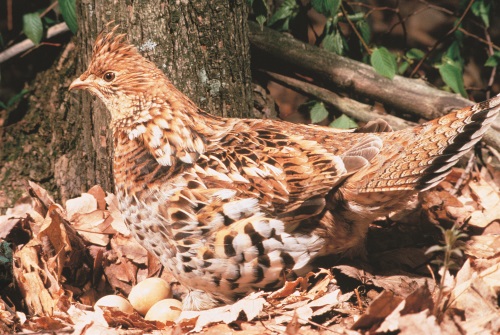
Walking through a North American wood one day, I was startled by a commotion. Ahead of me, a brown bird started squawking and acting as if its wing was broken. At the same time, several little brown ‘puffballs’ scattered in all directions. A mother ruffed grouse had interpreted my presence as a threat and immediately tried to distract me from her chicks by making me think that she was hurt. Meanwhile, her babies had vanished. I waited, motionless, a few more minutes, before the mother’s faint ‘pluck’ call summoned the chicks back to the safety of her protection.
The North American ruffed grouse (Bonasaumbellus) is common to northern USA, southern Canada, and central Alaska.1 Bonasa is Latin for ox (cf. Bison bonasus, the European bison). Some writers feel that the term refers to the drumming sound the bird makes which, to some, might sound like a bellowing, or even stampeding, bison. Others have suggested a resemblance of the startled grouse’s wild initial flight to the action of a charging buffalo.
The species name, umbellus, means something that shades (e.g. an umbrella). During the courtship display, the male raises his beautifully banded, 18-feather tail and forms it into a fan.2 At the same time, he elevates the feathers around his neck, making them look like a collar (or ruff).
In spring, the 40-50 cm (16-20 inch), 1-kg (2.2 lb) males look for females. After elaborate courtship displays, they mate. Each fertilised female then finds a site for nesting—usually against the base of a tree. Making a depression in the ground and adding a few leaves or pine needles, she lays her 8 to 14 eggs, one per day. During the incubation period, she instinctively ‘knows’ which eggs are infertile and rolls them out of the nest. She does not start incubating until all the eggs are laid. All will hatch at about the same time, some 24 days later.
Each chick is equipped with an egg tooth, which enables it to gain freedom from its shell. The newly hatched birds have no scent; they are covered in wet down and, when dry, can move out of the nest in about half-an-hour. Though the chicks are odourless, the newly opened eggs are not; hence the importance of all the eggs hatching at the same time, and the family evacuating the area immediately. The young ‘ruffs’ can run within 24 hours, and fly a few metres within a week.
Mother teaches them a warning call which immediately scatters them. When danger approaches, she squawks, writhes as if in pain, and acts as if her wing were broken. This way, all of the attention is on her, allowing the chicks to run for cover. When the predator is about to pounce, she explodes from the scene!
During good weather, the chicks’ diet consists mainly of insects. As the months go by, they are gradually introduced to more and more foods, especially tree buds, berries and seeds.
They are beautifully designed to weather the hazards they must face. Feathers help maintain a body temperature of 42°C (107°F), provide protection against rain, camouflage them in the forest, and carry them in flight. These amazing birds can swoop through the woods, weaving in and out between the trees at speeds of 55 km/h (35 mph) or more.3
Ruffed grouse rarely live beyond 20 months. Dangers are many, and 70% die within the first year. To compensate for this, females are designed to be capable of laying large numbers of eggs, should the need arise. When scientists have removed one egg from the clutch per day, females have continued laying eggs, sometimes as many as 32 or more. Their potential to multiply is so great that theoretically4 over 150,000 offspring could arise from one pair in four years.

During summer and autumn in north-eastern USA, the drumming sound of the male grouse can often be heard. With this, he defies other males and advertises for females. On top of a moss-covered log, in open hardwoods, he begins to beat his wings toward his body, slowly at first, then increasing in tempo. Some have described this sound as being like a tractor starting up in the distance. Contrary to popular belief, he’s not thumping his chest. The fast-beating wings create a vacuum into which air rushes, resulting in a drumming sound that reverberates through the forest. You might think he’d be extremely vulnerable to predators at this point, but the drumming has a ‘ventriloquistic’ effect and is extremely hard to locate. In addition, the sound has been measured at 40 Hz (cycles per second), low enough for other grouse to hear, but too low to attract the great horned owl (Bubovirginianus), a major predator, whose hearing range is 60-7000 Hz.
Ruffed grouse are beautifully endowed to meet the challenge of winter. As cold weather approaches, the birds’ feathers not only increase in density, but also cover legs and feet for increased insulation. Special feathers known as after-feathers begin growing from the main axis or rachis of the contour feathers. These may be as long as three-quarters of the originals from which they grow, and have a downy structure that greatly enhances insulation.5
‘Pectinations’ (comb-like structures) begin forming on the feet, enough to effectively double the toe surface. These extensions act like snowshoes, enabling the grouse to negotiate deep snow. When spring approaches, they fall off and will not grow again until the following winter.
On cold winter nights, when the snow is deep, the birds dive into snow-banks to utilise the snow’s insulation qualities. There are many advantages to this fascinating behaviour. Depending on the night, the temperature could be as much as 30 °C (about 50 °F) warmer in the snow-bank than in the surrounding air. And, where there are no tracks, no predators can follow.
“But their single greatest advantage in winter, the one distinctive feature common to all northern grouse and ptarmigan (another type of grouse) is a dietary one. Adapted to feeding on coarse, fibrous plant material, primarily buds, twigs and conifer needles, these birds have all the advantages of a ruminant without being confined to the ground.”6 This tough material is digested by ‘friendly’ bacteria in two special pouches called ‘ceca’.
These paired ceca start growing in autumn, and by mid-winter these coiled structures are a metre or so in length.7 The advantage of this lengthening is that it enables the bird to gather more food inside itself in less time, allowing the grouse to rest in shelter on the coldest days. Energy is thereby conserved, and digestion can take place in safety. These abilities to store more food and to extract energy from coarse plant fibre are wonderful design features for survival during harsh winters.
The ruffed grouse8 is obviously very well adapted to living in the fallen world we all inhabit. Its deceptive behaviour would not have been needed pre-Fall, but is a stratagem also used by other birds which lay eggs on the ground, such as the plover. This is only one of its many survival features that are consistent with its having been designed by an immensely intelligent Creator. Since this is the God of the Bible, it is not surprising that He foreknew the Fall and its consequences.
References and notes
- Field Guide to the Birds of North America (2nd edition), National Geographic, WA, USA, p. 210, 1989. Return to text.
- Gotch, A.F., Latin Names Explained: A Guide to the Scientific Classification of Reptiles, Birds & Mammals, Facts on File, NY, USA, p. 242, 1995. Return to text.
- Scott, J.D., Windows on the Wild, G.P. Putnam's and Sons, NY, USA, pp. 139-148, 1980. Return to text.
- Obviously under idealized laboratory conditions. Return to text.
- Marchand, P., Life in the Cold (3rd edition), University Press of New England, USA, p. 234, 1996. Note that these feathers lack hooks, a feature not needed for insulation, and so have a lower information content than feathers used for flying. Return to text.
- Ref. 5, p. 231. Return to text.
- Ref. 5, p. 233. Return to text.
- For further reading: Madson, J., The World of the Ruffed Grouse, J.B. Lippincott, New York, USA, 1973. Return to text.


Readers’ comments
Comments are automatically closed 14 days after publication.