

The super-senses of oilbirds
Bizarre birds elude an evolutionary explanation
What dwells in caves, has dolphin-like sonar, navigates like a bat, has eyes like a deep-sea fish, can hover like a kingfisher, finds its food by smell and can be boiled up to make oil?
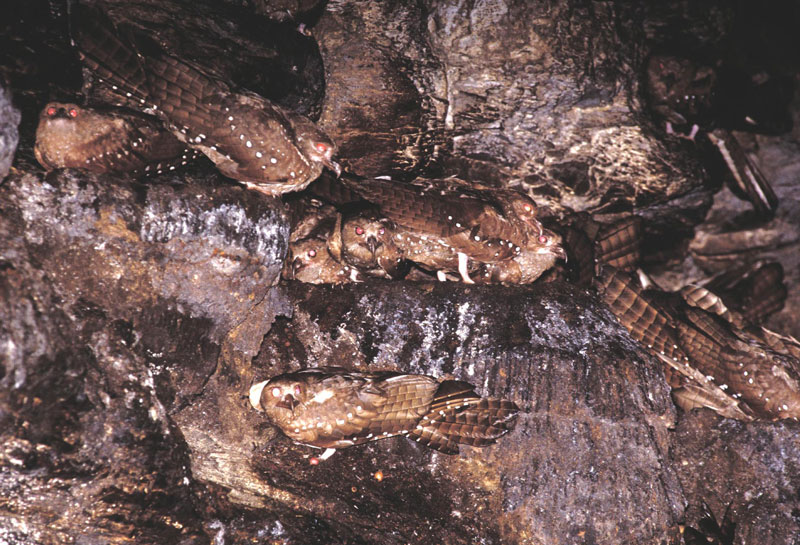
A bird of course—but no ordinary bird. It’s the unique and intriguing oilbird (or Guacharo) of Central and northern South America—the only nocturnal, fruit-eating bird in the world. The great German explorer, Alexander von Humboldt, first drew attention to these bizarre birds. He observed oilbirds in a Venezuelan cave in 17991 and described them in the report of his travels a few years later.
Natives of South America call the oilbird ‘Guáchart’—Spanish for ‘One who cries/laments’2 and another name is ‘Diablotin’. The scientific name is Steatornis caripensis and this single species is placed in a family all of its own, Steatornithidae,3 highlighting just how unusual it really is.
There is nothing very remarkable about an oilbird’s appearance, which is basically that of a rather drab, hawk-sized bird of prey, about 45 cm (18 inches) long. It is yet another example of a ‘bird of prey’ that is herbivorous. Males and females look similar—brown coloured feathers with black bars and flecked with white spots. It has short, bare legs, long curved toes (armed with sharp claws) and a hooked bill.3 More noteworthy are its large wings (long and pointed—giving it a wing span of one metre4) and long, rounded tail that enable it to fly slowly and even hover.
Different diet

Oilbirds only eat fruit (i.e. they are frugivores), which they locate by smell. They are partial to figs and palm nuts, but a population in Trinidad has been observed eating more than 36 different fruits.5 Like fruit bats, they are responsible for ‘planting’ new fruit trees far and wide as seeds, inside the fruits, pass through their guts and often get dropped at a considerable distance from the host tree—oilbirds may range up to 240 km (150 miles) in a single night.6
Oilbirds feed their young exclusively on fruit pulp. This is very unusual because an all-fruit diet would not normally provide adequate nutrition for baby birds. Oilbird nestlings retain food in their intestines for longer than normal, enabling them to extract all the nutrients which they need in order to thrive on fruit. For instance, they are able to extract 80% of the lipids (fats) from their diet.7 This means that young nestlings grow fat (even half as heavy again as their parents8)—causing the literal downfall of many! Using long poles, native Indians knock them down from their nests on cave ledges, then melt the fat (which is concentrated between the thighs) to produce a pure oil1 for lighting torches.
Denizens of the night
During the daytime, oilbirds roost on cave ledges, digesting food eaten the previous night. While most other bird species roost at night and are active during the day, at night oilbirds show their true colours. They are one of only two types of birds that can navigate in the dark using a unique echolocation system—the other being the cave swiftlets of forest caves in South Asia (see ‘Echolocation—hearing is seeing’ below)9.
Just like bats (and many sea mammals), they emit clicking calls in rapid succession and listen to the returning echoes. This means that, in the pitch blackness of their cave home, they can fly around without bumping into the cave walls or each other. At dusk, they leave the cave to find food and their echolocation system works together with their keen smell and super-sensitive vision, helping them to snatch nuts and small fruits in mid-flight without needing to land. In fact it is thought that they never perch during foraging trips, using instead their ability to hover while feeding.
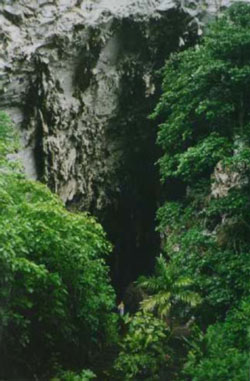
The eyes of oilbirds are highly specialized for their unique lifestyle (see ‘An oilbird’s—eye view’ below). While not apparently designed for distinguishing colour, it has recently been discovered that they are extraordinarily sensitive to light—a great advantage to a bird that ‘breaks all the rules’ by being nocturnal. This incredible light-sensitivity is achieved by each of the oilbird’s eyes having a large pupil (enabling them to gather the maximum amount of light) and millions of densely packed rods, the photoreceptor cells.10
Oilbird origin—a big mystery?
Evolutionists believe that mindless, purposeless, random natural processes have accomplished this marvelous design. If so, there ought to be some fossil evidence for this idea, but a recent technical paper admits, ‘The Steatornithidae have no certain fossil record …’.11 The same article reveals that certain features of the oilbird’s skeleton are virtually unique among all living species of birds. Unsurprisingly perhaps, the supposed evolutionary relationship between oilbirds and other birds has long been a matter of debate and speculation.
Evidence for a Creator!
Oilbirds possess many highly specialized and intricate design features for their peculiar way of life, method of feeding and navigation. The most cogent explanation is that the infinitely wise Creator designed the oilbird’s amazing super senses and unique behavioural instincts. To conclude otherwise is inexcusable because this Designer’s attributes are ‘clearly seen’ in His handiwork (Romans 1:20 ). As with the duck-billed platypus,12 one wonders whether God had evolutionists in mind when he fashioned these curious and enigmatic birds on the 5th day of Creation week!
References and notes
- Guacharo, www.showcaves.com/english/explain/Biology/Guacharo.html, 23 August 2005. Return to text.
- Brauer, O.L., Biological oddities that are unaccountable by evolution, CRSQ 9(1):41–44, 1972. Return to text.
- Scott, P. (Ed.), The world atlas of birds, Colour Library Books Ltd, Godalming, Surrey, p. 243, 1989. Return to text.
- Pilcher, H.R., Bird’s—eye view, Nature 427(6977):800, 26 February 2004. Return to text.
- Oilbird Steatornithidae, www.monterey bay.com/creagrus/oilbird.html, 23 August 2005. Return to text.
- As referenced on p. 576 of: Gutierrez, P.C., Mitochondrial-DNA polymorphism in the oilbird (Steatornis caripensis, Steatornithidae) in Venezuela , The Auk 11(3):573–578, 1994. Return to text.
- Bosque, C. and De Parra, O., Digestive efficiency and rate of food passage in oilbird nestlings, The Condor: A Journal of Avian Biology 94(3):557–571, 1992. Return to text.
- Oilbirds, www.asawright.org/tropical/oilbirds.html, 23 August 2005. Return to text.
- Ref. 3, p. 19. Return to text.
- See the abstract of: Martin, G., et al., The eyes of oilbirds (Steatornis caripensis): pushing the limits of sensitivity, Naturwissenschaften 91(1):26–29, 2004. Return to text.
- Mayr, G., On the phylogenetic relationships of trogons (Aves, Trogonidae), Journal of Avian Biology 34(1):81–88, 2003. Return to text.
- Weston, P., The platypus—still more questions than answers for evolutionists, Creation 24(2):40–43, 2002. Return to text.
An oilbird’s—eye view
In early 2004 there was a flurry of articles in the scientific press, reporting that researchers had discovered some astounding things about the eyes of oilbirds. Using microscopy, they found that each rod (photoreceptor cell) in an oilbird’s highly light-sensitive retina is unusually tiny, only 1.3µm in diameter by 18.6µm long.1,2 Furthermore, the rods are stacked up in three banks/tiers (an arrangement that has only previously be seen in deep-sea fish3) so that the density achieved is 1 million rods per sq. mm, higher than is known in any other vertebrate eye. In contrast, only a small number of cone photoreceptor cells (for discerning colour) is present. Although small, an oilbird’s eye nevertheless has ‘a light-gathering capacity that is the highest recorded in a bird’, due to a pupil that can enlarge to 9 mm in diameter.2 These unique eye features make oilbirds extremely sensitive to low light levels and, in tandem with their other senses (smell and echolocation) demonstrate the oilbird’s supreme design for a nocturnal lifestyle.
Of course, not everyone recognizes (or acknowledges) the Creator’s handiwork, e.g.: “So, just as in bats, a system of echolocation has evolved to help oilbirds locate their troglodytic roost ledges” (emphasis added).4 However, this just-so statement is a classic example of question begging. The research paper (a great example of operational science) gave no explanation about the origin of oilbird echolocation. Neither did it reveal how the super-sensitive eyesight of oilbirds evolved. The wishful belief in convergent evolution ignores the sheer impossibility of the complex sonar system evolving once, let alone twice, in different kinds of birds (see ‘Echolocation—hearing is seeing’ below)—not to mention in bats and dolphins! Here again, we have an example of so-called ‘convergent evolution’ (the same arrangement of rod cells in oilbirds and deep-sea fish) that defies any evolutionary explanation. Rather, we see the wisdom and skill of the Creator who has used the same retina design in very diverse creatures—equipping them beautifully to live where they live.
References and notes
- 1µm (one micron) is equal to one thousandth of a millimetre (0.00004 in.).
- From the abstract of: Martin,G., Rojas L.M., Ramirez, Y. and McNeil, R., The eyes of oilbirds (Steatornis caripensis): pushing the limits of sensitivity, Naturwissenschaften 91(1):26–29, 2004.
- Pilcher, H.R., Bird’s—eye view, Nature 427(6977):800, 26 February, 2004 .
- Atkinson, N., Sound and vision: the bird that’s the best vertebrate at seeing in the dark, BBC Wildlife 22(5):33, May 2004.
Oilbirds … one of a kind?
God created … every winged bird after its kind; and God saw that it was good. God blessed them, saying, ‘ … let birds multiply on the earth.’ There was evening and there was morning, a fifth day. Genesis 1:21–23
Sometimes people say that ‘God created all the species of birds’. But ‘species’ is a human construct, theoretically designed to reflect which organisms are ‘reproductively isolated’ from one another. Biologists struggle to find a clear-cut definition of the term because many ‘species’ are observed to interbreed, or hybridize. For example, swans and geese hybridize to produce a ‘swoose’, showing that they are descendants of the same original ‘webbed foot’ bird kind. Similarly, descendants of the original ‘parrot’ kind include cockatoos, galahs, keas, budgerigars, lorikeets, rosellas, parakeets and lovebirds. Pigeons, doves and the extinct passenger pigeon and dodo all originated from the same original ‘pigeon’ kind. This variation within a kind gives no support to the evolutionary notion of reptiles changing into birds—there is no viable mechanism for inventing new DNA information for constructing feathers, for example.
But what about the oilbird? It has some truly unique features, such as echolocation, retina design (see ‘An oilbird’s—eye view’ above), etc., which have not been found in any other bird. And there’s no evidence of any hybridization with other species. So it looks like the oilbird is actually unique among birds—literally ‘one of a kind’. If there have been other members of this kind in the past, then they either left no fossils or the fossils haven’t been found (yet). Thus the oilbird—or an ancestor that’s pretty close to it, i.e. with all its unique characteristics that are featured on these pages—was created as a unique ‘kind’ on Day 5 of Creation Week, and rode out the Flood on board the Ark.
Echolocation—hearing is seeing!
Oilbirds can navigate in pitch darkness—even in a cave full of other birds—by emitting sonar cries and judging the split-second timing of the returning echoes. Whereas bats echolocate using ultrasonic squeaks, which are not audible to the human ear, we can hear the oilbird’s cries, which are emitted at a frequency of between 1,000 and 15,000 cycles per second (hertz).1
Cave swiftlets of southern Asia have a similar echolocation apparatus and technique, but feed on insects rather than fruit.2 However, since both species are otherwise quite different, the evolutionists’ worldview forces them to see this as an impressive example of ‘convergent evolution’—the belief that similar environments or selection pressures (in this case, living in caves) can result in two unrelated creatures evolving very similar character traits. But the probability of such an exquisitely complex apparatus and behaviour evolving by chance, even once, let alone twice, is vanishingly small!
Imagine the precision required for a bird with a one metre wing-span to alight on a narrow ledge in a pitch black cave, without knocking its offspring out of the nest! In the mid-1960s, scientists plugged the ears of some oilbirds and found that they collided with the walls of their enclosure every time—indicating that oilbirds were navigating by listening to the echoes of their own clicks.3
The remarkable echolocation of oilbirds enables them to really ‘see’ in the dark. Young birds do not learn to navigate by this bat-like method but possess the mechanism from birth—the first time that these troglodytes4 (whose eyes have never seen the light of day) leap into the dark void, they must accurately fly or die.
All the information for this instinctive behaviour is already specified, in code form, in the young oilbird’s sophisticated software program, the marvellous message molecule called DNA. In accordance with the tenets of information theory, this fact dismisses any naturalistic origin—information must have an intelligent source.5
References and notes
- See abstract of: Konishi, M. and Knudsen, E.I., The oilbird: hearing and echolocation, Science 204(4391):425–427, 1979.
- Scott, P. (Ed.), The world atlas of birds, Colour Library Books Ltd, Godalming, Surrey, p. 19, 1989.
- Brauer, O.L., Biological oddities that are unaccountable by evolution, CRSQ 9(1):41–44, 1972.
- A troglodyte is a person or creature that lives in a cave.
- Gitt, W., In the beginning was information, Christliche Literatur-Verbreitung e. V., Bielefeld, Germany , 1997.
Readers’ comments
Comments are automatically closed 14 days after publication.