

A lousy story
This ‘exceptionally well-preserved specimen’ (fig. A) found near Manderscheid, Germany, bears a startling resemblance to present-day lice (fig. D) that live among the plumage of aquatic birds.1 These lice chew on their host’s feathers for sustenance.2
As did the fossil louse—it is so well preserved that photographic enlargement of its foregut (fig. B) reveals feather barbules inside! (Examples are highlighted with arrows in fig. C.) These look just like the feather barbules (fig. F) found nowadays in the foregut (fig. E) of Holomenopon brevithoracicum (fig. D) from a swan.

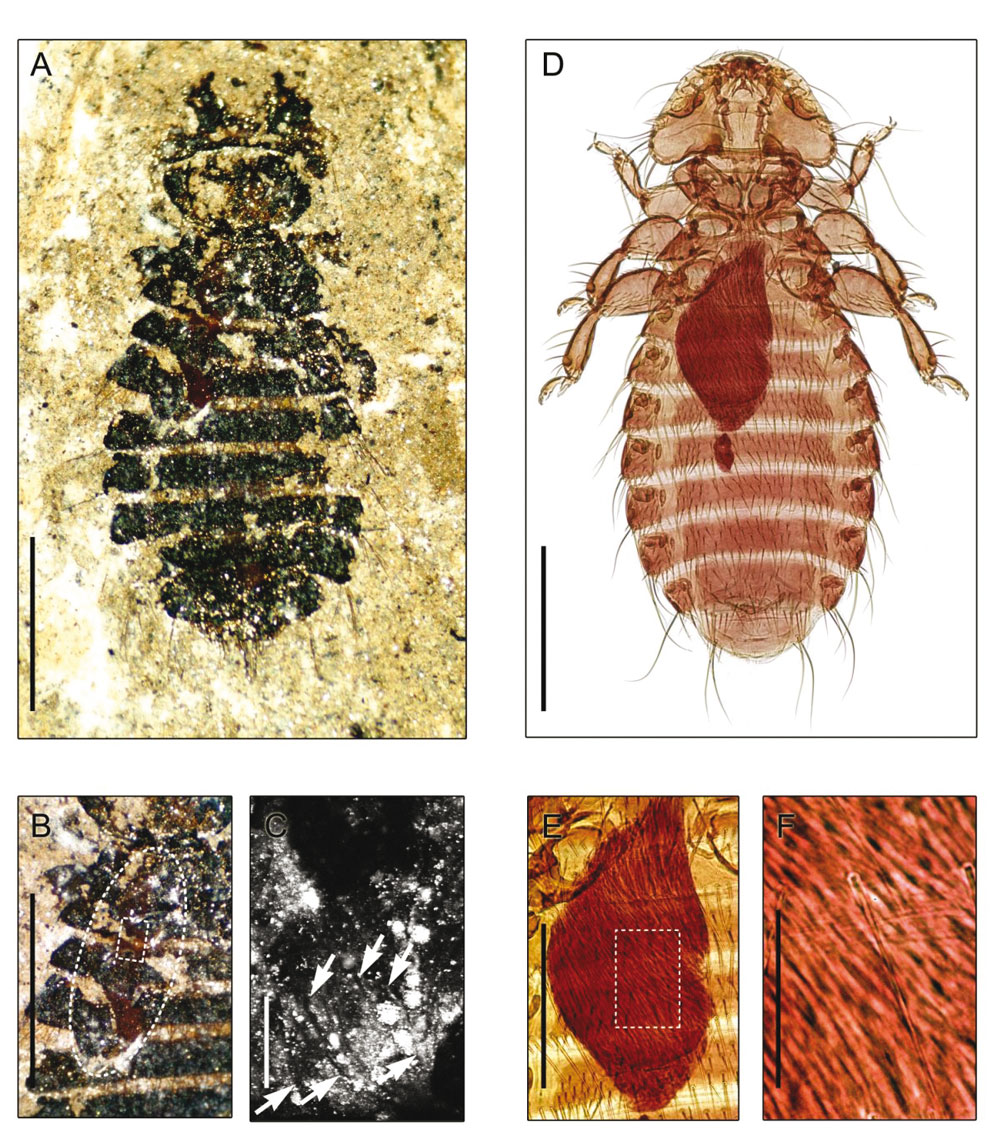
So, it’s a bird louse fossil. But it’s extraordinary that its last meal should be so well preserved. As one of the researchers remarked, ‘It’s very rare that you have evidence of the last meal of an ancient [i.e. dated at 44 million years old] insect.’3
But this fossil louse is ‘almost identical’ to lice today—has there been no evolution in all that time?
And how do the researchers explain the excellent preservation of this fossil, along with 30,000 other fossils with ‘perfect preservation’ recovered from the same site? ‘Rapid sedimentation over a 250,000 year period’, they say, combined with alkaline conditions and no oxygen.
Huh? How can sediment be deposited rapidly over a quarter of a million years?!
But there’s more to their story yet. Based on this fossil and the earlier discovery in Brazil of fossil eggs (probably of mites) on a fossilized feather ‘dated’ to 120 million years,4 the researchers say the original host for parasitic lice may not have been a bird or mammal.
‘If the age of lice predates that for birds, because the group as a whole are parasitic, the original host must have been a dinosaur.’3 What sort of dinosaur? ‘[A]n early-feathered dinosaur’!1
That’s quite a story. But it relies on the dino-to-bird evolution story being true, which evolutionists themselves don’t agree on,5 and which has always struggled to get off the ground.6–8 In short, it’s a lousy story.
Let’s go back to the facts of this case—a louse and its stomach contents beautifully preserved in sedimentary rock, virtually identical to lice on aquatic birds today. Does this make sense in the light of the biblical account of history? Sure does:
- God made creatures to reproduce ‘after their kind’ (Genesis 1) about 6,000 years ago. So, it’s no wonder that fossil and living lice are essentially the same.
- Massive numbers of organisms buried rapidly under layers of water-borne sediment (sufficient to shut out scavengers and oxygen) requires rushing water, consistent with the Flood (Genesis 7:11), around 4,500 years ago.9
- Originally, in the ‘very good’ world God created (Genesis 1:31), lice may not have been parasitic ‘freeloaders’,
but might have helped their hosts by cleaning up sloughed-off layers of skin, hair,
etc.
So, things make sense in the light of the Bible—not a lousy story, but a true account of history.
References and notes
- Wappler, T., Smith, V.S. and Dalgleish, R.C., Scratching an ancient itch: an Eocene bird louse fossil. Proceedings of the Royal Society of London B (Suppl.), Biology Letters, 03bl0387.S2, 2004. Return to Text.
- Lice (order Phthiraptera) have traditionally been divided into two suborders: the chewing lice (Mallophaga) and the sucking lice (Anoplura). The Anoplura are all blood-feeding parasites of mammals; the Mallophaga parasitize birds (feathers) and some mammals (hair). Return to Text.
- Rincon, P., louse reveals last meal, BBC News, 5 March 2004. Return to Text.
- Martill, D.M. and Davis, P.G., Did dinosaurs come up to scratch? Nature 396(6711):528–529, 1998. Return to Text.
- Sarfati, J., ‘Birdosaur’ beat-up, Creation 22(2):54–55, 2000. Return to Text.
- Sarfati, J., Dino-bird evolution falls flat! Creation 20(2):41, 1998. Return to Text.
- Sarfati, J., Skeptics/Australian Museum ‘Feathered Dinosaur’ display: Knockdown argument against creation?, <creation.com/skepticmuseum>, 23 June 2004. Return to Text.
- See also Ch. 4 in: Sarfati, J., Refuting Evolution (3rd ed.), Creation Ministries International, Queensland, Australia, 2004. Return to Text.
- You don’t need millions of years to get layers of sediment or for rocks to harden. See, for example, Batten, D., Sandy stripes, Creation 19(1):39–40, 1996; and, Petrified waterwheel, Creation 16(2):25, 1994. Return to Text.
Readers’ comments
Comments are automatically closed 14 days after publication.