

Sandy stripes
Do many layers mean many years?
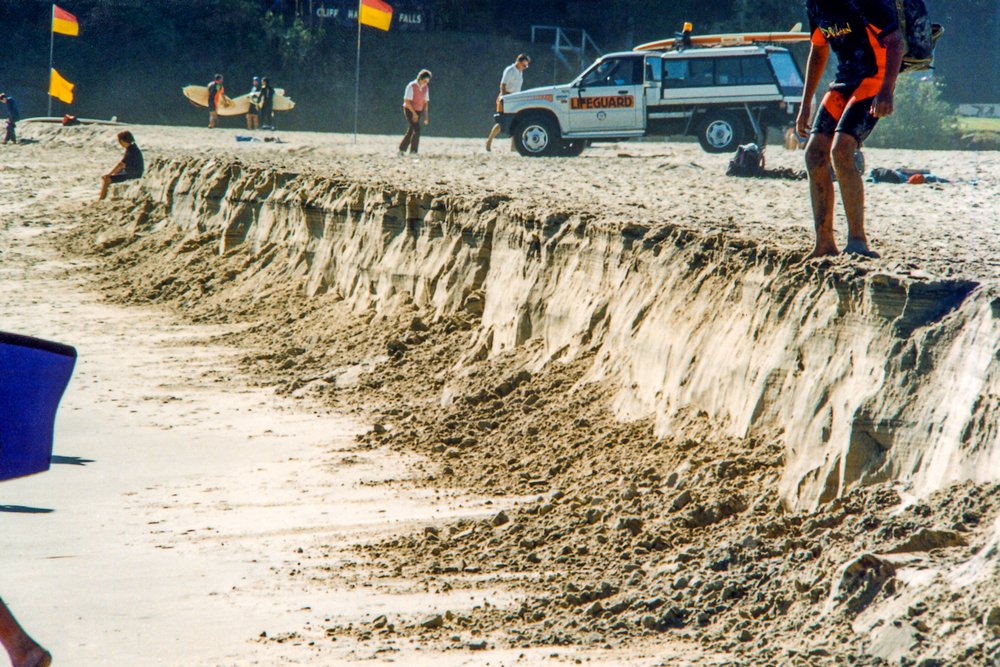
Early one morning in August 1995, I went surfing with my son at Greenmount Beach on the Gold Coast, QueensIand Australia. I took my camera just in case anything interesting would tempt me to finish off the loaded film. Walking along the beach, I noticed where the high tide and waves during the night had eroded sand from the beach (Photo 1). To my surprise I saw what looked like clear laminations, or layering, in the sand—formed by the separation of normal silica sand-grains and smaller, denser mineral sand-grains such as rutile, which are dark in colour (Photo 2). The layering was present along the whole sand mass exposed.
Layers which look similar to these are often believed to be evidence for huge periods of time. For example, they may be interpreted as being the result of periodic floods depositing material. In some rocks there are pairs of dark and light layers which are regarded as the material deposited in annual floods. In such a concept, material is washed into a lake and settles slowly to the bottom, the fine material settling after the coarse, giving one pair of bands of fine and coarse material for each flood. If it happened this way, and there are thousands of laminations, this would represent thousands of years of floods. Using this sort of reasoning, such rocks can be assigned ages of many millions of years.
However, many laminations have been found to form quite rapidly—within a few hours on June 12, 1980—in mud/ash flows following the Mount St Helens eruption in Washington state in the North-west of the United States.1 Also, the experiments of Pierre Julian, Yongqiang Lan and Guy Berthault using flow tanks showed how, with a mixture of sand particles of different sizes and densities, many laminations can form almost instantaneously in rapidly flowing water.2 The type of lamination—whether it was fine on coarse or coarse on fine—depended on the relative density and size of the particles.
Some detective work
How did the sand on the beach come to be laminated? Beach sand is not often layered like this. This sand had been put there recently in a beach restoration project of the Gold Coast City Council. The beaches along this part of the coast lose sand, apparently because of breakwaters built to protect the Tweed River mouth for shipping purposes. These breakwaters stop the natural drift of sand northward to the Gold Coast beaches, which occurs because of prevailing ocean currents. When the supply of sand from the south is impeded, sand lost is not replaced so the beaches lose sand—which is not good for the beaches or the tourism industry.

The beach restoration project involved the dredging of sand from the sand bar in the Tweed River and carrying it by ship several kilometres north to the southern Gold Coast beaches, where it was pumped ashore as a water/sand slurry through a large pipe to the beach. As the sand was restored to one section of beach, the pipe was extended by sections to supply sand to the next section of beach (see the diagram below, which shows the ship, the pipe to the beach and slurry discharge on the beach).
According to Dr Tom Conner of Kinhill, Cameron and McNamara, the engineering company which managed the project, the ship carried 8,000 cubic metres of sand at a time. It took only an hour to pump the sand to the beach in a slurry of approximately 30 per cent sand and 70 per cent water. This amounts to over 400,000 litres of water and sand (equivalent to about 10 private swimming pools of water) per minute. This created what Dr Conner described as quite a fast flowing little ‘river’ back towards the sea, with the sand being deposited as the water flowed. In other words, the sand was deposited in quite a fast-flowing, turbulent environment. The amount of sand pumped in one hour is enough to cover a football field to well over a metre deep. The sections in the photographs would have been formed in less than an hour, since the area covered at one time was much less than a football field in size.
Guy Berthault and his co-workers, in their controlled experiments with flow tanks, were able to obtain layering like this using particles with different sizes—here, they were different densities, as well as different sizes. It appears that there are different ways to get many alternating bands of layering rapidly, without millions of years.
Many evolutionist geologists would themselves acknowledge this, if pressed. In any case, the idea that thousands of perfectly formed laminations can form slowly and gradually has other problems. For example, how does a lamination on a lake bottom from a flood remain undisturbed for many months until the next flood comes to deposit the next lamination? One would expect that biological activity and even mild currents would disturb the neat laminations, which, in the Green River Formation in the United States, for example, average only about 0.1 millimetre thick. Each such thin lamination is supposed to have remained undisturbed for about a year before the next influx of sediment was deposited on top. Also, there are many fish beautifully preserved as fossils in the Green River rocks—how could this happen with a mere 0.1 millimetre per year of sediment being deposited? There is now ample evidence that fine layering and laminations can form rapidly in flowing water—in the sorts of conditions that one could expect during various phases of the biblical Flood.3
How it’s done

References and footnotes
- I got excited at Mount St. Helens!, Creation 15(3):14–19, June 1993. Return to text.
- Julien, P., Lan, Y., and Berhault, G., Experiments on stratification of heterogenous sand mixtures, Journal of Creation 8(1):37–50, 1994. Return to text.
- Strictly speaking, true laminations require desiccation (drying) planes between layers, which are not present here—yet. Also, some of the patterns in this beach example merge, as they do in some sandstones (sand which, under right conditions, has dried and hardened). The Berthault example (Ref. 2) is thus more potent for the formation of true laminations than that shown here. Return to text.
Readers’ comments
Comments are automatically closed 14 days after publication.