

Are look-alikes related?

My childhood best friend looked so much like me that our teachers, and even our friends, had a lot of trouble telling us apart. ‘Are you twins?’, we were often asked. However, there was no family connection as far back as anyone could trace. The similarity in our appearance was not due to being closely related—or, putting it another way—due to us having a recent common ancestor, like a common father, grandmother, or even great grandparent. It was just a ‘fluke’.
The main (only?) argument for evolution is that similarities between living things are due to relatedness, or common ancestry. If two kinds of animals share a lot of common features, then they are ‘obviously’ closely related and so must have had a recent common ancestor—or so the evolutionary reasoning goes.1,2 Birds, for example, all lay eggs, have feathers and a specialized lung comprised of interconnected air sacs, so the evolutionist would say all birds had a common ancestor which had these features. Creationists would say that birds have these similarities because they were created with a common basic plan. People would assume that because my friend and I were so similar we must have shared a very recent common ancestor—like the same parents. They were wrong. In like manner, the evolutionists are often—not always—wrong in assuming similarity is due to common ancestry.

Of course my friend and I are members of the same human kind and so we know that we had a common ancestor—who was a descendant of Japheth, in this case. However, the analogy is accurate—that the degree of similarity in appearance does not necessarily indicate the degree of genetic relatedness. As we shall see, evolutionists are forced to recognise this at times, but they (illogically) do not admit that such recognition undermines the main argument for evolution (if similarities occur that clearly are not due to common ancestry, how does the evolutionist know that any similarities are due to evolution?).
If living things had a common creator/designer, we would expect there to be many similarities—just like the early Porsche and VW ‘beetle’ have many similarities because they shared the same designer. If there were not these similarities in living things we might be inclined to believe in many creators, not just one. The Bible tells us that God’s very nature is revealed to us in what He has created (Romans 1:18–23). I believe that God created things in such a way that the patterns we see defy a natural explanation—such as evolution—but support a supernatural explanation. In other words, the patterns of similarity cannot be consistently explained by any naturalistic (everything–made–itself) theory.
Many creatures show similar features because their Creator used similar structures for similar purposes.


The more similar creatures are, according to the evolutionary argument, the more closely they should be related—that is, the more recent it is since they had the same ancestor. Take, as an example, the usual textbook illustration of the similarities between the limbs of animals with backbones (vertebrates) and people. Human beings have a five–finger/toe hand/foot pattern, and limbs with two bones attached to the hand/foot joined to a single other major limb bone. We share this pattern with bats and frogs and therefore, the evolutionist argues, we must share common ancestors with these animals. That explains the similarities, we are told.
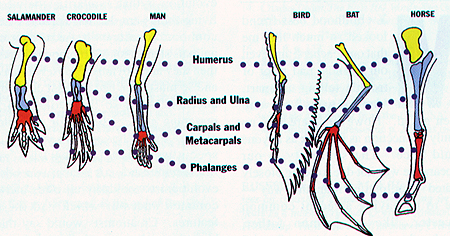
However, if we look at the horse limb (right), we see that it is quite different to the human form. Frogs and people have remarkably similar limb structures, but horses, which are supposedly very much more closely related to humans, have a limb with little resemblance to the human limb. Just on the basis of limb structures, it might be reasonable to suppose that frogs and people are more closely related than people and horses.
However, horses, as mammals, share many similarities to humans which frogs, as amphibians, don’t share—horses, like us, are warm–blooded, give birth to live young, suckle their young, have hair, etc. The evolutionist claims that horses and humans must be more closely related than frogs and humans.
But what about the remarkable differences in the limbs of horses and humans? The evolutionist ‘explains’ the profound differences in the horse and human limbs as due to ‘adaptation’ in the horse. So, when the evolutionist confronts anomalies like the horse limb, a story is invented to ‘explain’ it. In this case the story is ‘adaptation’. The limb was supposedly ‘modified’ by natural selection to do a different job. However, this is a just–so story to explain away evidence which does not fit the common ancestry idea.
Quolls and cats
Marsupials are mammals which give birth to very immature babies which are suckled in a protective pouch. These include the kangaroos, koalas, wombats and possums of Australasia and the opossums of the Americas. Placental mammals nurture their young in the womb, which develops an elaborate nourishing structure called a placenta. The babies are born in quite a developed state compared to marsupials.
Marsupial |
Placental |
| Tasmanian ‘Tiger’ or Thylacine | Wolf |
| Feathertail Glider | Flying squirrel |
| Dunnart or Marsupial mouse | Mouse, Shrew |
| Cuscus | Monkey |
| Marsupial mole | Golden mole of Africa |
| Quoll | Cat |
| Bilby | Hare |
| Rat kangaroo | Rat |
| Wombat | Marmot |
| Numbat | Anteater |
| Table 1. Some marsupial and placental animals showing remarkable similarities. | |
Nearly all the mammals in Australia are marsupials. Why is this so? The evolutionist claims to have an answer: the marsupials evolved in Australia from a common ancestor which just happened to be here.3 Placental mammals—such as dogs, cats, horses, squirrels, mice, etc., evolved on other continents. That’s the story.
However, there are many incredible similarities between marsupial and placental animals which defy this naturalistic story. Take the marsupial mouse, or dunnart, and placental mouse, for example. Some types are so similar it is difficult to tell them apart without close inspection to look for the pouch.
The marsupial mole from the Northern Territory of Australia is incredibly similar to the golden mole of Africa. When the cuscus was first discovered in Papua New Guinea it was mistaken for a type of monkey. It has a flat monkey-like face, opposable digits on front and hind limbs, and a prehensile (grasping) tail.
The number of similar marsupial and placental animals is astounding, if they just arose by the evolutionary processes of chance mutations and natural selection.
The list could be extended by including extinct types such as the marsupial diprotodon, a hippopotamus-like creature. So there are many similarities which are not due to common ancestry, or evolution. How does the evolutionist account for these similarities? Here another story comes into play: many of the marsupials and placentals ended up looking like one another because they happened to be in similar ecological niches and so evolved similarly to fill those similar niches. This is another ‘just–so’ story. Such similarities are said to be due to ‘convergence’ or ‘parallel evolution’. ‘Convergence’ is really just a grab bag to put similarities which cannot be explained through common ancestry (evolution). This is supposed to account for similarities which do not fit the evolutionary scheme of descent based on other similarities.
It stretches the bounds of credulity to believe that so many marsupials just happened, without any plan and purpose, to look so similar to their placental counterparts. It’s like trying to believe that two artists painted a series of almost identical paintings without reference to one another, or that the similarities between a VW and Porsche were not due to their having a common designer.
Also, if being in a similar ecological niche automatically generates similarities, why is the kangaroo not more like cattle, horses or deer—the kangaroo’s ecological counterparts on other continents? The kangaroo throws a spanner into the logic of the ‘convergence’ story used to explain similarities which do not fit the evolutionary story.4
God has indeed created things in such a way as to confound naturalistic (everything made itself) explanations for the origin of organisms. Various ad hoc, or just–so, stories have been invented in an attempt to explain the many things which do not fit the evolutionary scheme, but they are just that—stories. May God receive the glory that is His due for the marvelous things He has created!
Re-posted on homepage: 23 January 2013
References and notes
- In the case of my friend and me, we were related—having descended from Noah’s family, but the degree of similarity did not reflect the degree of relatedness. We looked like twins but we were not even cousins. That is the problem with the evolutionists’ argument: degree of similarity does not necessarily imply degree of relatedness. Return to text.
- Specialists in the classification of organisms (taxonomists) call the similarities between organisms which are thought to be due to relatedness ‘homologies’. This concept is quite valid for creationists to apply in defining what were the original created kinds—where there is genuine relatedness amongst the descendants. For example, the many different species of Eucalyptus trees could possibly represent one created kind. Likewise there are various types of cattle which are almost certainly the one biblical kind. See Re-creating the extinct aurochs? Creation 14(2):25–28, 1992, and Ligers and Wholphins: what next?. Return to text.
- Marsupial fossils have been found on all continents. Return to text.
- There are extreme examples of obviously non-homologous similarities being discovered at the molecular level. An example is the complex hemoglobin molecule found in the blood of vertebrates being also in some crustaceans (such as Daphnia, the water flea), and even in the roots of some plants (Nature 331:178, 1988). See Walter ReMine’s The Biotic Message for an in–depth treatment of the evolutionists’ selective use of similarities to argue for evolutionary relationships. Return to text.


Readers’ comments
Comments are automatically closed 14 days after publication.