
Re-creating the extinct aurochs?
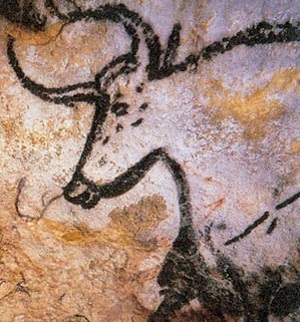
In the 1940s, Professor Heinz Heck, and his brother Lutz, of the Munich and Berlin zoos, claimed to have re-created an aurochs by cross-breeding various European cattle with each other. (Grzimeks Tierleben, DeutscherTaschenbuch Verlag, October 1979, pp. 375–381.) The aurochs was the original wild bull of Europe, the ancestor of European domestic cattle. It was a massively powerful creature standing almost two metres (six feet) at its shoulder. Julius Caesar, in describing its size and strength, compared it with an elephant.
As the cattle family tree shows, such a reconstruction should theoretically be possible, since modern breeds have not ‘evolved’ from their wilder ancestor, but ‘devolved’ through selection (see chart next two pages), so each carries less information than the aurochs. In theory, therefore, allowing them to freely recombine this information could result in all of it being lumped together again in one population. In practice, however, there are problems. There is a vast number of different chromosomal combinations possible, some of the information may have been in lines that died out and degenerative mutations may have played a role, so that it is not likely that the Heck brothers had a ‘carbon copy’ of the aurochs. Nevertheless, some of the aurochs features were indeed ‘recreated’. New Scientist reports that breeders in South Africa are close to ‘resurrecting’ the extinct quagga from plains zebra stock. (‘Born-again quagga defies extinction’, New Scientist, November 30, 1991, p. 8.)
Contemplating such ‘re-creations’ helps us understand better the way in which many breeds have been ‘split off’ from one ancestral group, which in turn was one of many such groups which themselves ‘split off’ from the original created kind.
Shown overleaf is a possible, reasonable reconstruction. As selective breeding and/or natural selection in different niches ‘chooses’ a portion of the original information contained in the ancestor population, the information not selected for is ‘rejected’ in that line. Daughter populations thus have less information and therefore less potential for further variation. That such devolutionary diversification can take place in only a few generations is shown by man’s selecting efforts. Particularly in the early centuries after Noah’s Flood, with rapid migration/ dispersal and many empty niches, selection pressure would have been unusually high in any case. Most texts would (misleadingly) label such downhill (information-losing) change as the ‘evolution’ of cattle. They assume that the ancestor of cattle evolved from noncattle—for which there is no fossil evidence. [For further reading at general level, see Cattle of the World by John Friend (Blandford, UK, 1978);note that no information was available on, for example, mtDNA (mitochondrial DNA) comparisons which could more accurately define some of the relationships. Also, not all known varieties could be represented and all such charts are, of necessity, simplifications. Domesticated lines in particular would have seen much crossflow of genetic information.]
Footnotes
* All bison have 14 pairs of ribs, not the 13 typical of cattle. However, since they (and all the Bos group) freely interbreed with each other (offspring may not always be fertile), they are unlikely to be a separate created kind. Rib numbers may reflect the variability in the original baramin, or kind (the yak also has 14 pairs) or else a mutation in regulatory genes (duplicating or deleting existing information, not creating any) may have become fixed in certain lines.
** True buffalo do not voluntarily interbreed with the other members of the cattle family. This raises the possibility that they descended from a separate created kind, in which the similarities are due to common design, not common gene pool. However, this is not necessarily true, since as Harvard’s Richard Lewontin admits (The Genetic Basis for Evolutionary Change, 1974, p. 186), substantial species divergence can occur without requiring the postulate of ‘novel genes’ by mutation.
Readers’ comments
Comments are automatically closed 14 days after publication.