

Journal of Creation 21(3):19–23, December 2007
Browse our latest digital issue Subscribe
Astronomical troubles for the astronomical hypothesis of ice ages
The astronomical theory of ice ages based on the Milankovitch mechanism has become the ruling paradigm of Pleistocene paleoclimatology. It is even used to date sedimentation during the pre-Pleistocene period. However, there is little, if any, physical basis behind it. It does not provide a mechanism for the sudden onset of the ice-age cycle at 2.7 Ma, nor why the 41-kyr tilt cycle predominated between 2.7 and 0.9 Ma, why it shifted to the 100-kyr cycle at 0.9 Ma, how the very weak 100-kyr eccentricity cycle could even affect solar radiation, and why such weak changes in solar radiation could produce such dramatic climate changes as ice ages. The Milankovitch hypothesis was supposedly ‘proved’ by statistical matches with deep-sea cores obtained in the 1950s through to the 1970s. However, cores require very accurate dating, which was beyond the state of the art back then. The fact that the Milankovitch hypothesis is so strongly believed attested more to the reinforcement syndrome.
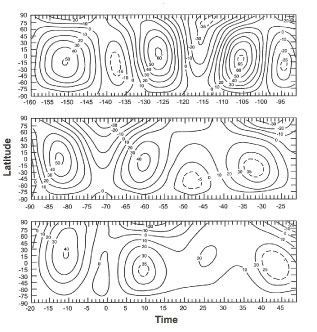
The astronomical theory of the ice ages, also called the Milankovitch theory, has swept the climate community during the past 40 years. It is the new paleoclimate paradigm for multiple ice ages repeating at regular intervals during the past 2.7 Ma of uniformitarian time. The theory is actually an old theory from the 1800s that was rejected by meteorologists long ago because of obvious problems, such as its small effect on solar radiation. However, it was revived by geologists in the 1950s through the 1970s and supposedly proved by the statistical matches between the three Milankovitch cycles and oscillations of certain variables measured in deep-sea cores.1–3
The Milankovitch cycles
There are three cycles, termed the Milankovitch cycles, that result in slight changes in the earth’s orbital geometry around the sun.4 The first is the earth’s eccentricity, in which the elliptical orbit of the earth cycles every 100 kyr between an eccentricity of near zero to almost 0.06. The eccentricity also has a longer-period 413-kyr cycle that some scientists believe to be important. It is controversial as to whether this cycle shows up in climate variables. The second is the tilt of the earth, which oscillates between 22.1° and 24.5° with a period of 41 kyr. The third Milankovitch cycle is the precession of the equinoxes, in which the equinoxes rotate around the orbital ellipse of the earth with a period of around 22 kyr. The net effect of all three cycles results in a slightly different distribution of solar radiation between the seasons and latitudes with time (figure 1). However, the net solar radiation remains the same over the earth.
Supposedly, the solar radiation trend around 65°N latitude is the significant force affecting the ice age cycles. As a result of the acceptance of this astronomical theory of the ice ages, the number of ice ages went from four (a belief that lasted 60 years and was ‘verified’ from all over the earth) to anywhere between thirty5 and as many as 49.6
The astronomical theory is considered so well established that it has become the ruling paradigm in climate research. All climate data and Quaternary dating mechanisms are fit to the theory, including deep-sea cores, ice cores, pollen cores and lake sediment cores. Scientists have become so certain of the theory that they have ‘tuned’ or modified climatic data sets to the Milankovitch cycles. Needless to say, this is circular reasoning and is one reason why these data sets match Milankovitch oscillations so well.
Milankovitch cycles believed to determine ancient sedimentation cycles
The Milankovitch mechanism has become such a dominant paradigm that geologists have extrapolated the theory to account for pre-Pleistocene cyclic sedimentation.7 Such cyclical sedimentation includes limestone-marl, limestone-black shale and sandstone-shale vertical rhythmites. Geologists have used Milankovitch oscillations to date sediments throughout the Phanerozoic part of the geological column—clear back to the Cambrian. The geologists first date certain portions of the strata and then use statistical matches with the three Milankovitch cycles to verify their finer chronology between dates.
The Milankovitch mechanism is supposed to work through repeating ice ages, or glacial/interglacial oscillations. However, they recognize there were only two ancient ‘ice ages’ during the Phanerozoic, one during the Ordovician and the other during the late Paleozoic.8 There is thus a theoretical problem accounting for pre-Pleistoccene Milankovitch cycles, especially the 100-kyr cycle:
‘However, this hypothesis [free oscillations internal to the climate system] does not adequately explain why 100-kyr climate fluctuations exist in a number of pre-Pleistocene climate records when large ice sheets were not available to provide the 100-kyr sensitivity, or when ice sheets were oscillating at other frequencies.’9
So, mainstream geologists have come up with other mechanisms to relate Milankovitch cycles to sedimentation during non-glacial times, such as changes in sea level, episodic crustal movements, episodic migration of the geoidal surface and climatic control.10,11
Numerous problems with Milankovitch mechanism
However, there are numerous problems with the astronomical hypothesis.12–17 These problems continue to plague the hypothesis and have been emphasized in recent articles.
How does the ice age cycle begin?
The most obvious problem is why should the ice age cycle begin about 2.7 Ma when the Milankovitch cycles supposedly have existed for many hundreds of millions of years? Is there an argument here that could be raised regarding changing planetary alignments or solar ‘evolution’ that might account for this? It is widely assumed that the gradual cooling during the Cenozoic first triggered an ice sheet on Antarctica, then Greenland, and finally over areas where they no longer exist today. It is believed the latter ice sheets have been regularly oscillating between glacial and interglacial phases ever since. One would expect that at the beginning of the ice age cycle at 2.7 Ma each glacial period would have started with limited ice and that each glacial phase would have grown with time. Apparently, this is not the case, as one ice age at about 2 Ma, near the beginning of the glacial/interglacial cycle, was just as large as the last ice age.18
So, the start of the ice age cycles remains an enigma. Kerr states: ‘How the glaciation in the north got started in the first place 2.75 million years ago is another enigma.’19 Some researchers suggest that sub-Milankovitch cycles (less than or equal to 15 kyr) initiated the Milankovitch cycles.20 Two recent hypotheses that attempt to explain the 41-kyr periodicity before 900 kyr ago (see below), nevertheless fail to explain the origin of the ice ages: ‘Still, neither hypothesis can account for the beginning of Northern Hemisphere glaciations around 3 million years ago.’21 We are supposedly still within the glacial-interglacial cycles, being within an interglacial at the moment, but are extremely far from developing a glacial phase.22
Milankovitch cycles should be out of phase between hemispheres
A second major problem is that the ice age cycles are in phase between the Northern and Southern Hemispheres; the glacial/interglacial oscillations occur at the same time between the hemispheres. It is the solar radiation at the high northern latitudes that determine the oscillations—even in the Southern Hemisphere! The reason this is a problem is because the amount of sunshine is generally out of phase been the hemispheres, mainly because the precession cycle is out of phase (figure 1). When solar radiation is below normal in the high northern latitudes it is above normal in the high southern latitudes. The reason for this situation is unknown:
‘And we don’t understand why ice ages occur in both hemispheres simultaneously when the changes in solar irradiance from orbital variations have opposite effects in the north and south.’23
The 41,000-year paradox
The third problem is the cause of the 41-kyr cycle between 2.7 and 0.9 Ma. This cycle is stronger than the eccentricity cycle, but it is not a significant cycle either. It is the precession cycle that is the strongest Milankovitch cycle, but no ice ages fluctuate at the 22-kyr periodicity:
‘Given that the canonical Milankovitch model predicts that global ice volume is forced by high northern summer insolation, which at nearly all latitudes is dominated by the 23-kyr precession period … why then do we not observe a strong precession signal in the LP/EP [late Pliocene/early Pleistocene] ice volume record? The lack of such a signal and the dominance of obliquity [the 41-kyr cycle] have defied understanding.’24
This is called the 41,000-year paradox.25 The origin of this cycle with no 22-kyr variability remains unresolved:
‘But a major problem exists for the standard orbital hypothesis of glaciation: Late Pliocene and early Pleistocene glacial cycles occur at intervals of 40 ky …, matching the obliquity period, but have negligible 20-ky variability … The origins of strong obliquity over precession-period glacial variability during the early Pleistocene remain unresolved.’26
It has even been discovered that changes in tropical sea surface temperatures up to 4.5°C follow the tilt cycle between 1.2 and 1.8 Ma when the tilt cycle has very little tropical effect (it mainly affects high latitudes) while the precession cycle is strongest in the tropics.27
Why does the Ice Age cycles change from a 41-kyr to a 100-kyr cycle?
A fourth major problem with the hypothesis is that the glacial/interglacial cycle changed from the 41-kyr tilt cycle to the 100-kyr eccentricity some 900 kyr ago.14 Why should the cycle change periods? Why the change to the 100-kyr cycle when this cycle has extremely little, if any, effect on solar radiation (as will be discussed below)? Rutherford and D’Hondt state: ‘The timing of this transition and its causes pose one of the most perplexing problems in palaeoclimate research.’28
Why didn’t the glacial/interglacial cycle change to a 70-kyr or 150-kyr or some other cycle, rather than another Milankovitch cycle? I suggest it is the reinforcement syndrome of the Milankovitch hypothesis described below that causes researchers to believe Milankovitch cycles are the only ones available. So, according to this thinking if one Milankovitch cycle ends, then another cycle must take over.
The 100-kyr cycle extremely weak
The fifth major problem already alluded to above is that ice ages have cycled according to the 100-kyr eccentricity cycle for the past 900 kyr. However, this cycle produces extremely little change in solar radiation:15
‘Furthermore, during the past 1 million years, glacial-interglacial oscillations have largely been dominated by a 100,000-year periodicity, yet there is no notable associated 100,000-year [solar] insolation forcing. There is currently no consensus on what drives these late Pleistocene 100,000-year cycles.’21
This cycle is indistinguishable from random variations.29
Paleoclimatic researcher William Ruddiman suggests four possibilities to account for this cycle: (1) other external forcing, (2) natural resonance or free oscillations in the climate system, (3) non-linear responses within the climate system that transform the tilt and precession cycles into a 100-kyr periodicity, and (4) non-linear amplification from other climatic variables.30 For the first suggestion, it has been proposed that ice ages would cycle every 100 kyr as the earth passed through regions of varying interplanetary dust.31 This idea has been considered disproved.30,32 The idea of natural resonance, the second suggestion, is unlikely also, especially because this ‘resonance’ would have to be suppressed for the ice ages between 2.7 and 0.9 Ma and then suddenly switched on at 0.9 Ma. The third suggestion, nonlinear forcing by the tilt or precession cycles, has been studied for many years, but nothing significant has been found. There is a huge body of literature on the fourth suggestion of non-linear amplification of the eccentricity cycle, but nothing definite seems to have resulted from this effort.33 It has been suggested that changes in CO2 and snow-albedo feedback somehow amplify the 100-kyr signal. However, the climate effect of CO2 is overblown34 and the snow-albedo feedback operates only after a cooling trend begins by some other mechanism.
Milankovitch cycles too weak to cause ice ages
Lastly, regardless of which cycle a researcher focuses on, the Milankovitch mechanism is much too weak to cause such dramatic climate changes as ice ages:
‘Milankovitch cycles are the only known major climate forcing functions identified in ocean and ice cores. Yet despite the small resulting radiation changes, large climate changes occur. Thus, there are strong nonlinear and positive feedbacks in the system [emphasis mine].’35
Notice that the Milankovitch mechanism is so widely believed that researchers must believe there is some type of amplifying mechanisms to boost an admittedly weak signal. Schrag reminds us that scientists really are clueless how such small changes in solar radiation result in such big effects:
‘We still don’t know how subtle changes in the pattern of solar irradiance are amplified to produce such spectacular changes in climate—cooling the deep ocean almost to the freezing point and extending ice sheets thousand of kilometres towards the Equator [emphasis mine].’36
So, researchers still do not know the physical causes for their deductions of multiple ice ages based on deep-sea cores:
‘Although the glacial-interglacial cycles of the past 3 million years (My) represent some of the largest and most studied climate variations of the past, the physical mechanisms driving these cycles are not well understood.’24
What about the statistical match?
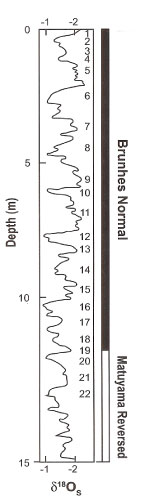
It seems like mainstream scientists cannot explain much about the Cenozoic ice age period: how it started, why the phase was the same in both hemispheres, why there is a 41-kyr cycle, why this cycle changed to the 100-kyr cycle, how the very weak 100-kyr cycle can work and the small effect on the solar radiation. I will add at this point that the argument even for multiple ice ages is weak as evidenced from terrestrial sediments.37 The idea of multiple ice ages has generally been assumed from oscillations in certain deep-sea variables, such as oxygen isotope fluctuations (figure 2).
The only thing going for the Milankovitch mechanism is the statistical match with deep-sea cores. Why are there such good statistical correlations between Milankovitch cycles and other climatic variables?
The Milankovitch cycles can be calculated backwards with good accuracy for millions of years using celestial mechanics (assuming of course that the present planetary arrangement has been in place and undisurbed for all that time).38 However, in order to obtain a match with these oscillations, accurate dates for other climate variables are required. For instance, the statistical correlation between Milankovitch cycles and climate was first made on variables from deep-sea cores believed related to climate: ‘Deep-sea sediment cores have long provided the standard for past climatic developments.’39 So, these cores must be accurately dated by radiometric, biostratigraphic, and paleomagnetic methods to a precision of a few tens of thousands of years.13,14
Knowing all the many problems with such dating methods, how can such precision be believed? Creationists have found numerous reasons to reject these methods.40 I believe that the good statistical fit is attributable to ‘the reinforcement syndrome’,41 a type of circular reasoning in which initial result from prominent scientists are reinforced by further research. Dates from deep-sea cores and other data sets are then subtly manipulated to agree with the Milankovitch hypothesis.13,14
Back in the 1950s and 1960s these dating methods were not that accurate. I think that prominent researchers back then believed that the Milankovitch hypothesis was true and so were attempting to prove it by dating oscillations. Wallace Broecker stated over 40 years ago that statistical correlations would prove the Milankovitch hypothesis:
‘The chronology of insolation maxima that is calculated from the known periodicities of the tilt and precession of the earth’s axis and from the earth’s orbital eccentricity can be compared with curves based on absolute dating of events in climate-controlled systems. Agreement of the two curves over several cycles would provide strong evidence for a cause-and-effect relationship.’42
Broecker went on to claim that the Milankovitch mechanisms were verified by ‘accurate dating’ of deep-sea cores. However, he found the tilt and precession cycle predominant in the cores over the past few hundred thousand years: ‘Changes in climate occur in response to periodic variations in the earth’s tilt and precession.’42 Although the tilt and precession cycles still show an influence, the uniformitarian ice ages are now seen as oscillating according to the eccentricity cycle.
Summary
Although Milankovitch cycles are believed to be the cause of dozens of ice ages during the late Pliocene and Pleistocene of the geological column, there remain many unresolved problems. The physical mechanism for uniformitarian ice ages, and the details of those ice ages, is quite weak. The Milankovitch mechanism is believed because of statistical matches between solar radiation at 65°N and supposed climatic variables measured in deep-sea cores, mainly oxygen isotope variations. But it is also difficult to believe how Milankovitch cycles can be detected within pre-Pleistocene sedimentary rhythmites. High precision dates from radiometric, biostratigraphic and paleomagnetic methods are necessary to relate deep-sea cores and sedimentary rhythmites to orbital variables. The accuracy required of the dating methods was beyond the state of the art during the 1950s to the 1970s for such supposed accuracy as Milankovitch cycles. The whole paradigm continues today as a reinforcement syndrome.
References
- Emiliani, C., Pleistocene temperatures, Journal of Geology 63:538–578, 1955. Return to text.
- Hays, J.D., Imbrie, J. and Shackleton, N.J., Variations in the earth’s orbit: pacemaker of the ice ages, Science 194:1121–1132, 1976. Return to text.
- Imbrie, J. and Imbrie, K.P., Ice Ages Solving the Mystery, Enslow Publishers, Short Hills, NJ, 1979. Return to text.
- Oard, M.J., The Frozen Record: Examining the Ice Core History of the Greenland and Antarctica Ice Sheets, ICR Technical Monograph, Institute for Creation Research, Santee, CA, pp. 111–115, 2005. Return to text.
- Kennett, J., Marine Geology, Prentice-Hall, Englewood Cliffs, NJ, p. 747, 1982. Return to text.
- Wilson, R.C.L., Drury, S.A. and Chapman, J.L., The Great Ice Age: Climate Change and Life, Routledge, London, p. 26, 2000. Return to text.
- Oard, M.J., Are pre-Pleistocene rhythmites caused by the Milankovitch mechanisms? Journal of Creation 11(2):126–128, 1997. Return to text.
- Oard, M.J., Ancient Ice Ages or Gigantic Submarine Landslides? Creation Research Society Monograph No. 6, Creation Research Society, Chino Valley, AZ, 1997. Return to text.
- Rutherford, S. and D’Hondt, S., Early onset and tropical forcing of 100,000-year Pleistocene glacial cycles, Nature 408:72–75, 2000; p. 73. Return to text.
- Crowley, T.J., Kim, K.t-Y., Mengel, J.G. and Short, D.A., Modeling 100,000-year climate fluctuations in pre-Pleistocene time series, Science 255:705–707, 1992. Return to text.
- Goodwin, P.W. and Anderson, E.J., Punctuated aggradational cycles: a general hypothesis of episodic stratigraphic accumulation, Journal of Geology 93:515–533, 1985. Return to text.
- Oard, M.J., Ice ages: the mystery solved? part I: the inadequacy of a uniformitarian ice age, Creation Research Society Quarterly 21(2):66–76, 1984. Return to text.
- Oard, M.J., Ice ages: the mystery solved? part II: the manipulation of deep-sea cores, Creation Research Society Quarterly 21(3):125–137, 1984. Return to text.
- Oard, M.J., Ice ages: the mystery solved? part III: paleomagnetic stratigraphy and data manipulation, Creation Research Society Quarterly 21(4):170–181, 1985. Return to text.
- Oard, M. J., An Ice Age Caused by the Genesis Flood, Institute for Creation Research, Santee, CA, pp. 1–22, 1990. Return to text.
- Oard, ref. 4, pp. 116–122. Return to text.
- Oard, M. J., Frozen in Time: The Woolly Mammoth, the Ice Age and the Bible, Master Books, Green Forest, AR, pp. 65–68, 2004. Return to text.
- Ruddiman, W.F., Orbital changes and climate, Quaternary Science Reviews 25, 3098–3104, 2006; p. 3104. Return to text.
- Kerr, R.A., Why the ice ages don’t keep time, Science 285:504–505, 1999; p. 505. Return to text.
- Willis, K.J., Kleczkowski, A, Briggs, K.M. and Gilligan, C.A., The role of sub-Milankovitch climatic forcing in the initiation of the Northern Hemisphere glaciation, Science 285:568–571, 1999. Return to text.
- Paillard, D., What drives the ice age cycle? Science 313:455–456, 2006; p. 456. Return to text.
- Oard, ref. 17, pp. 33–52. Return to text.
- Schrag, D.P., Of ice and elephants, Nature 404: 23–24, 2000; p. 23. Return to text.
- Raymo, M.E., Lisiecki, L.E. and Nisancioglu, K.H., Plio-Pleistocene ice volume, Antarctic climate, and the global δ18O record, Science 313:492, 2006. Return to text.
- Paillard, ref. 21, p. 455. Return to text.
- Huybers, P., Early Pleistocene glacial cycles and the integrated summer insolation forcing, Science 313:508–511, 2006; p. 508. Return to text.
- Oard, M.J., The astronomical theory of the Ice Age becomes more complicated, Journal of Creation 19(2):16–18, 2005. Return to text.
- Rutherford and D’Hondt, ref. 9, p. 72. Return to text.
- Wunch, C., Quantitative estimates of the Milankovitch-forced contribution to observed Quaternary climate change, Quaternary Science Reviews 23:1001–1012, 2004; p. 1001. Return to text.
- Ruddiman, ref. 18, p. 3098. Return to text.
- Muller, R.A. and MacDonald, G.J., Glacial cycles and orbital inclination, Nature 377:107–108, 1995. Return to text.
- Oard, M.J., The 100,000-year Milankovitch cycle of ice ages challenged, Journal of Creation 12(1):9–10, 1998. Return to text.
- Ruddiman, ref. 18, pp. 3098–3104. Return to text.
- Oard, M.J., Global warming: examine the issue carefully, Answers 1(2):24–26, 2006. Return to text.
- Hecht, AD et al., Group report long-term ice core records and global environmental changes: in; Oeschger, H. and Langway Jr, C.C. (Eds.), The Environmental Record in Glaciers and Ice Sheets, John Wiley & Sons, New York, p. 384, 1989. Return to text.
- Schrag, ref. 23, p. 23. Return to text.
- Oard, ref. 15, pp. 135–166. Return to text.
- Vernekar, AD, Long-period global variations of incoming solar radiation, Meteorological Monograph 12(34), American Meteorological Society, Boston, MA, 1972. Return to text.
- Grootes, P.M. and Stuiver, M., Oxygen 18/16 variability in Greenland snow and ice with 103- 105-year time resolution, Journal of Geophysical Research 102(C12):26, 460, 1997. Return to text.
- Oard, ref. 4, pp. 121–122. Return to text.
- Oard, ref. 8, pp. 11–17. Return to text.
- Broecker, W.S., Absolute dating and the astronomical theory of glaciation, Science 151:299–304, 1966; p. 299. Return to text.
- Oard, ref. 12, p. 69. Return to text.
- Vernekar, ref. 38, p. 19. Return to text.
- Oard, ref. 13, p. 126. Return to text.
- Shackleton, N.J. and Opdyke, N.D., Oxygen isotope and palaeomagnetic stratigraphy of equatorial Pacific core V28-238: oxygen isotope temperature and ice volume on a 105 year and 106 year scale, Quaternary Research 3:39–55, 1973. Return to text.


Readers’ comments
Comments are automatically closed 14 days after publication.