

Journal of Creation 22(1):17–19, April 2008
Browse our latest digital issue Subscribe
How did 90% of large Australian Ice Age animals go extinct?
Most large mammals and birds went extinct at the end of the Ice Age, but Australia was the hardest hit of all the continents, with 90% going extinct. Uniformitarians try to explain this via two different hypotheses: either they went extinct because of climate change—the overchill hypothesis, or humans hunted them to extinction—the overkill hypothesis. However, there are numerous problems with these explanations in general and in their specific applicability to the Australian extinctions. From a biblical perspective, severe drought at the end of the Ice Age is likely the primary factor that caused the severe extinction event of the large animals in Australia.
The extinction record

Throughout much of the world, most of the large mammals and many large birds became extinct at the end of the Ice Age. Some animals disappeared from whole continents, but never became extinct. In North America 70% of mammals weighing over 40 kg disappeared.1,2 About 75% disappeared from Eurasia.3 But Australia was the hardest hit, losing about 90% of its large Ice Age animals, including all marsupials exceeding 100 kg, 22 out of 38 species between 10 and 100 kg, three large reptiles, and three large flightless birds.4,5 Strangely, Africa is the only continent where mass extinction did not occur at the end of the Ice Age.6
The mystery of the end-Ice Age mass extinctions
In evolutionary thinking, these extinctions occurred at a time when the ice was melting and the climate was supposedly becoming warmer. This melting resulted in more land becoming available for the animals. Furthermore, few extinctions took place during other glacial or interglacial periods, though there supposedly were several dozen glacial/interglacial cycles during the Quaternary of the uniformitarian ice age paradigm. Why did this mass extinction occur only at the end of the last Ice Age?
To make the mystery more profound, the extinctions in Australia supposedly occurred 45,000 years ago, well before the end of the last Ice Age, while extinctions on other continents occurred at the end of the last Ice Age, purportedly around 10 to 15,000 years ago.
Overchill or overkill?
There are two main categories of uniformitarian extinction hypotheses: either they died of a climate change—the overchill hypothesis; or they died at the hands of man—the overkill hypothesis. A third possibility of disease is believed by very few scientists. The cause of the mass extinction has been debated for over 150 years and not always on scientific grounds:
‘Debate about the possible cause of the extinction has continued for over 150 yr … , stimulated by new fossil finds, dating techniques, and modes of analysis. The debate is not strictly scientific, however, because it impacts on the broader understanding of the evolutionary theater of early human cultures, the fact of contemporary global biodiversity, and the rights of indigenous hunters … ’7
Other authors have suggested that the overkill hypothesis is being reinforced by the environmental movement: ‘For these discussions, and others like them, overkill provides powerful political capital.’8
Furthermore, scientists are entrenched in their positions, and both sides have lately claimed that they are right. The debate is often acrimonious:
‘Few topics in Quaternary science match the late Pleistocene megafauna extinction debate for the intensity of polemic it has generated, with most authorities championing either a human or a climatic cause.’9
Regardless of polemics, both the overchill and the overkill hypotheses have serious, seemingly insurmountable problems trying to fit within the uniformitarian paradigm.10 Some scientists advocate both hypotheses, but the problem is really within the uniformitarian paradigm of slow processes over millions of years, along with dozens of regularly repeating ice ages according to the astronomical theory of the ice ages.
Problems specific to Australia
The demise of the animals in Australia comes with several unique problems of its own. One is that the extinctions occurred some 20,000 years or more before the end of the Ice Age.11 This date supposedly eliminates climate change, since most Quaternary scientists believe massive drought did not occur until the end of the Ice Age at about 20,000 years ago.
Yet, some scientists still argue that Australia had been drying up for the past 500,000 years, and that increasing drought caused by climate change killed off the megafauna.12,13 The overkill advocates, of course, dispute this claim by saying the animals had survived countless oscillations between wet periods and droughts with hardly any extinctions before 45,000 years ago, and that the climate was not that dry about 45,000 years ago.7,14-16
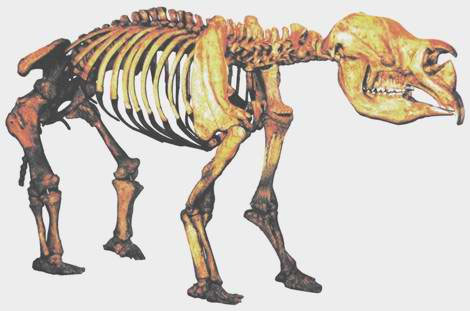
Overkill advocates point to New Zealand and other islands where hunting destroyed many species of animals, including large flightless birds.17 However, overchill advocates make a good case that islands cannot be extrapolated to continents because many other variables must be included for continents, such as a greater space for the animals to hide.12,18
Overkill enthusiasts, of course, point to humans entering Australia around 55,000 years ago. They say that this date is too much of a coincidence with the megafauna disappearing 10,000 years later. This seems to be their most significant argument.12,16 Such a belief does eliminate the more radical overkill hypothesis of ‘blitzkrieg’ in which, according to the hypothesis, the animals died off within a hundred years or so of humans first entering the land.
Some overchill advocates further claim that the megafauna had mostly died out well before the magical date of 45,000 years ago.12 They also claim that some of the fauna survived beyond 45,000 years ago.13,19 Overchill advocates also claim that there are very few or no kill sites, and that archaeological sites during the period 45 to 55,000 years ago show no evidence of the type of technology required to have killed big game.13,20 They doubt that ‘primitive’ humans could have possibly killed the immense hippo-sized marsupial, Diprotodon, as well as the other large beasts of the Ice Age. There seems to be plenty of archaeological sites that do contain megafaunal remains,21 but the number of the remains within those sites is sparse.22
Problems with Australian uniformitarian scenarios
Accurate dating is required to correlate human settlement with megafaunal extinction and it is freely admitted that this is a big problem.23-25 Furthermore, to arrive at an extinction date of about 45,000 years ago, some researchers have dismissed fauna with younger dates.20,26,27 So, there is an element of circular reasoning regarding the dates of settlement in Australia and the time of extinction, similar to the situation in North America with the ‘magical’ date of 11,000 years ago.
There is even a paucity of data upon which to determine the accuracy of either hypothesis:28
‘This is partly because few well-stratified faunal successions have been discovered, but more so because of the rarity of field-based studies and the historical difficulties involved with dating deposits beyond the limit of radiocarbon dating (ca. 45 ka).’9
It is obvious the assumptions of the researchers have often driven their conclusions.25
A creationist’s interpretation
How would I as a creationist interpret the data? First, I would throw out all the dates, which are admittedly problematic and likely subject to bias. The significant dates are beyond the range of radiocarbon dating and hence are not reliable. Besides, with different creationist assumptions, the calculated radiocarbon dates become much younger.29
I would go with the general trend that many large and diverse animals thrived for a while in Australia after the Flood during the early and middle stages of the Ice Age. This was a time when the climate was cooler and wetter and a small ice cap formed on the mountains of southeast Australia. Most of Tasmania was glaciated.
Humans enter the picture about midway through the Ice Age, having been held up building the Tower of Babel in the Middle East and then later spreading away from there. It would take some time to reach Australia. In other words, the animals came first, followed by humans. Then conditions changed, in tandem with other areas of the world, at the end of the Ice Age.
Second, the Ice Age was much different from what uniformitarians believe.30,31 Instead of the Ice Age being a time of cold, the winters were actually mild. This is because the ocean temperatures at mid and high altitude were warm and much more latent heat was released to the atmosphere due to more precipitation. Summers were cool, especially over large continental areas, due to large amounts of volcanic ash and aerosols in the stratosphere.
Winters then become cold at the end of the Ice Age, much colder than today, especially at mid and high latitudes due to drier air, more sea ice, cooler oceans and more reflection of sunlight from ice sheets. The animals were not adapted to cold winters and did not have time to adapt. Such very cold winters can account for many of the extinctions on other continents, but likely not Australia. Due to cold winters, less oceanic evaporation, more sea ice and stronger upper winds, dust storms would be severe on some continents. Severe dust storms likely account for the extinctions in Siberia.32
One variable most applicable to Australia was extreme drought. This probably played a minor role on other continents but was likely the number one cause of extinctions in Australia. The severe drought dried up pluvial lakes and caused the large animals that required more food and water to die out. Humans played a little part in the extinctions. Climate change was the real culprit.
The post-Flood rapid Ice Age can account for both the thriving of the megafauna at the beginning, and their extinction at the end.
References
- Stone, R., Mammoth: The Resurrection of an Ice Age Giant, Perseus Publishing, Cambridge, MA, pp. 94–143, 2001. Return to text.
- Agenbroad, L.D. and Nelson, L., Mammoths: Ice Age Giants, Lerner Publications Company, Minneapolis, MN, pp. 87–99, 2002. Return to text.
- Stone, ref. 1, p. 102. Return to text.
- Agenbroad and Nelson, ref. 2, p. 88. Return to text.
- Miller, G.H., Magee, J.W., Johnson, B.J., Fogel, M.L., Spooner, N.A., McCulloch, M.T. and Ayliffe, L.K., Pleistocene extinction of Genyornis newtoni: human impact on Australian megafauna, Science 283:205–208, 1999. Return to text.
- Barnosky, AD, Koch, P.L., Feranec, R.S., Wing, S.L. and Shabel, A.B., Assessing the causes of Late Pleistocene extinctions on the continents, Science 306:70–75, 2004. Return to text.
- Brook, B.W. and Bowman, D.M.J.S., Explaining the Pleistocene megafaunal extinctions: models, chronologies, and assumptions, Proceedings of the National Academy of Sciences 99(23):14624–14627, 2002; p. 14624. Return to text.
- Grayson, D.K. and Meltzer, D.J., A requiem for North American overkill, Journal of Archaeological Science 30:585–593, 2003; p. 590. Return to text.
- Prideaux, G.J., Roberts, R.G., Megirian, D., Westaway, K.E., Hellstrom. J.C. and Olley, J.M., Mammalian responses to Pleistocene climate change in southeast Australia, Geology 35:33–36, 2007; p. 33. Return to text.
- Oard, M.J., Frozen in Time: The Woolly Mammoth, the Ice Age and the Bible, Master Books, AR, pp. 47–52, 2004. Return to text.
- Roberts, R.G., Flannery, T.F., Ayliffe, L.K., Yoshida, H., Olley, J.M., Prideaux, G.J., Laslett, G.M., Baynes, A., Smith, M.A., Jones, R. and Smith, B.L., New ages for the last Australian megafauna: continent-wide extinction about 46,000 years ago, Science 292:1888–1892, 2001. Return to text.
- Wroe, S. and Field, J., A review of the evidence for a human role in the extinction of Australian megafauna and an alternative interpretation, Quaternary Science Reviews 25:2692–2703, 2006. Return to text.
- Trueman, C.N.G., Field, J.H., Dortch, J., Charles, B. and Wroe, S., Prolonged coexistence of humans and megafauna in Pleistocene Australia, Proceedings of the National Academy of Sciences 102(23):8381–8385, 2005. Return to text.
- Prideaux et al., ref. 9, pp. 33–36. Return to text.
- Prideaux, G.J., Long, J.A., Ayliffe, L.K., Hellstrom, J.C., Pillans, B., Boles, W.E., Hutchinson, M.N., Roberts, R.G., Cupper, M.L., Arnold, L.J., Devine, P.D. and Warburton, N.M., An arid-adapted middle Pleistocene vertebrate fauna from south-central Australia, Nature 445:422–425, 2007. Return to text.
- Miller, G.H., Fogel, M.L., Magee, J.W., Gagan, M.K., Clarke, S.J. and Johnson, B.J., Ecosystem collapse in Pleistocene Australia and a human role in megafuanal extinction, Science 309:287–290, 2005. Return to text.
- Miller et al., ref. 5, p. 207. Return to text.
- Grayson and Meltzer, ref. 8, pp. 585–593. Return to text.
- Johnson, C.N., What can the data on late survival of Australia megafauna tell us about the cause of their extinction? Quaternary Science Reviews 24:2167–2172, 2005. Return to text.
- Wroe and Field, ref. 12, p. 2697. Return to text.
- Wroe and Field, ref. 12, p. 2698. Return to text.
- Johnson, ref. 19, p. 2171. Return to text.
- Brook and Bowman, ref. 7, pp. 14624–14627. Return to text.
- Miller et al., ref. 5, p. 205. Return to text.
- Diamond, J.M., Australia’s last giants, Nature 411:755–757, 2001; p. 755. Return to text.
- Brook and Bowman, ref. 7, p. 14627. Return to text.
- Diamond, ref. 25, pp. 755–756. Return to text.
- Wroe and Field, ref. 12, p. 14624. Return to text.
- Baumgardner, J.R., 14C evidence for a recent global Flood and a young earth; in: Vardiman, L., Snelling, A.A. and Chaffin E.F. (Eds.), Radioisotopes and the Age of the Earth: Vol. II, ICR, El Cajon, CA, CRS, Chino Valley, AZ, pp. 587–630, 2005. Return to text.
- Oard, M.J., An Ice Age Caused by the Genesis Flood, Institute for Creation Research, Santee, CA, 1990. Return to text.
- Oard, ref. 10, pp. 1–217. Return to text.
- Oard, ref. 10, pp. 169–173. Return to text.

Readers’ comments
Comments are automatically closed 14 days after publication.