

Beginning at the writings of Moses
Evangelization of the Tugutil

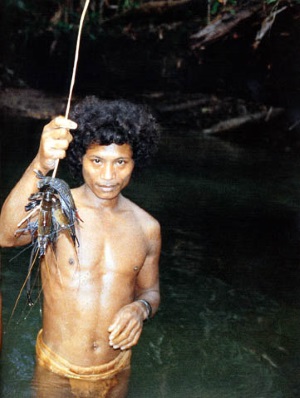
Pounding drums penetrate the stillness of the jungle. Crudely built shelters stand beside the Lili River on the island of Halmahera, just one of many such tropical islands that make up the nation of Indonesia (see map). Roaming the thick jungles here are the Tugutil, a war-like tribe of hunters and gatherers.
Fear and despair
The Tugutil live in simply built shelters—four poles, a thatched roof, and sometimes a slightly raised palm bark floor. These ‘homes’ have no walls—they would allow the enemy to sneak up easily at night and wipe out the entire family. In fact, the husband’s main responsibility is to protect the family from this happening.
There appeared to be only a very simple political structure among this semi-nomadic tribal group. They usually live in little groups of three or four families and move from the coast inland into the jungle and back again. On the coast at the mouth of the Lili River for possibly as long as two months the people reside in what is like a small village, but when their ‘houses’ become so infested with lice, bed bugs and cockroaches that they can no longer stand it, they simply move inland back into the jungle.
While there are some tribal elders, the most influential men in the tribe are the witchdoctors. They had imposed rigid taboos, such as forbidding contact with Christianity or Christians. Transgression of such a taboo, even if unintentional, was believed to bring dire consequences.
For example, one day Ula Ula, a loved and respected man, went hunting, and failed to return. Two days later his body was found in the jungle. No cause of death was readily apparent. Evidently, Ula Ula’s son had two months earlier attended a timber (lumber) company worker’s birthday party some distance away, when a small thanksgiving service was also held. Unintentionally he had transgressed this anti-Christian taboo. This had resulted in the death of a close family member, the witchdoctors insisted. Ula Ula’s death only served to reinforce this satanic belief in their fearful hearts.
And how do they respond to death? A bereaved Tugutil man will take his machete and go into a trance-like frenzy, chopping indiscriminately in the house of the deceased until other mourning men restrain him. This is done to prevent injury to himself or others, and after being restrained the man will sob loudly for up to half an hour. The women wail continuously day and night, the utter hopelessness, frustration and despair that death brings being made all too obvious. Yet many outside people claimed these tribal people were happy the way they were in their jungle home and that we should leave them alone. But the sad fact is that they lived in fear of the spirits of people they formerly loved. In the case of Ula Ula, they now believed that his spirit would return to take vengeance on anyone who had offended him, and would bring sickness and death on his loved ones so that they would be with him.
Into this gloomy and threatening tribal situation came missionaries from the New Tribes Mission—the Miles (USA) and Sharpe (Australia) families in late 1982 and the McCall (New Zealand) and Lahu (Indonesia) families in March 1983. The objective was to bring the good news of Jesus Christ, our Creator-Redeemer, to these needy people in pagan darkness. But how should they broach this message with these war-like, semi-nomadic people?
At first they did not realize how dangerous it was for them as Christians to be among these people, who could turn violent, particularly because of their fear and taboo regarding Christians and the Christian church. Indeed, the Tugutil had a reputation for murder and revenge.
The missionaries began building modest homes for themselves near the Tugutil’s shelters beside the Lili River. Their presence soon attracted visits from the people, all of whom were welcome. Almost everyone dropped in on their way to hunt pig and deer, and to gather jungle foods.
To reach these people close relationships had to be built. This necessitated befriending the children, who for the first few months often screamed in terror at the sight of these long-nosed white people. Then came the task of winning adults’ confidence and friendship. The missionaries were the best entertainment these people had ever had, as they constantly tried to use the people’s language, often being met with gales of laughter which suggested that there was some room for improvement. Many hours were spent just sitting and talking with the people. Missionary John Sharpe recalls how his family’s house became the local hairdresser’s—a much better way to get a trim than by a friend using a knife or machete!
Language learning and medicines
The first five years were primarily spent trying to become fluent in the extremely complex Tugutil language. Having their front rooms almost constantly filled with people, many sleeping overnight, gave the missionaries abundant opportunities to practise. A lot of language and culture was learned by just being with people in their homes or at work, and eating together (even if sometimes the food didn’t look all that appetizing).
During this time efforts were also made by the missionaries to improve the people’s health. Soap was traded for bananas and sweet potatoes. A small clinic was setup at Lili. More than 400 people were treated in a day during a serious measles epidemic. Sometimes the people were too sick to come, so the missionaries had to go into the jungle to them.
Meanwhile, linguist Keith Miles worked to put a script to the sounds and words used by these tribal people. Only by mastering the language could the missionary team tell the people God’s story. The missionaries found the language very difficult, and Keith was quite surprised by its complexities. Five years were spent studying the Tugutil culture and language, making up formal language lessons, and preparing Bible lessons.
Working among tribal peoples across the world, the New Tribes Mission had learnt that to tell animistic tribal peoples the message about Jesus Christ their Saviour first required beginning with Moses. Jesus had done this with the two disciples on the road to Emmaus. Those being reached need first to know who God is (the Creator), what sin is, and therefore why they need a Saviour. Then they are ready to accept Jesus Christ as their Saviour. So Bible lessons were taught in their chronological order. This strategy became known as the chronological teaching method.
Confidence established
From the outset the Tugutil missionary team had said nothing about God and His story, although the people had early realized that these strange but kind foreigners were Christians. This would have been an immediate barrier because of their taboo against the church and Christians. The people believed that if they had anything to do with Christianity they would die, so they wouldn’t even marry a person who had been inside a church, nor could they go inside a church themselves. If the missionaries had Christian music on in their houses the people wouldn’t come inside, and after visits to some of the people’s homes, an animistic ritual cleansing of the houses had to be performed.
Because of this, plus the powerful hold over the people by their witchdoctors, one wrong move in this time of preparation could easily have brought trouble for the missionary team. However, God was at work in overcoming these barriers.
A miracle
To the Tugutil, murder was a way of life. One day two young men were fighting over a girl. One got in a big huff and went to walk away, so the other loaded up his arrow-rifle and shot him in the back. The arrow went straight through and lodged protruding about 25 cm (10 in) out of his abdomen slightly above his navel. Four days later news of the shooting arrived in Lili, along with a plea for help. So two of the missionary men went into the jungle with medical supplies and brought the badly injured victim back to Lili.
On the radio they talked to a doctor. The wound was nasty and the arrow, which still had pig’s blood on it, had damaged the young man’s intestines. It wasn’t long before peritonitis set in. The doctor was sure this man would die.
Nothing could be done without an operation, which was impossible in this jungle setting. Yet it was less than two weeks to the commencement of teaching the people God’s story, the objective they had been working towards for over five years. So the missionaries prayed for a miracle. God saved this man’s life—he was running around healthy again in a short time. News spread, so many came to see him and the miracle that had occurred.
This miracle, and others, gave the missionaries opportunities to say to the people, ‘Look what God has done for these people. He has kept them alive so they can hear His story too. That’s how important it is that you hear God’s story.’
Meanwhile, the missionaries worked feverishly to finalize the first lessons, making sure they had the right Tugutil words to faithfully convey the opening chapters of Genesis. As the big day approached a ‘teaching house’ was built—some poles in the ground supporting a large roof. Almost daily, new houses went up around Lili and new faces from far away were seen. The people seemed to be getting excited about the coming story.
God’s story at last!
The big day arrived! That morning, more than 250 people gathered in the ‘teaching house’. Some were still wary because of the taboo. They wanted to be reassured that this wasn’t going to be a church meeting with praying and singing. They were told there would be none of that, and if they preferred to listen to the story under the trees or down on the beach then that would be acceptable. But since they had built this shelter it made sense to use it.
So over the next six months the missionaries taught the people three mornings a week from Genesis 1:1 through to the ascension of Christ. To ensure understanding, each lesson commenced with a summary of the main points. These were then systematically expounded before being summarized again. Drama, pictures and cassette tapes were used to ensure that the message was clearly understood. After each session the people were broken into small groups to check their comprehension of the lesson just taught. There was always opportunity for revision and repetition at the next lesson if they hadn’t understood.
The people’s hunger to hear God’s story was enormous. After each session, they would return to their gardens and hunting, but at night would crowd into the missionaries’ homes to listen to the recorded lessons over and over. Some people were getting to hear each lesson up to 10 times. Meanwhile, the missionaries would frantically work at keeping ahead with the preparation of subsequent lessons.
Convicted hearts
Beginning at Genesis chapter 1, the people were taught that this God is none other than the Creator Himself, the One who made the earth, the sky, the trees and all people. Then from Genesis chapter 3 they heard about Satan, the Fall and the entrance of sin, death, struggle and bloodshed.
The following week an incredible thing happened. The missionaries had said no more than what the Scriptures taught, yet the people took their spirit rocks, fetishes and other things they had trusted for protection, crushed them and threw the powder into the river. They had also believed that locks of hair from their ancestors had tremendous power, so usually before they buried a person they would cut off some hair and keep it. Now they threw those away too.
The people said, ‘We realize that the one who deceived Adam and Eve is the one who has given us these things so that we wouldn’t trust in the real God!’ The missionaries had made a point of never saying that anything the people did was wrong, including their worship of demons. Instead it was left to the Holy Spirit to convict them in His time.
God’s Spirit was working mightily, using His Word presented in a way which was meaningful and understandable to these people. Their hunger increased as the lessons continued. On one occasion it had rained so heavily that the river was a raging torrent, so the missionaries thought the people living on the other side of the river wouldn’t be able to cross for the morning’s lesson. However, they did, risking their lives rather than missing out on the next lesson. It was suggested that in future, if there was flooding, the lesson would be postponed so no one would risk their lives trying to get there. However, they unanimously insisted that the lessons continue no matter what. What a thrill to see this deep hunger for God’s Word!
Changed lives
Amazingly, as the lessons through the Old Testament progressed, incredible changes occurred in the people’s lives. God’s Spirit was convicting these people of their sin and it was simply astounding. They didn’t even know about Jesus, yet they were being taught, just as Adam and Eve had been told, that there was a promised One Who would come. So like the children of Israel they were looking forward to knowing who this Messiah would be. They thought it might be Joseph, and then later Moses. They were taught the Ten Commandments and recognized that before God they were sinners. But the Coming One would deal with the sin problem we all have.
There was a temptation among the missionaries to jump ahead of the sequence, but they continued to work step by step through the Scriptures, unfolding God’s story. As they came to the New Testament and began to tell them about Jesus, the people already knew about the prophecies that would be fulfilled by this Coming One. As the story of Jesus unfolded they noted the prophecies being fulfilled.
A church is born
Some setbacks occurred, including violent opposition from a prominent witchdoctor who used threats to draw away a large number of the people who had attended the lessons. However, when presentation of the Gospel message had been completed and understood, approximately 100 people put their faith in Christ and His finished work on the Cross. A new church came into being in this tribal group, which will in a future day be represented in that great throng in Heaven before God’s Throne.
What a different place Lili now is. Instead of despair, there is hope; instead of fear, joy; instead of hatred, love … as God by His Spirit continues to do a mighty work among these people, conforming them to the image of His dear Son. Even now, the Tugutil believers continue to proclaim the Gospel to others who have not heard. God is also raising up leaders from their midst to shepherd His Church.
Postscript
The Lord has so mightily used this chronological approach to the teaching of His Word to animistic tribes that the lessons have been formalized in print. They have also been adapted for use in the ‘pagan’ West—after all, most children in Australian public schools, for example, have never read a Bible. The New Tribes Mission book First Foundations: Creation to Christ, is now available.


Readers’ comments
Comments are automatically closed 14 days after publication.