

Catching a kinkajou

Researcher Roland Kays had a problem. His task: to find out more about the elusive kinkajou (Potos flavus), or ‘honey bear’.1,2 People knew that it slept all day in tree holes in the tropical rainforests of Central and South America, and that it was usually found alone—but who could say what actually goes on up in the canopy at night? So, Dr Kays wanted to fit kinkajous with radio collars for tracking—but to do that, he had to catch them first!
Dr Kays rigged up a system for hoisting traps up into trees, but … how to lure kinkajous into the traps?
Kinkajous are classified as carnivores because of their skull structure and teeth, so Kays thought he’d try using meat (chicken) as bait. But the kinkajous weren’t interested. What to do now?
Dr Kays had heard reports of pet kinkajous raiding their owners’ liquor stocks, so thought he’d try to lure kinkajous with some schnapps. But that ploy was just as fruitless—still no kinkajous.
Then Dr Kays considered what fruit might entice the kinkajous, so he tried using bananas, which don’t grow in that forest. And it turned out that, finally, here was something the kinkajous couldn’t resist. Success at last!
But wait a minute. Isn’t the kinkajou classified as a carnivore on the basis of its skull structure and teeth—so what’s it doing going after bananas?
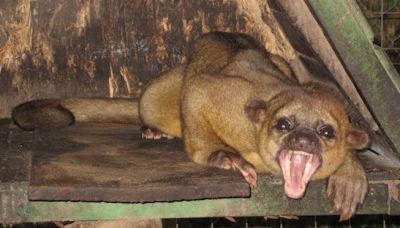
In fact, many animals classified as carnivores have a diet derived largely, or even exclusively, from plants (fruit, nuts, leaves, stems and roots), e.g. the panda (and other bear species), various species of bats, and the red panda.3,4,5 And thanks to Dr Kays and his research team, we now know that the kinkajous they studied in the wild are exclusively vegetarian, feeding on fruit, leaves, flowers and nectar.6
This simply goes to show that just because an animal has teeth usually associated with meat-eating, it doesn’t mean that it has to eat meat.7
And surely this helps us to understand how it could have once been—that all animals (whether they had sharp teeth or not) were originally exclusively vegetarian (Genesis 1:30), just like the kinkajous in the forest today.8
References and notes
- Unless otherwise indicated, information derived from: Menino, H., Kinkajous, National Geographic 204(4):42–57, 2003. Return to text.
- Though named ‘honey bear’ (because of the colour of its coat), the kinkajou is actually classified as being in the raccoon family. Honolulu Zoo—Kinkajou, honoluluzoo.org, 7 October 2003. Return to text.
- Catchpoole, D., The bamboozling panda, Creation 23(2):28–32, 2001. Return to text.
- Match the bat’s teeth, Creation 21(1):29–30, 1998. Return to text.
- Did you know? Red Panda, Creation 8(3):15, 1986. Return to text.
- Kays, R.W., Food preference of kinkajous (Potos flavus): a frugivorous [fruit-eating] carnivore, Journal of Mammalogy 80:589–599, 1999. Return to text.
- Catchpoole, D., The lion that wouldn’t eat meat, Creation 22(2):22–23, 2000. Return to text.
- For a detailed and thought-provoking discussion of the origins of apparent design features for carnivory, see chapter 6 in Batten, D. (Ed.), The Creation Answers Book, Creation Ministries International, Brisbane, Australia. Return to text.


Readers’ comments
Comments are automatically closed 14 days after publication.