

Bats: sophistication in miniature

When it comes to hunting and catching prey, few creatures use a system as complex and highly specialized as that of the insect-eating bats.
These small bats (of the sub-order Microchiroptera) rely on echolocation, or ‘bat sonar’ as it is commonly called, for hunting in the dark.
The bat sends out a high-pitched sound, then listens for the echoes reflected from nearby surfaces and objects. By detecting its own reflected sounds, often among other distracting noises, the small mammal is able to avoid obstacles, and obtain the information necessary for tracking and catching an insect. This amazing system can accurately discriminate between an individual insect and any others close by.1
To achieve this, the bat has a number of very special features. These include a specialized larynx (an organ in the throat) which allows it to produce intense, high-frequency sounds (ultrasound). High frequencies (i.e., short wavelengths) are essential so the bat can determine the fine details of the objects which reflect the sounds.1
From the echoes of these ultrasonic sound pulses, the bat determines not only the distance and direction of its prey, but also its speed, size, shape and surface texture, all while in full flight.2
The bat’s large external ears act as efficient collectors and resonators of the high-pitched sounds.1 Its internal ear mechanisms are highly sensitive. The process also requires a sophisticated integration of the vocal and auditory centres of the brain.3 Not only must the nervous system of the bat analyze, in a few thousandths of a second, the reflected sound of its own pulse, it must separate this echo from those sent out by other bats, and from others of its own pulses4 This is an astonishing technological feat.

Bats have always been bats
The ‘earliest’ bat fossils (i.e. those buried lowest in the geologic record) come from the Eocene layers. According to evolutionary reasoning, these are roughly 50 million years old. Yet they are 100% bats (there is no trace of any partway development of the wing, for instance). They show evidence of having had fully functioning echolocation.
The species usually given in textbooks as the ‘earliest bat’ is Icaronycteris index from North American Eocene. However, more recently, specimens from the (likewise Eocene) Messel oil shale pit in Germany have shown many more interesting features. Shown here from the Messel shales is Palaeochiropteryx tupaiodon, featured in German creationist Dr Joachim Scheven’s Lebendige Vorwelt museum. Note that this ‘oldest bat’ is as specialized and ‘evolved’ as any of today’s bats.
For echolocation to work successfully, both emitting and receiving organs within the bat’s skull must co-operate. This fact makes life difficult for evolutionists attempting to explain how the bat developed its sonar, or, more importantly, how the species survived as a hunter while this supposed evolution was taking place.
Things are even tougher for the evolutionist with the knowledge that the ‘oldest known’ complete fossils of bats (actually, all this means is that they are the lowest found so far in the geologic record), of so-called Eocene age, show indications of a fully-developed echolocation system. According to the evolutionary time scale, these bats (which, by the way, look essentially the same as modern bats) lived around 50 million years ago!5
Dr Duane Gish, in his book Evolution: The Fossils Still Say NO!, explains how evolutionists believe the development of flight in mammals took millions of years, from a number of rare ‘good’ mutations produced randomly among an ocean of bad mutations.
Match the bat’s teeth

We are often led to believe that such and such a fossil animal must have eaten a certain type of diet because ‘we know from the shape of its jaws and teeth’. However, the examples here suggest that it is not possible to be dogmatic about this. It is obviously relevant to discussion of what various animals were eating before the Fall, and how this may have altered afterwards, as the ‘dracula’ article explores for vampire bats.
The Bible indicates that animals were not fighting and eating each other before the sin of Adam. We see here that teeth are, of themselves, no reason to insist that an animal may not be (or once have been) a plant eater. For a fuller discussion, see The Creation Answers Book.
This process supposedly converted the forelimbs of the land-dwelling ancestor of the bat into wings, as four fingers of each hand gradually reduced in length. The wing membrane also had to be generated by a series of ‘good’ mutations which also produced, step by step, flight muscles, and the numerous unique arrangements of tendons, nerves and blood vessels required for the specialized features of the bat.6
If this were true, Gish argues, the fossil record would produce a series of transitional forms documenting intermediate stages, revealing, for example, the gradual conversion of forelimbs to wings as the fingers became longer and longer.
However, no such evidence linking bats to ground-dwelling mammals exists. Evolutionists simply describe bats as being ‘already highly evolved when they first appeared in the fossil record.’7 As mentioned above, the ‘earliest’ bat skeletons, supposedly 50 million years ‘old,’ are virtually indistinguishable from living bats, with fully formed wings.
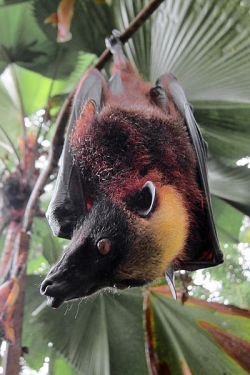
Bats belong to the mammalian order Chiroptera, which comprises two sub-orders, the Microchiroptera (as described earlier), and the Megachiroptera (megabats), comprising larger bats including flying foxes, or fruit bats. Unlike the Microchiroptera, the Megachiroptera, though they also usually fly at night, mostly locate their food by sight, except for one genus, which echolocates like the smaller insectivorous bats.
These two groups pose an interesting problem for evolutionists. They have so many features in common that it was naturally assumed that they must have inherited these features from the same (common) ancestor. However, the brains of megabats have very specialized visual pathways which are very much like those of primates, the order into which apes, monkeys and humans are classified.8 So evolutionists cannot explain both these lots of similarities by saying they came from a common ancestor. Either the megabats had a common ancestor with primates (in which case their similarities to the other bats is not due to common ancestry) or they had a common ancestor with each other. In which case, the similarities to primates didn’t come from having the same ancestor. In each case, the only alternative to common ancestry would be to invoke what is called ‘parallel’ evolution, the belief that the same features just happened to evolve twice, responding in the same way to the same environmental circumstances, by ‘luck of the draw’ genetic mistakes (mutations).
Such ‘parallel evolution,’ i.e. evolution repeating itself, causes huge difficulties for thoughtful evolutionists. Harvard University’s Stephen J. Gould writes:
‘… the pageant of evolution [is] a staggeringly improbable series of events … utterly unpredictable and quite unrepeatable … the chance becomes vanishingly small that anything like [for example] human intelligence would grace the replay [of this pageant].’9
However, the biblical account of creation can reconcile all this data. The book of Genesis recounts how each beast was created ‘after its kind.’ The various families of bats were created as separate ‘kinds.’ The similarities between the megabats and other bats are due to common design, not common ancestry. The similarities between the visual pathways of megabats and primates are also because they came from the same designer, not because they have a common ancestor.
Belief that bats were created just as Genesis recounts is not a blind faith, but one which is consistent with the evidence.
Interesting facts from the bat-file
- Contrary to mythology, bats do not get entangled in human hair, and are not blind.
- With more than one thousand species, bats make up almost a quarter of all known mammal species.
- Many bat species are in alarming decline and/or threatened with extinction.
- Many plants are dependent on bats for pollination; other plants benefit from seed dispersal by bats.10
- The smallest mammal in the world is Thailand’s bumblebee bat; it weighs less than a 1c coin.11
- The giant flying fox of Indonesia can have a wingspan of nearly 1.8 metres (six feet).
- The echolocation of fishing bats is able to detect a minnow’s fin, as fine as a human hair, extending only 2 mm above the water surface. This is because bats can distinguish ultrasound echoes very close together. Man-made sonar can distinguish echoes 12 millionths of a second apart, although with ‘a lot of work this can be cut to 6 millionths to 8 millionths of a second.’12 But bats ‘relatively easily’ distinguish ultrasound echoes only 2 to 3 millionths of a second apart according to researcher James Simmons of Brown University.12 This means they can distinguish objects ‘just 3/10ths of a millimetre apart—about the width of a pen line on paper.’12
- The free-tailed bats of Mexico can be seen hunting at two miles (more than three kilometres) in altitude. They can ride tailwinds to fly at more than 100 km/h (60 mph).
- One small brown bat can catch 600 mosquitoes in an hour. The 20 million bats in the Bracken Cave of Texas eat 250 tons of insects each night. As bat numbers diminish, the use of chemical insecticides increases.
References and notes
- The New Encyclopædia Britannica, (15th Edition) 27:162, 1992. Return to text.
- Grantham-Hill, B.W., The world of bats, Creation 9(3):7, 1987. Return to text.
- Ref. 1, 1:952. Return to text.
- Ref. 1, 23:373. Return to text.
- ucmp.berkeley.edu, accessed 29 June 1998. Return to text.
- Gish, Duane T., Evolution: The Fossils Still Say NO!, p. 185, Institute For Creation Research, California, 1995. Return to text.
- Ref. 6, pp. 186–187. Return to text.
- Novacek, M.J., Mammalian phytogeny: shaking the tree 121, Nature 356(6365):123, 1992 | doi:10.1038/356121a0. Also, Is it a bat or is it a monkey?, New Scientist 134(1816):9, 11 April 1992. Return to text.
- Gould, S.J., Wonderful Life, W.W. Norton & Co, NY and London, 1989, p. 14 preface, quoted from Origins 17(1):34, 1990. Return to text.
- The New Encyclopædia Britannica, (15th Edition) 23:374, 1992. Return to text.
- batcon.org; also many of the unreferenced facts herein are supported by this site, September 1998. Return to text.
- Simmons was cited in the appropriately titled article: Bats put technology to shame, Cincinnati Enquirer, 13 October, 1998. His research paper is, J.A. Simmons et al., Echo-delay resolution in sonar images of the big brown bat, Eptesicus fuscus, Proceedings of the National Academy of Sciences USA, 95(21):12647–12652, 13 October 1998. Return to text.


Readers’ comments
Comments are automatically closed 14 days after publication.