

Darwin’s ‘savages’
Darwin supported a missionary society for years—but why?

On 17 December 1832, Charles Darwin arrived in Tierra del Fuego1 at the southernmost tip of South America, as part of his world tour aboard H.M.S. Beagle. Here he got his first view of the native inhabitants,2 whom he described as ‘miserable degraded savages,’ a term he used many times in his journal concerning these people.
He wrote, ‘I could not have believed how wide was the difference between savage and civilized man: it is greater than between a wild and domesticated animal, inasmuch as in man there is a greater power of improvement.’3
He described one group of Fuegians as ‘the most abject and miserable creatures I anywhere beheld’ and as existing ‘in a lower state of improvement than in any part of the world.’ … ‘These poor wretches were stunted in their growth, their hideous faces bedaubed with white paint, their skins filthy and greasy, their hair entangled, their voices discordant, and their gestures violent.
Viewing such men, one can hardly make oneself believe that they are fellow creatures and inhabitants of the same world. It is a common subject of conjecture what pleasure in life some of the lower animals can enjoy; how much more reasonably the same question may be asked with respect to these barbarians. At night, five or six human beings, naked and scarcely protected from the wind and rain of this tempestuous climate, sleep on the wet ground coiled up like animals.’3
Concerning their painted faces he wrote, ‘… with their naked bodies bedaubed with black, white, and red, they looked like so many demoniacs who had been fighting,’ and ‘The party altogether closely resembled the devils which come on the stage in plays like Der Freischütz.’3
Concerning their language Darwin wrote, ‘The language of these people, according to our notions, scarcely deserves to be called articulate. Captain [James] Cook has compared it to a man clearing his throat,4 but certainly no European ever cleared his throat with so many hoarse, guttural, and clicking sounds.’3
Comparison with the views of Christopher Columbus
The people Darwin saw were in many ways similar to the native inhabitants whom Columbus had seen when he landed at San Salvador in the Bahamas, north of the South American continent on 12 October 1492. The natives of both Tierra del Fuego and the Bahamas were naked or nearly so, both decorated their bodies and faces with coloured paints, both traded trinkets with their visitors, both communicated by gestures in an attempt to bridge the language barrier, and both imitated the gestures and speech of their visitors.
However Columbus, in his Log,5 described the people he saw as being ‘friendly and well-dispositioned,’ having ‘handsome bodies and very fine faces,’ with eyes that were ‘large and very pretty,’ and he praised their ‘docility.’
He is delighted at finding a group of people in need of salvation, and wrote, ‘I think they can easily be made Christians, for they seem to have no religion.’5
Darwin, on the other hand, in obvious racist disparagement and disgust, compared his group to devils he had seen in plays and equated their habits to those of animals.
Why the difference?
Why was there such a difference in the way these two explorers described the people they saw?
It was during this voyage of the Beagle that Darwin read Charles Lyell’s newly published Principles of Geology, which subtly ridiculed belief in recent creation in favour of an old earth, and denied a global flood in favour of slow and gradual geological processes. It also presented Darwin with a time frame of vast geological ages—which seemed to make his theory of natural selection as the mechanism of evolution plausible.
All this was part of the commencement of his slippery slide into unbelief and rejection of Genesis, which blinded his eyes to the fact that all human beings (no matter how apparently ‘uncivilized’) are made in the image of God (Genesis 1:26), and all are related through Adam.6
In fact, a few years later (1871) he wrote The Descent of Man, in which he repeatedly presents the racist view that primitive peoples stand between the animals and man, and in which he says, ‘At some future period, not very distant as measured by centuries, the civilized races of man will almost certainly exterminate, and replace, the savage races throughout the world.’7
The Gospel comes to the Fuegians
In due course, missionaries came to Tierra del Fuego. The first was Allen Gardiner, who from 1841 onward made several attempts to reach the Fuegians. In 1844, he formed the Patagonian Missionary Society, which was renamed the South American Missionary Society (or SAMS) in 1864. Gardiner made two attempts to settle in Tierra del Fuego in 1845 and 1848 (both of which were frustrated by the hostility of the natives), and again in 1850, this time with six companions, only for them all to die a year later from hunger and exposure to the awful cold of a sub-Antarctic winter,8 when a relief ship was two months late in arriving.
Another missionary was Thomas Bridges, who committed the language of the people (called Yahgan) to writing and compiled a dictionary of 32,000 entries.9 Contrary to the erroneous and disparaging remarks of Charles Darwin, the oral forms of the language seem to have been unusually intricate and complicated. Bridges’ dictionary included fifty different words for family relationships.10 When Bridges had translated the four Gospels and Acts, and produced a Prayer Book, the mission was well on its way to fruitfulness and success.
In 1862 the leader of a fresh missionary party was Waite Hocking Stirling. His doctors had warned him that he probably had only three years to live, to which he replied that he would live them where they would be most used of God.
He served for the next 38 years in Tierra del Fuego, traveling throughout the region by horseback, bringing the Gospel to the Yahgan and to other Fuegian tribes.11 By 1869, over 400 Indians had believed and been baptized.
Darwin’s reaction
News of this changing lifestyle of the Fuegians reached Darwin in 1867. He was so impressed that he immediately sent off a cheque to SAMS, and then continued to contribute to this Society for the next 15 years until his death in 1882.

Vice-Admiral B.J. Sulivan [sic] wrote to the Daily News of 24 April 1885 about this, as follows: After referring to Charles Darwin as ‘my old friend and ship-mate for five years,’ he said, ‘Mr Darwin has often expressed to me his conviction that it was utterly useless to send missionaries to such a set of savages as the Fuegians, probably the very lowest of the human race. I had always replied that I did not believe any human beings existed too low to comprehend the simple message of the Gospel of Christ. After many years … he wrote to me, that the recent accounts of the Mission proved to him that he had been wrong and I right in our estimates of the native character, and the possibility of doing them good through missionaries; and he requested me to forward to the Society an enclosed cheque for £5, as a testimony of the interest he took in their good work.’12 The date of this payment was 9 February 1867.
On 30 June 1870, Darwin wrote to B.J. Sulivan concerning the success of the Tierra del Fuego Mission: ‘It is most wonderful, and shames me, as I always prophesied utter failure. It is a grand success. I shall feel proud if your Committee think fit to elect me an honorary member of your society.’12
However, this did not mean that Darwin now believed in the truth of the Gospel or that he accepted the Gospel for himself.13 His support of SAMS had more to do with his delight, as a typical member of the English gentry of Queen Victoria’s day, at the ‘civilizing’ effects of Christianity. He continued to think that ‘savages’ were more closely related to animals than Englishmen. And even though he acknowledged that the effects of the Gospel on the Fuegians meant that he had been wrong in his assessment of them, this did not result in his seeing them (and all mankind) as being created in the image of God (Genesis 1:26) or in their converted state as being ‘sons and daughters of God.’ Sadly he remained an agnostic to the end of his days.13
Paradoxically, the man who wiped the idea of God from the minds of millions14 had a kindly side to his nature. This meant that he not only supported missionary work, he was also vocal about the abolition of slavery. His racist and inaccurate assessment of tribal peoples was therefore (in contrast to the views of Christopher Columbus) not so much intrinsic to his nature, as it was the logical consequence of his evolutionary views and the associated rejection of the authority of the Word of God.
Clicks, groans and grunts
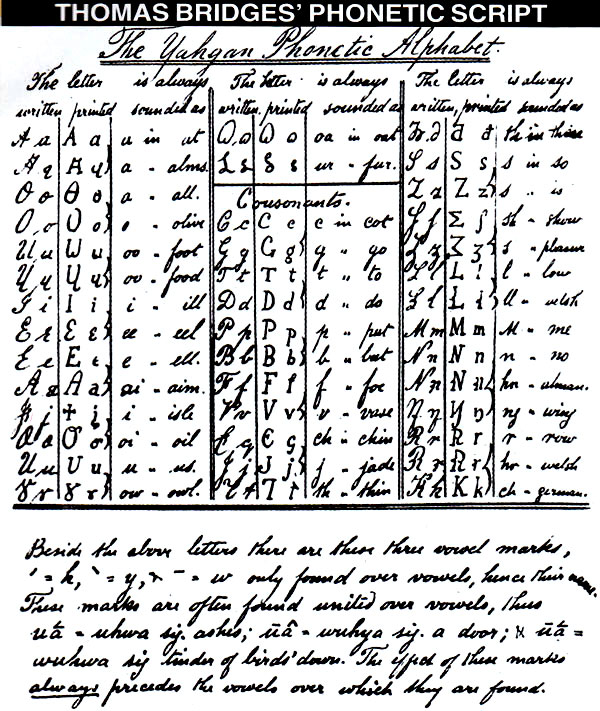
Thomas Bridges’ Yahgan phonetic alphabet (click image to enlarge)
Darwin’s journal characterizes the Fuegians of South America as primitive for using ‘hoarse, guttural, and clicking sounds’ in their speech. This not only demonstrates his racial prejudice, but also shows an unawareness in linguistic matters. The use of ‘click’ suggests that Fuegians made ‘tut-tut’ noises (‘tsk-tsk’ in USA) in the same way that Victorian English people showed disapproval, equivalent to saying (in Victorian style), ‘Dear me, how dreadful!’
Modern linguists find no clicks in Patagonian languages, but South African languages like Xhosa do use ‘tut-tut’ clicks within words. The X in Xhosa is itself a click similar to the ‘gee-up’ noise used to encourage horses. Of course the use of such sounds phonemically says nothing about the status of the language of the people. It is more likely that Darwin (and Captain Cook) heard them use both a velar ‘r’-sound (i.e. produced by aid of the soft palate, see figure below) and a pharyngeal plosive. Velar ‘r’ occurs in both French and German. and in the ‘Geordie’ speech of Northeast England. No doubt Darwin regarded his own speech as further evolved.

Oral situation during utterance of celar ‘r’.
The pharyngeal plosive. popularly called a ‘glottal stop’, was used by Cockneys of Darwin’s day, but we can be pretty certain that Darwin would unknowingly have used it himself in a word like ‘technical’, where foreigners can be identified by not using the stop. As a native English speaker, Darwin would have phonetically used the pronunciation [tɛ’nik?l], i.e. te ‘glottal’ followed by ‘nickel’, Most of us don’t realise we do this.
Darwin wrote his journal in blissful linguistic ignorance, assuming that his own speech was not at all like that of low-bred foreigners, However, there is no such thing as a ‘primitive’ language. The language of ‘primitive’ peoples is often far more complex phonologically and grammatically than that of ‘advanced’ peoples. The usual trend is for language to simplify.
Charles Taylor, MA., Ph. D., PGCE, LRAM, FIL., Cert. Th.
Dr Taylor has qualifications in languages, music and theology. He was for many years coordinator of applied linguistics courses at the University of Sydney, Australia
References and notes
- Tierra del Fuego means ‘land of fire,’ so named by the Portuguese navigator and explorer, Ferdinand Magellan, in 1520, after he saw the dancing flames from Indian camps along the darkened shore. Return to text.
- Along the shores of what came to be called Beagle Channel. Return to text.
- Charles Darwin, A Naturalist’s voyage round the World, (Journal of Researches into the Natural History and Geology of the Countries Visited During the Voyage of H.M.S. Beagle under the Command of Captain Fitz Roy, [sic] R.N.), John Murray, London, pp. 205–231,1845 reprinted 1928. Return to text.
- Captain Cook, who ‘discovered’ the east coast of Australia, visited Cape Horn in January 1769. Return to text.
- Log of Christopher Columbus, trans. by Robert Fuson, International Marine Pub. Co., Maine, pp. 73–79, 1987. Return to text.
- See John Brentnall and Russell Grigg, Darwin’s slippery slide into unbelief, Creation 18(1): 34–37, 1995. Return to text.
- Charles Darwin, The Descent of Man, John Murray, London, p. 156, 1887. Return to text.
- Tierra del Fuego, at latitude 55°S, is the southernmost inhabited land in the world and thus the nearest to Antarctica. Return to text.
- Bridges grew up with Fuegian children from the age of 13. He thus became completely fluent in the Yahgan language. The manuscript of his Yahgan dictionary was deposited in the British Museum in 1951. It contains 32,000 Yahgan words translated into English via a phonetic system, and is a priceless documentation of a language now almost extinct. It was Bridges who first used the term ‘Yahgan.’ ‘Yahga’ is the Fuegian Indian word for the Murray Narrows, situated in the centre of Fuegian territory. Return to text.
- For example, Yahgan has separate words for ‘mother’s brother,’ ‘mother’s sister’s husband,’ ‘father’s brother,’ etc. where we would just use ‘uncle.’ Return to text.
- In 1869 Stirling was consecrated first Bishop of the Falkland Islands, with almost all of South America for his Diocese. This meant Anglican support and coordination of the work. Return to text.
- Quoted from The Life and Letters of Charles Darwin, ed. Francis Darwin, Appleton & Co., London, 2:306–308, 1911. Note that there are some small differences in the wording of these letters, between the version given by Francis Darwin and that of other writers. E.g. Canon MacDonald, Bishop Stirling of the Falklands, Seeley, p. 69, 1929, gives the date of Darwin’s letters to Sulivan as 30 January 1870. Return to text.
- Darwin’s deathbed conversion is an urban myth. See Russell Grigg, Did Darwin recant?, Creation, 18(1):36–37, 1995. Return to text.
- See Carl Wieland, Darwin’s real message: have you missed it?, Creation 14(4):16–19, 1992. Return to text.
The author wishes to thank the Sydney SAMS office, Mrs Naomi Ansell (grand-niece of Bishop Stirling), and Mrs Dory Zinkand of Delaware, USA, who supplied much historical information; also Rev. A. Graeme Smith who supplied a copy of his article on ‘The Mission to Tierra del Fuego’ published in Evangelical Quarterly.
Readers’ comments
Comments are automatically closed 14 days after publication.