
Journal of Creation 19(3):4–5, December 2005
Browse our latest digital issue Subscribe
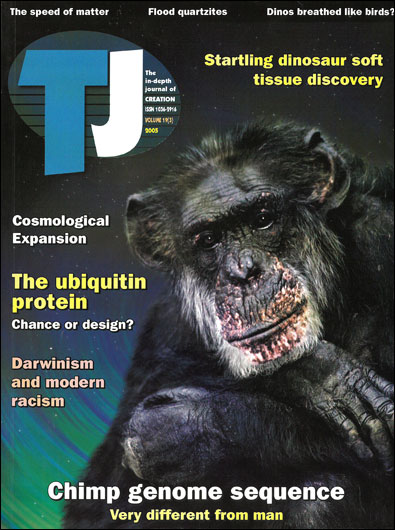
Chimp genome sequence very different from man
5 September 2005
For many years, evolutionary scientists—and science museums and zoos—have hailed the chimpanzee as “our closest living relative” and have pointed to the similarity in DNA sequences between the two as evidence. In most previous studies, they have announced 98-99% identical DNA.1 However, these were for gene coding regions (such as the sequence of the cytochrome c protein), which constituted only a very tiny fraction of the roughly 3 billion DNA base pairs that comprise our genetic blueprint. Although the full human genome sequence has been available since 2001, the whole chimpanzee genome has not. Thus, all of the previous work has been based on only a portion of the total DNA.
Last week, in a special issue of Nature devoted to chimpanzees, researchers report the initial sequence of the chimpanzee genome.2 No doubt, this is a stunning achievement for science: deciphering the entire genetic make up of the chimpanzee in just a few years. Researchers called it “the most dramatic confirmation yet” of Darwin’s theory that man shared a common ancestor with the apes. One headline read: “Charles Darwin was right and chimp gene map proves it.”3
So what is this great and overwhelming “proof” of chimp-human common ancestry? Researchers claim that there is little genetic difference between us (only 4%). This is a very strange kind of proof because it is actually double the percentage difference that has been claimed for years!4 The reality is, no matter what the percentage difference, whether 2%, 4%, or 10%, they still would have claimed that Darwin was right.
Further, the use of percentages obscures the magnitude of the differences. For example, 1.23% of the differences are single base pair substitutions. This doesn’t sound like much until you realize that it represents ~35 million mutations! But that is only the beginning, because there are ~40–45 million bases present in humans and missing from chimps, as well as about the same number present in chimps that is absent from man. These extra DNA nucleotides are called “insertions” or “deletions” because they are thought to have been added in or lost from the sequence. (Substitutions and insertions are compared in Figure 1.) This puts the total number of DNA differences at about 125 million. However, since the insertions can be more than one nucleotide long, there are about 40 million separate mutation events that would separate the two species.
| Substitution | Insertion/deletion |
|---|---|

|

|
|
Figure 1. Comparison between a base substitution and an insertion/deletion. Two DNA sequences can be compared. If there is a difference in the nucleotides (an A instead of a G) this is a substitution. In contrast, if there is a nucleotide base which is missing it is considered an insertion/deletion. It is assumed that a nucleotide has been inserted into one of the sequences or one has been deleted from the other. It is often too difficult to determine whether the difference is a result of an insertion or a deletion and thus it is called an “indel.” Indels can be of virtually any length. |
|
To put this number into perspective, a typical page of text might have 4,000 letters and spaces. It would take 10,000 such full pages of text to equal 40 million letters! So the differences between humans and chimpanzees include ~35 million DNA bases that are different, ~45 million in the human that are absent from the chimp and ~45 million in the chimp that are absent from the human.
Creationists believe that God made Adam directly from the dust of the earth just as the Bible says. Therefore, man and the apes have never had an ancestor in common. However, assuming they did for the sake of analyzing the argument, then 40 million separate mutation events would have had to take place and become fixed in the population in only ~300,000 generations—a problem referred to as “Haldane’s dilemma.” This problem is exacerbated because the authors acknowledge that most evolutionary change is due to neutral or random genetic drift. That refers to change in which natural selection is not operating. Without a selective advantage, it is difficult to explain how this huge number of mutations could become fixed in the population. Instead, many of these may actually be intrinsic sequence differences from the beginning of creation.
Some scientists are surprised at the anatomical, physical and behavioral differences between man and chimpanzee when they see so much apparent genetic similarity. With a philosophy that excludes a Creator God, they are forced to accept similarity as evidence of common ancestry. However, similarity can also be the result of a common Designer.
It is the differences that make the difference. The most important difference is that man is created in the image of God.
Dr. DeWitt is the director of the Center for Creation Studies and an associate professor of biology at Liberty University in Lynchburg, Virginia, USA. His Ph.D. is in neurosciences from Case Western Reserve University and the focus of his research is the cell biology of Alzheimer’s disease.
References
- DeWitt, D.A., >98.5% Chimp human DNA similarity? Not anymore.
- The Chimpanzee Sequencing and Analysis Consortium 2005. “Initial sequence of the chimpanzee genome and comparison with the human genome,” Nature 437:69–87.
- www.news-medical.net/?id=12840, August 31 2005.
- Studies of chimp-human similarity have typically ignored insertions and deletions although this accounts for most of the differences. A study by Roy Britten included these insertions and deletions and obtained a figure that is close to the 4% reported here. Britten, R.J., “Divergence between samples of chimpanzee and human DNA sequences is 5% counting indels,” Proceedings National Academy Science 99:13633–13635, 2002.
Readers’ comments
Comments are automatically closed 14 days after publication.