

Church leader takes stand against evolution!
Published: 16 September 2010(GMT+10)
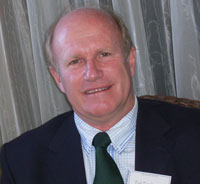
Church leaders tend to avoid publicly participating in the creation-evolution debate. Reasons for this reluctance may be that they consider the debate to be a topic for specialists, or perhaps they simply wish to avoid controversy or criticism. Hence it is of some encouragement when a church leader does speak out in opposition to evolution, and in favor of biblical creation.
Prof. Piet Strauss, moderator of the Dutch Reformed Church in South Africa, was recently interviewed by JUIG!, a leading Afrikaans Christian magazine. He had the opportunity to state the church’s viewpoint on evolution and its official position on the Bible as the infallible Word of God. The moderator made comments on evolution which drew considerable criticism directed at him, both in the electronic and printed media. These were that evolution is essentially a religion, even a superstition; that his ancestors were not apes; and that no authentic transitions exist between different kinds (types) of organisms.
Not wanting to miss an opportunity to promote his own evolutionary agenda, outspoken anti-creationist crusader, Dr Jurie van den Heever (palaeontologist, University of Stellenbosch), also weighed in on the issue, asserting that the moderator’s answers demonstrate that he lacks the necessary background and critical judgment regarding the ‘facts’ about evolution. By stating that humans are not descended from apes, but that man and apes have a common ancestor, Van den Heever attempted to demonstrate that the moderator (representing the Christian community) did not properly understand evolution. Furthermore, he made the usual claim that the evidence for transitional forms between animals and man is indisputable.
So, what of this distinction made between ‘ape’ and some supposed ‘common ancestor of both man and ape’? Evolutionists often make use of this straw man argument to assert that their opponents lack proper background and therefore do not understand evolution. Yet, it is significant that a renowned evolutionist and paleontologist, George G. Simpson (1902–1984) conceded that an earlier ancestor would certainly be called an ape or monkey in popular speech by anyone who saw it. Since the terms ‘ape’ and ‘monkey’ are defined by popular usage, man’s ancestors were indeed apes or monkeys. Simpson concluded that it would be a feeble attempt, if not dishonest, for an informed investigator to say otherwise.

Regarding transitional forms, Van den Heever insisted that thousands of examples exist for evolutionary changes taking place within (note, not between) different kinds of organisms. He then referred to a recent documented example of a single genetic change in an existing bird species that is leading (through natural selection giving rise to speciation) to the origin of a new species.
Scientists who embrace the account of biblical creation have no problem with speciation, natural selection and change within a created kind, all observed (like the example above) to take place over time in nature. Yet, the sort of change which is observed in all examples to date of such ‘speciation’ entails a mere sorting or loss of genetic information, and is thus very different from the sort of change which is needed for molecules-to-man upwards evolution which implies an enormous gain of genetic information.
So changes observed here are really just variations (i.e. different species/breeds) within a kind, where new species/breeds can form fairly rapidly from other species/breeds (only within the limits of the information already in the gene pool of those kinds), but not a transition between kinds. Definitely not the sort of change required to, step by step, turn microbes into microbiologists. It is therefore quite misleading in this particular context to speak of “evolutionary” changes, as Van den Heever did.
For decades, evolutionary protagonists such as Van den Heever have sought to intimidate Christians by wrapping a scientific veneer around their own faith commitment to philosophical naturalism (i.e. nature is all that there is). This tactic has served evolutionists well in the past, but their audacity and the scientific weaknesses of their position are now increasingly being exposed.
Please join together with us in encouraging all Christian leaders who are willing to defend the biblical account of origins, standing for the authority and truth of God’s Word.
Update: Since Prof. Piet Strauss, the Dutch Reformed Church moderator, came under criticism for expressing his doubts about evolution, an online article entitled “NG Kerk sê nie ja óf nee vir evolusie” (“DR Church is not for or against evolution”) briefly set out the view of the synodal board on the matter. Among other things, it stated that the church is not in a position to speak authoritatively on scientific theories such as evolution. Yet for many Bible-believing Christians, both in the pews and in leadership, this is certainly not the end of the discussion!
(First published in South African INFObytes, August 2010)

Readers’ comments
Comments are automatically closed 14 days after publication.