
Will comet Elenin destroy us?
And: What about the planets lining up in the sky?
Subsequently revised to appear in Creation 34(1):51–53, 2012.
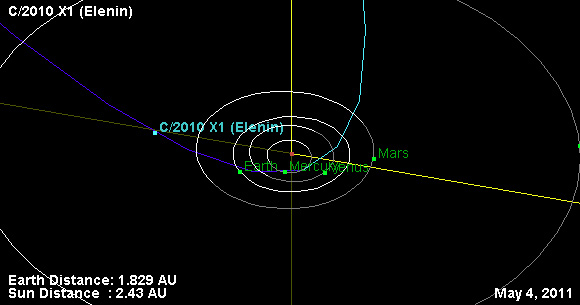
NASA/JPL-Caltech
Quite a number of readers have written to us about the comet Elenin. A number of websites are preaching doom and gloom about this, as they have done with planetary alignment. Dr Jonathan Sarfati demolishes these claims with real physics and astronomy.
What is a comet?
We have addressed the issue of comets in detail in Comets—portents of doom or indicators of youth? Readers may like to study this, especially for the strong evidence they provide against millions of years. This also points out that comets have widely been regarded as indications of looming disaster. Now the sensationalism has a pseudo-scientific gloss involving the actual comet.
But in reality, the comet itself is a ‘dirty snowball’ only a few km across. And when it is close to the sun, then some of this material evaporates and forms an ion tail and a dust tail. These can dominate the sky. However, the actual material of the tail is even thinner than our best laboratory vacuums. So there is no way the tail can hurt us in the slightest—there is almost nothing there! Indeed, Earth passed through the tail of Halley’s Comet in 1910 and barely noticed.
A direct comet impact would certainly be damaging to life. Because of their enormous speed relative to the earth (11 to 74 km/s, 25,000 to 166,000 mph), their kinetic energy is huge as shown by the standard formula E = ½mv². Because of the likely damage of an impact, NASA is tracking Near-Earth Objects (NEOs).
A small comet about 50 m across has been proposed as a cause of the 1908 explosion in Tunguska, Siberia, a ~10 megaton blast which flattened over 2,100 km² (800 sq. miles) of forest. But this caused no loss of human life, since there were no human habitations close by; there was no global effect. In fact, as explained in this 2008 feedback, impacts from far bigger comets would barely make a detectable difference to Earth’s axis, rotational speed or orbit.
What about Elenin itself?

Comet C/2010 X1 was named after Leonid Vladimirovich Elenin (Леони́д Влади́мирович Еле́нин, b. 1981), a Russian amateur astronomer who discovered it on 10 December 2010. He was remotely using the International Scientific Optical Network’s robotic observatory near Mayhill, New Mexico, USA. It is not a very spectacular object: even at its brightest, it will be 25 times too faint for the naked eye to see. It is probably only about 3–4 km in diameter. It’s most likely a lot smaller than the famous Halley’s comet, which has a mass of 2.2×10¹⁴ kg. This sounds a lot, but the earth’s mass (M⊕) is 5.9722 × 1024 kg—27 billion times more.
Furthermore, its closest approach to Earth is 34.4 million km (21.4 million miles) on 16 October 2011—this is about the same as the closest approach of Venus. Venus has 81.5% of the mass of the Earth, and poses not the slightest threat. So a fortiori, how much less will a little pipsqueak snowball at about the same distance, with only 0.000,000,003% of the earth’s mass?
Tidal forces
Actually, the biggest effect of any heavenly object on Earth, outside of an actual collision, is tidal: the difference in gravitational attraction between different parts of the Earth. As explained in The moon: the light that rules the night, the gravitational force between two objects is given by F = Gm1 m2 /R², where G is the gravitational constant, m1 and m2 are the masses of the objects, and R is the distance between their centres of mass—an inverse square law. Thus it is highest on the part of the earth closest to the object, and lowest on the opposite side. This difference is the tidal force; and this drops off with R³—an inverse cube law.
The strongest tidal forces on Earth are exerted by the moon, with a mass of 7.35 × 10²² kg (1.23% of Earth’s) and distance of 384,404 km (239,000 miles). And the moon is very ineffective at producing serious earthquakes or supertides. But compare Elenin: the moon is 334 million times more massive, as well as almost 90 times closer. This means that its tidal effect on Earth would be 240 trillion times weaker than the moon’s! Disastrous? No, totally undetectable! Don Yeomans, of NASA’s NEO program, made the pithy comment, “my subcompact automobile exerts a greater influence on the ocean’s tides than comet Elenin ever will”.
Planet alignment disasters?
From time to time, we receive queries about pending disasters when the planets are aligned in the sky. First of all, ‘aligned’ to a solar system astronomer usually means ‘in the same quadrant of the sky’, not ‘in a straight line’ as many think. But this is not the main issue. Understanding the inverse cube law of tidal forces should immunize readers against any sensationalist nonsense.
The sun is much further away than the moon (400 times), so has a much lesser effect despite being 333,000 times Earth’s mass, or 27 million times more massive than the moon. The inverse cube law means that this is more than countered by a factor of 64 million (400³) due to the greater distance. Overall, this means that the sun’s tidal effect on the earth is less than half the moon’s.
But because the sun is so massive—over 99% of the total mass of the solar system—its effect is far bigger than all the planets combined could ever be. The sun’s effect can be seen by comparing spring tides, when the sun and moon are aligned, with neap tides when they are perpendicular. Clearly the most important alignment in the solar system—as far as the earth is concerned—is far from catastrophic.
To show the fallacy of sensationalist claims, we can compare the effect of a planetary alignment with alignment of the sun. Since the sun’s effect is the difference between the spring and neap tides, what is the effect of the other planets?
The closest planet is Venus. It has only 1/400,000th the mass of the sun. However, at its closest point, it is almost four times closer. So, to a good approximation, its tidal effect on Earth compared to the sun’s is 4³/400,000, or 0.003%. I.e. it might add this much effect to the spring tide—not noticeable.
Jupiter is the biggest planet, 2.5 times more massive than all the other planets combined. But it is still less than a thousandth of the mass of the sun, and it is more than four times further away from Earth at its closest approach. So its tidal effect is only 1/12,000th that of the sun, or 0.008%.


Readers’ comments
Comments are automatically closed 14 days after publication.