

Evolution: an ancient pagan idea
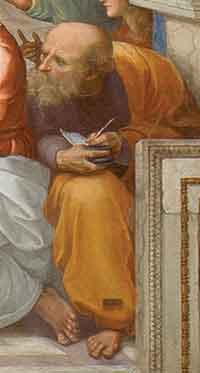
While studying ancient history at University, I came across the pagan beliefs about origins. It was this study that caused me first to question evolution and the vast ages given for the Universe. It was later, after many years of scientific investigation, that I finally broke free from a liberal understanding that sought to harmonise naturalism with biblical Christian faith.
The Greeks
As I read the works of the Greek philosophers, who lived between about 600–100BC, I was amazed to discover primitive evolutionary theory and vast ages long before Darwin and modern assumptions. The fragments of Anaximander (c. 610–546 BC) taught that ‘humans originally resembled another type of animal, namely fish.1 There was Democritus (c.460–370BC) who taught that primitive people began to speak with ‘confused’ and ‘unintelligible’ sounds but ‘gradually they articulated words.’2 Epicurus (341–270BC) taught that there was no need of a God or gods, for the Universe came about by a chance movement of atoms.3
After them, the Roman naturalist Pliny the Elder (AD23–79) said, ‘ … we are so subject to chance that Chance herself takes the place of God; she proves that God is uncertain.4
Concerning the great ages of the Universe, Plato and many Greek philosophers held to the view that this present Universe came about millions of years ago. Lactantius, writing in the fourth century AD, said:
‘Plato and many others of the philosophers, since they were ignorant of the origin of all things, and of that primal period at which the world was made, said that many thousands of ages had passed since this beautiful arrangement of the world was completed … ’.5 (An ‘age’ here is 1,000 years.)
Egyptians, Babylonians and Hindus
The Greeks borrowed some of these ideas from the Babylonians, Egyptians and Hindus, whose philosophies extended back centuries before. For example, one Hindu belief was that Brahman (the Universe) spontaneously evolved by itself like a seed, which expanded and formed all that exists about 4.3 billion years ago.6 These Hindus believed in an eternal Universe that had cycles of rebirth, destruction and dormancy, known as ‘kalpas’, rather like oscillating big bang theories. We also read in the Hindu Bhagavad Gita that the god Krishna says, ‘I am the source from which all creatures evolve.’7
Some of the Babylonians claimed that they had astronomical inscriptions on clay tablets for 730,000 years; others, like Berosus, claimed 490,000 years for the inscriptions.4 The Egyptians claimed that they had understood astronomy for more than 100,000 years.8
The early Christian Church Fathers constantly argued with the pagans about the age of the earth, or about the age of civilization. They were unanimous that God had created the earth less than 6,000 years before they wrote.9 For example, one of the most influential, Augustine (AD354–430), in his most famous work, City of God, has a whole chapter, Of the Falseness of the History Which Allots Many Thousand Years to the World’s Past, where he says:

‘Let us, then, omit the conjectures of men who know not what they say, when they speak of the nature and origin of the human race. … They are deceived, too, by those highly mendacious documents which profess to give the history of many thousand years, though, reckoning by the sacred writings, we find that not 60009 years have yet passed.’10
Theophilus (AD115–181), Bishop of Antioch, wrote an apologetic work to the pagan magistrate Autolycus about the problem of the pagan long ages, mentioning Plato’s 200 million year period between the Flood and his time, and Apollonius the Egyptian’s claim of at least 155,625 years since creation.11
The ancient pagans may have calculated their vast ages through astrology because they regarded it as true science. Julius Africanus (AD200–245) wrote:
‘The Egyptians, indeed, with their boastful notions of their own antiquity, have put forth a sort of account of it by the hand of their astrologers in cycles and myriads of years … ’ [myriad = 10,000].12
Modern pagans?

Today scientists use far more complex ‘dating’ methods, e.g. radiometric techniques, to ‘prove’ vast ages. But, as Creation magazine has often shown, these methods are not measurements of time, but interpretations of measurements of such things as radioactive decay products, and such interpretations are based on faulty assumptions.13
More recently, scientists have been thinking up ‘new’ theories to explain how life could have developed on Earth, given the vanishingly small probability of spontaneous evolution actually happening. The late Francis Crick, the co-discoverer of DNA’s structure (along with James Watson and Maurice Wilkins), came to believe that aliens, and not God, were responsible for life on earth.14 The pagan gods have struck back with a vengeance!
More recently, much speculation has been made about the ‘multiverse’, or ‘parallel Universe’ theory, such as a recent article in Scientific American by Max Tegmark.15,16 This fantasy is quite useful, because anything can now happen, as in the science fiction Matrix movies! However, such an idea is ancient. Augustine complained about it before AD430 when he said:
‘There are some, again, who, though they do not suppose that this world is eternal, are of opinion either that this is not the only world, but that there are numberless worlds or that indeed it is the only one, but that it dies, and is born again at fixed intervals, and this times without number.’17
Solomon wrote about 3,000 years ago: ‘There is nothing new under the sun. Is there anything of which it may be said, “See, this is new”? It has already been in ancient times before us. There is no remembrance of former things, nor will there be any remembrance of things that are to come by those who will come after’ (Ecclesiastes 1:9-11).
We should heed Theophilus’ words to Autolycus only about 150 years after Christ’s Resurrection:
‘For my purpose is not to furnish mere matter of much talk, but to throw light upon the number of years from the foundation of the world, and to condemn the empty labour and trifling of these authors, because there have neither been twenty thousand times ten thousand years from the flood to the present time, as Plato said, affirming that there had been so many years; nor yet 15 times 10,375 years, as we have already mentioned Apollonius the Egyptian gave out; nor is the world uncreated, nor is there a spontaneous production of all things, as Pythagoras and the rest dreamed; but, being indeed created, it is also governed by the providence of God, who made all things; and the whole course of time and the years are made plain to those who wish to obey the truth.’11
‘From the creation of the world to the deluge were 2242 years. … All the years from the creation of the world amount to a total of 56989 years, and the odd months and days.’18,19
References and notes
- Barnes, J., Early Greek Philosophy, Penguin Books, London, England, p. 72, 1987. Return to text.
- Cartledge, P., Democritus, Phoenix, London, England, pp. 20–21, 1998. Return to text.
- The Epicurus Reader: Selected Writings and Testimonia, translated and edited by Brad Inwood and L.P. Gerson, introduction by D.S. Hutchinson, Hackett Publishing Company, 1994. Return to text.
- Pliny the Elder, Natural history, translated with an introduction and notes by John F. Healy, Penguin Books, London, England, p. 13, 1991. Return to text.
- Lactantius, The Divine Institutes 7:14, Of the first and last times of the world, <www.ccel.org/ccel/schaff/anf07.iii.ii.vii.xiv.html>. Return to text.
- From The Mundaka Upanishad, Understanding Hinduism, pp. 5–9, <https://web.archive.org/web/20050214230902/http://www.hinduism.org.za/creation.htm>. Return to text.
- The Bhagavad Gita, translation and introduction by Eknath Easwaran, Penguin, Arkana, p. 142, 1985. Return to text.
- Augustine of Hippo, City of God 18:40, About the most mendacious vanity of the Egyptians, in which they ascribe to their science an antiquity of a hundred thousand years, AD>410, <www.ccel.org/ccel/schaff/npnf102.iv.XVIII.40.html>. Return to text.
- These figures are based on the Greek Septuagint translation (ca. 250 BC), while our English Bibles are mainly translated from the standard Hebrew (Masoretic) text. Dr Pete Williams shows why the Masoretic Text is likely to be closer to the original Hebrew in ‘Some remarks preliminary to a Biblical chronology’, Journal of Creation 12(1):98–106, 1998; <creation.com/chronology>. Return to text.
- Augustine, ref. 8, 12:10, <www.ccel.org/ccel/schaff/npnf102.iv.XII.10.html>. Return to text.
- Theophilus, To Autolycus 3:26, Contrast between Hebrew and Greek Writings, AD 181, <www.ccel.org/ccel/schaff/anf02.iv.ii.iii.xxvi.html>. Return to text.
- The Extant Fragments of the Five Books of the Chronography of Julius Africanus 3(1), On the mythical chronology of the Egyptians and Chaldeans, <www.ccel.org/ccel/schaff/anf06.v.v.i.html>. Return to text.
- Walker, T., The way it really is: little-known facts about radiometric dating, Creation 24(4):20–23, 2002; Radiometric Dating Q&A <creation.com/dating>. Return to text.
- Bates, G., Designed by aliens? Discoverers of DNA’s structure attack Christianity, Creation 25(4):54–55, 2003; <creation.com/aliens>. Return to text.
- Tegmark, M., Parallel Universes, Scientific American 288(5):31–41, May 2003. Return to text.
- But it is unscientific and special pleading. See Sarfati, J., Multiverses: Parallel Universes, in: Refuting Compromise, pp. 187–189, Master Books, Arkansas, USA, 2004. Return to text.
- Augustine, ref. 8, 12:11, Of those who suppose that this world indeed is not eternal, but that either there are numberless worlds, or that one and the same world is perpetually resolved into its elements, and renewed at the conclusion of fixed cycles, <www.ccel.org/ccel/schaff/npnf102.iv.XII.11.html>. Return to text.
- Theophilus, ref. 11, 3:28, Leading chronological epochs, <www.ccel.org/ccel/schaff/anf02.iv.ii.iii.xxviii.html>. Return to text.
- An exact date for the age of the Universe cannot be ascertained, but we know from Scripture that it is somewhat less than 7,000 years—see Freeman, T.R., The Genesis 5 and 11 fluidity question, Journal of Creation 19(2):83–90, 2005; Sarfati, J., Biblical chronogenealogies, Journal of Creation 17(3):14–18,2003. Return to text.

Readers’ comments
Comments are automatically closed 14 days after publication.