
Expelled: New movie exposes persecution of anti-Darwinists
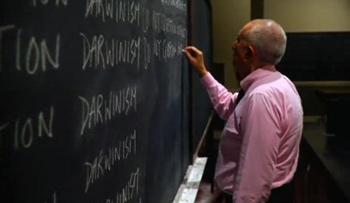
Last October, in a move that revived memories of Stalinistic censorship, the Council of Europe voted to encourage member countries to ban the teaching of creationism as a scientific discipline. (See When will Europe wake up?). The Council’s Parliamentary Assembly declared: ‘If we are not careful, creationism could become a threat to human rights.’ In stark contrast, the reality on academic campuses around the world is that evolutionary orthodoxy is already threatening human rights, as a new movie is about to show. This major feature film, revealing the academic censorship of intelligent design theory, is to be released in the Northern Hemisphere spring of 2008.
The controversial movie, Expelled: No Intelligence Allowed, is a documentary that will expose how the Darwinist hierarchy has closed ranks against the rise of intelligent design, a theory that opposes evolution and says that a Designer is responsible for life. Some leading scientists have lost their jobs for expressing dissident views on the origins of life.
The film shows that in this particular field, science is far from being a free and open exploration of the truth and is, in fact, a closed book.
Expelled uncovers the persecution of educators and scientists who are being denied tenure, and even fired in some cases, for their belief in the evidence for design in nature, challenging the idea that life is a result of random chance and evolution.
The movie is made with the 2008 American elections in mind, and intelligent design vs evolution has already become an issue—with candidates taking sides. It is the brainchild of software developer Walt Ruloff, who has also funded the movie. He made his fortune by selling his software to Microsoft in the early 1990s. Then he discovered the intelligent design controversy. He says he was stunned ‘both by the arrogance and brutality of the Darwinist establishment, and the lack of solid scientific evidence for their views.’
The film has already received endorsements from high-profile Christian figures like Luis Palau, Charles Colson, Michael Medved and J.I. Packer. The filmmakers, Premise Media, plan to use viral marketing to ensure that Expelled reaches students. The campaign is directed by Motive Entertainment, the company behind the grass roots promotions for Hollywood blockbusters such as The Passion of the Christ and The Chronicles of Narnia.
Unlike many documentaries, Expelled doesn’t just talk to people representing one side of the story. The film confronts evolutionists such as Richard Dawkins, author of The God Delusion, influential biologist and atheist blogger PZ Myers, and Eugenie Scott, head of the anti-creationist lobby group, National Center for Science Education. The creators of Expelled crossed the globe over a two-year period, interviewing scores of scientists, doctors, philosophers and public leaders. The result is a startling revelation of the way in which freedom of thought and freedom of inquiry have been expelled from high schools, universities and research institutions.

The star of the film is Hollywood actor Ben Stein, who is also a lawyer, an economist, a former presidential speechwriter, author and social commentator. In the film, he discovers biologists, astronomers, chemists and philosophers who have had their reputations destroyed and their careers ruined by a scientific establishment that allows absolutely no dissent from evolution.
For example, Stein meets Richard Sternberg, a double Ph.D. biologist who allowed a peer-reviewed research paper describing the evidence for intelligence in the universe to be published in the scientific journal Proceedings. Not long after publication, officials from the National Center for Science Education and the Smithsonian Institution, where Sternberg was a research fellow, began a coordinated smear and intimidation campaign to get the promising young scientist expelled from his position. This attack on scientific freedom was so egregious that it prompted a congressional investigation. See The Smithsonian/Sternberg controversy.
Stein also meets astrophysicist Guillermo Gonzalez, who was denied tenure at Iowa State University in spite of his extraordinary record of achievement. Gonzalez made the mistake of documenting the design he has observed in the universe. See Darwinian thought police strike again. There is also Caroline Crocker, a brilliant biology teacher at George Mason University who was forced out of the university for briefly discussing problems with Darwinian theory, and for telling the students that some scientists believe there is evidence of design in the universe. The list goes on and on.
‘Big Science in this area of biology has lost its way,’ says Stein. ‘Scientists are supposed to be allowed to follow the evidence wherever it may lead, no matter what the implications are. Freedom of inquiry has been greatly compromised, and this is not only anti-American, it’s anti-science. It’s anti-the whole concept of learning.’
Walt Ruloff, Co-Executive Producer, says,
‘The incredible thing about Expelled is that we don’t resort to manipulating our interviews for the purpose of achieving the “shock effect,” something that has become common in documentary film these days.
‘Premise Media took on this difficult mission because we believe the greatest asset of humanity is our freedom to explore and discover truth.’
Even since the film was made, another case of censorship in American universities has come to light. In September, Baylor University took offline the Evolutionary Informatics Laboratory website that had been administered by Robert Marks, Distinguished Professor of Electrical and Computer Engineering at Baylor, because the administration claimed there were anonymous complaints linking the lab to intelligent design.
This is the third instance in which Baylor University has restricted free speech and punished a faculty member because of their views on intelligent design. In 2000, the University administration caved in to pressure from Darwinian activists demanding they shut down the Michael Polanyi Research Center, established in part to do research on intelligent design theory. In 2006, legal scholar Francis Beckwith was denied tenure by Baylor administrators in part because of his writings supporting the constitutionality of teaching intelligent design. The Board of Regents reversed that decision and Beckwith was granted tenure, but only after a long public battle.
Casey Luskin, a spokesman for Discovery Institute, America’s leading think tank on intelligent design, says: ‘There is a troubling pattern of scientists and scholars at Baylor University coming under attack for questioning evolution. The freedom of scientists, teachers and students to question Darwin is coming under increasing attack by people that can only be called Darwinian fundamentalists. ‘What has happened to Professor Marks is censorship, pure and simple.’ (See also US Congressional leader castigated for creation comments.)
Dr Marks has gone the extra mile in trying to accommodate any legitimate concerns Baylor administrators may have had about his evolutionary informatics website, even agreeing to put a disclaimer on the site making clear that it represented his views as a faculty member, not the university as a whole. But Baylor administrators have now spurned Marks’ efforts to accommodate them, apparently reneging on a compromise brokered by Marks’ attorney.
But scientists who support intelligent design shouldn’t be surprised at their predicament. Before the particular subset of anti-Darwinism known as ‘intelligent design’ arrived on the scene, creationist scientists had been systematically persecuted for decades, and still are today. For example, when Dr Marcus Ross, a young palaeontologist at the University of Rhode Island, submitted his doctoral thesis on mosasaurs—giant extinct marine reptiles—he was ‘outed’ as a young-Earth creationist. The revelation, in The New York Times, sparked an impassioned debate about whether his views should preclude him from his chosen profession. (Dr Ross was interviewed in CMI’s Creation magazine in December 2007.)
The fact that he is a brilliant scientist, whose research is described by colleagues as impeccable, seemed irrelevant to the orthodox Darwinists, who called for him to be sacked simply because he expresses different scientific views to theirs.
Eugenie Scott, executive director of the US National Centre for Science Education, favoured a hard line against Dr Ross because of the suspicion that he would use his doctorate ‘to miseducate the public’.
Is academic censorship also taking place in the UK? If anything, it’s probably worse on Darwin’s home patch. Mark Pickering, head of student ministries at the Christian Medical Fellowship, says that there is systematic bias in the scientific world against intelligent design: ‘I have academic colleagues who do not yet have tenure who cannot own up to their professors that they have sympathy with intelligent design because that would be the end of their career. This is despite them already proving themselves as good scientists’ (Student British Medical Journal, June 07).
In December 2006, The Guardian reported that an influential group of academics were demanding a change in the law to ensure UK scholars are given complete freedom of speech in universities. More than 60 educators from Academics for Academic Freedom called for laws to be extended to ensure that academics are free to ‘question and test received wisdom, and to put forward unpopular opinions’.
A statement on the AFAF website says:
‘In today’s political climate it is harder than ever for academics to defend open debate. Restrictive legislation, and the bureaucratic rules and regulations of government quangos and of universities themselves, have undermined academic freedom.
‘Many academics are fearful of upsetting managers and politicians by expressing controversial opinions. Afraid to challenge mainstream thought, many pursue self-censorship.’
The very fact that such a campaign is necessary seems to prove that free debate and research in the UK are under threat. Richard Dawkins has publicly called for Andy McIntosh, Professor of Thermodynamics at Leeds to be sacked simply for claiming evolutionary theory is wrong. (Note: the title ‘professor’ is given only to the highest academic rank at UK and British Commonwealth universities, unlike in American universities.)
Howard Taylor, chaplain at Heriot–Watt University in Edinburgh, says: ‘At Caltech University in Los Angeles, a lecturer has complained that the scientific hierarchy is behaving like the “mother church” of the Middle Ages and intimidating those of a different view.’
While the lecturer was talking about scientific dissent on global warming, it appears that the comparison is just as applicable to evolution. It seems the scientific establishment has nullified the Royal Society’s motto: ‘Nullius in verba’1 , which refers to open, unprejudiced, uninhibited inquiry and unstifled debate.
References
- Latin for ‘On the word of no-one’. Return to text.


Readers’ comments
Comments are automatically closed 14 days after publication.