

Gecko foot design—could it lead to a real ‘spiderman’?
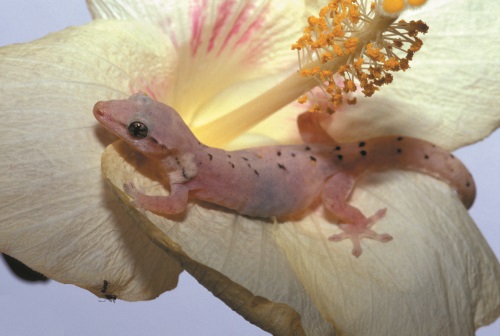
In Creation, we reported on how a gecko can stick to almost any surface, so it can even run upside down on a ceiling of polished glass.1 This is due to the way tiny chemical forces are exploited by tiny hairs called setae, about 1/10 of a millimetre long and packed 5,000 per square millimetre (three million per square inch). The end of each seta has about 400–1,000 branches ending in a spatula-like structure about 0.2–0.5 microns—less than 1/50,000 of an inch—long (a micron is 1/1,000 of a millimetre). This is an amazingly fine structure that the researchers said was ‘beyond the limits of human technology’.2
But this is not enough—it would do the gecko no good to have this amazing foot if it could only stick—it must also unstick quickly. The gecko manages this with the ‘unusually complex behaviour’ of uncurling its toes when attaching, and unpeeling while detaching.
Since man was created in God’s image, we should not be too surprised that man can also imitate God’s creativity to some degree.
Engineer Metin Sitti, of Carnegie Mellon University in Pittsburgh, USA, has managed to duplicate the gecko foot surface structure to some extent.3 He used a very fine nanoprobe and an electron microscope to make a tiny wax mould for a resin, which set to form artificial hairs. Dr. Sitti points out that the shape and orientation of the hairs is important for their function. His artificial hairs are not yet strong enough to support the weight of a human, but the researchers are continually improving their technology. He aims to makes robots for planetary exploration that could climb over any surface.3
Dr André Geim, of the University of Manchester, leading a team of scientists from the UK and Russia, prepared a self-cleaning adhesive tape modelled on the gecko’s foot.4 Their tape,5 with a contact area of only 0.5 cm2 with glass, could bear a load of more than 100 grams. However, the tape is not durable enough to attach and detach more than a few times, unlike the real gecko. The researchers proposed using a more durable material—that which the real ones are made of, keratin.6
If they did, then gloves and shoes made of this might enable a real spiderman (or should that be geckoman?) to climb up walls of almost any surface. However, this would require training, to match the gecko’s movement patterns, and one must wonder whether humans could manage this. And a planet-exploring robot would need this to be programmed into it. So far, the artificial gecko skin seems good only for attaching things in place.
Once more, we see that the intelligence that went into the artificial setae (hairs) and tape is a good lesson on the much greater intelligence of the One who designed the original. Despite their ingenuity, the researchers cannot equal the original design, which evolutionists believe arose by time, chance and natural selection.
References and notes
- Sarfati, J., Great gecko glue?, Creation 23(1):54–55, 2000. Return to text.
- Autumn, K. et al., Adhesive force of a single gecko foot hair, Nature 405(6787):681–685, June 2000; perspective by Gee, H., Gripping feat, same issue, p. 631. Return to text.
- Graham-Rowe, D., Fancy a walk on the ceiling?, New Scientist 178(2395):15, May 2003. Return to text.
- Geim, A. et al., Microfabricated adhesive mimicking gecko foot-hair, Nature Materials 2:461–463, 2003. Return to text.
- The tape had fibres 2 microns long, with a diameter of around 0.5 microns and spaced 1.6 microns apart, on a film of polyimide 5 microns thick. Dr. Geim and his colleagues used the advanced nanotechnology methods of electron-beam lithography and dry etching in oxygen plasma. Return to text.
- Kalaugher, L., ‘Gecko tape’ sticks with polymer fibres, Physics Web, physicsweb.org, accessed June 2003. Return to text.

Readers’ comments
Comments are automatically closed 14 days after publication.