
The ‘giant footprint’ of South Africa
Firewalking giant or fortuitous weathering?1
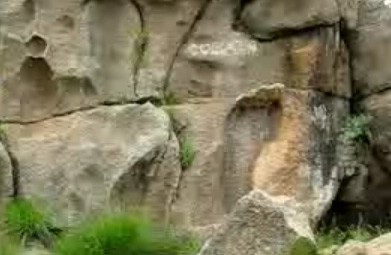
The Bible talks in a number of places about ‘giants’ in the land of Canaan, and the pre-Flood Nephilim (please see Return of the Nephilim?). We have recently received reports of a ‘giant footprint’ about 1.2 m (4 ft) long in granite near Mpuluzi, near the Swaziland border in the Mpumalanga province in north-eastern South Africa. In a recent video posted on Youtube,2 one Michael Tellinger, styled as a ‘scientist’, researcher, author,3 depicted this footprint as evidence of ancient giants that walked the land. While we may not give much credence to Tellinger’s far-fetched conjectures on the history of these giants, does this print still provide positive evidence for ‘ancient giants’?
Weathering the ‘footprint’ hype
Perhaps the most important fact about this ‘footprint’ is that it is stated to be in granite. Every geologist (or even field geological observer)—creationist or evolutionist—agrees that granite is not a sedimentary rock, such as the ‘mud’ Tellinger refers to as having been ‘pushed up’. Granite is an igneous rock, which becomes solid as crystals form when a previously very hot molten magma (around 800°C) cools down. It is difficult to imagine any sort of footprint, or fossil for that matter, surviving such a process. It is even more difficult to contemplate what would happen to the ‘giant’ who was going for a stroll barefoot in this igneous material that being soft, was still blazing hot! Remember too that granite does not form on the surface of the earth but deep underground in large plutons. So one can really rule out this giant-footprint idea without going much further. But since this is already doing the ‘internet rounds’, and someone is bound to ask how this shape could form if it were not a print, we can look at some of the other features that enable an ‘offsite’ dismissal of the claim with an even greater overall degree of confidence.

When exposed on the surface, granite not uncommonly erodes in ways that can result in some remarkable shapes This website features photos of the famous Remarkable Rocks on South Australia’s Kangaroo island. And here is a photo of a similar type of cavernous weathering, in Sardinia. The rock face with the alleged footprint has numerous such small cave-like features called tafoni—singular tafone— (Figure 1 — pic of the rock face), which are common weathering features in granite (See this photo for another such example). In fact the overhanging ledge above the ‘toes’ of the ‘footprint’ is most likely a more resistant portion of the rock which has favoured the mini-tafoni formation (Figure 2 — close up of the ‘toes’).
In the Tellinger video documenting this ‘footprint’, on the way up the hill to the formation you can see lots of granite ‘flakes’ that have broken off the larger granite body through weathering. It is not uncommon for rocks to crack and flake in a shape that can look vaguely like a footprint. There are also numerous little pools with water and vegetation draining a trickle of water, often in interconnected sequence all along the slopes.
In short, the single foot-like shape is nowhere near as unlikely to have occurred by random, natural processes as it might appear at first.
Digits 2 to 4 are virtually of the same length, which is unusual in humans but consistent with the ledge controlling tafone formation. The ‘toe’ tafoni may have also been enhanced by human chiselling attempting to make a structure already resembling a human print look even more so, but more investigation on site would be needed to demonstrate this.
If all of that were not enough, the position of the ‘footprint’ doesn’t favour it being a genuine footprint either. The ‘footprint’ is found on an essentially vertical outcrop of granite, and as such would need to be turned and pushed up by tectonic movement, which the video also claims has happened. However, the granite looks like an undisturbed pluton and does not have any indications of having been tilted up because it has no signs of metamorphism (recrystallization of pre-existing rock caused by heat and/or pressure). Granite that has been tilted and metamorphosed should show signs such as banding or layering. The movement of the rock would move the minerals into darker and lighter bands of more mafic and more felsic layers respectively. It seems that not only would the ‘giant’ need to be able to walk on molten magma, but he would have to be able to walk up the side of a wall of molten magma underground!
Importantly, too, all we have is a single ‘footprint’, not a trackway. In fact, even if this print had been in sedimentary rock, and was only a little bit enlarged, an isolated footprint impression is one of the most difficult of fossil types to be able to positively identify as even being a fossil. There are heaps of random shapes in rocks across the world, and sometimes one will look like a particular animal print, or as if a toy boat had been left in the sediment, and all sorts of similar things. It is not uncommon for rocks to crack and flake in a shape that can look like a footprint, or even a shoeprint. This means one cannot make a case for a one-off shape being a single footprint. It is necessary to have a series of footprints in a trackway to make a case.
Dubious ‘giant’ physiology
The ‘footprint’ is roughly four times the size of an adult footprint. Applying that 4x to other linear dimensions would suggest a human some 7 metres (23 feet) tall. The Bible does mention that there were some giants in the pre-Flood world, but ‘giant’ is a relative term. To some people groups today, a US basketball ‘dream team’ would certainly qualify for that description. But there are limits to the degree to which one can speculate about the size of past members of the human race, and it is likely that the approximately 2.7-metre (9-foot) Goliath was at or very near the size limit. Scaling up the linear dimensions four times means that the human would have weighed around six tonnes (2D measurements like area would be increased 16 times, but mass as an approximation to the volume of a sphere (3D) would increase by some 64 times. Thus, though the mass would have increased 64 times, the cross sectional area of the leg bones would have only increased 16 times. So, in order to support the weight, the leg bone thickness would have to be increased dramatically. Many other aspects of this ‘scaling up’ issue would mean that the entire human body would have to have been totally ‘redesigned’, such that the person would look very, very strange indeed to our eyes, and not just because of the ‘giant’ aspect. Further, such a person could not have any genetic continuity with any humans on earth, for the same reason: i.e. so many aspects of their body would have to be totally different in order for them to be able to survive at that size in our gravity. Therefore, if this were a giant footprint, the creature that made it certainly would not qualify as ever having been part of the gene pool of the human race.
Summary and conclusions
This giant footprint suffers from giant problems—and numerous problems at that. Even if this were a footprint, it wouldn’t be a human footprint because the redesign necessary for such a creature to exist at such a size would be so severe that the creature couldn’t have any genetic continuity with us. However, we can dismiss the claim that this is a footprint because there is only one print, not a trackway; it is in granite, an igneous rock that no living organism would have a hope of leaving any sort of impression in; granite can produce some remarkable weathering features; and the granite outcrop bears numerous tell-tale features of patterns of weathering likely to produce a similar class of shapes at random.
We have a tendency to see patterns and purpose in things where they don’t exist. The textbook example is seeing recognizable shapes in clouds—we may sometimes see a face, or a balloon, or a rabbit, or any number of shapes we are familiar with. The same can be said of many rock formations, especially when one considers the names of many rock formations: e.g. “Glasshouse Mountains, “Giant’s Causeway”, “Bear Rock”, “Murphy’s Haystacks”, etc. The list is almost endless. Trace fossils, such as footprints, are often tough to identify in sedimentary rocks because weathering patterns can produce an amazing array of shapes that it can be hard to know whether an impression is a footprint or a weathering feature. However, when the print is in an out-of-place context, such as in igneous rock, the conclusion is rather straightforward—it is not a footprint.4 And it is certainly not relevant to either the pre-Flood Nephilim or the post-Flood mention of ‘giants’.
References
- Special thanks for quick and helpful comments from geologists Dr Emil Silvestru and Dr Tas Walker. Return to text.
- Tellinger, M., Giant Foot Print 200 Million Yrs Old-South Africa www.youtube.com/watch?feature=player_detailpage&list=UULF2DONV6JCJUs6eK6POaxg&v=dRuxw-nZoJw, as at 11 January 2012. Return to text.
- South African Press Association, Aliens want our gold – UFO conference, www.citypress.co.za/SouthAfrica/News/Aliens-want-our-gold-UFO-conference-20111126, 26 November 2011. Return to text.
- Not surprisingly, perhaps, Tellinger’s other videos reveal a very flaky New-Age/UFO type flavour. Return to text.


Readers’ comments
Comments are automatically closed 14 days after publication.