

Interracial marriage: is it biblical?

What if a Chinese person were to marry a Polynesian, or an African with black skin were to marry a Japanese, or a person from India were to marry a person from America with white skin—would these marriages be in accord with biblical principles?
There are a significant number of Christians (particularly in America) who would claim that such ‘interracial’ marriages directly violate God’s principles in the Bible, and should not be allowed.
But does the Word of God really condemn such mixes as those above? Is there ultimately any such thing as ‘interracial marriage’?
What constitutes a ‘race’?
In the 1800s, before Darwinian evolution was popularized, most people, when talking about ‘races,’ would be referring to such groups as the ‘English race,’ ‘Irish race,’ and so on. However, this all changed in 1859, when Charles Darwin published his book On the Origin of Species by Means of Natural Selection or the Preservation of Favoured Races in the Struggle for Life.
Darwinian evolution was (and still is) inherently a racist philosophy, teaching that different groups or ‘races’ of people evolved at different times and rates, so some groups are more like their ape-like ancestors than others. The Australian Aborigines, for instance, were considered the missing links between the ape-like ancestor and the rest of mankind.1 This resulted in terrible prejudices and injustices towards the Australian Aborigines.2 The leading evolutionary spokesperson, Stephen Jay Gould, stated that ‘Biological arguments for racism may have been common before 1859, but they increased by orders of magnitude following the acceptance of evolutionary theory.’3
Racist attitudes fueled by evolutionary thinking were largely responsible for an African pygmy being displayed, along with an orangutan, in a cage in the Bronx zoo.4
As a result of Darwinian evolution, many people started thinking in terms of the different people groups around the world representing different ‘races,’ but within the context of evolutionary philosophy. This has resulted in many people today, consciously or unconsciously, having ingrained prejudices against certain other groups of people.
However, all human beings in the world today are classified as Homo sapiens Sapiens. Scientists today admit that, biologically, there really is only one race of humans. For instance, a scientist at the Advancement of Science Convention in Atlanta stated, ‘Race is a social construct derived mainly from perceptions conditioned by events of recorded history, and it has no basic biological reality.’5 This person went on to say that ‘Curiously enough, the idea comes very close to being of American manufacture.’5
Reporting on research conducted on the concept of race, the American ABC News science page stated, ‘More and more scientists find that the differences that set us apart are cultural, not racial. Some even say that the word race should be abandoned because it’s meaningless.’6 The article went on to say that ‘we accept the idea of race because it’s a convenient way of putting people into broad categories, frequently to suppress them—the most hideous example was provided by Hitler’s Germany. And racial prejudice remains common throughout the world.’6
In an article in the summer issue of the Journal of Counseling and Development,7 researchers argue that the term ‘race’ is basically so meaningless that it should be discarded.
Personally, because of the influences of Darwinian evolution and the resulting prejudices, I believe everyone (and especially Christians) should abandon the term ‘race(s).’ We could refer instead to the different ‘people groups’ around the world.
The Bible and ‘race’
The Bible does not even use the word race in reference to people,8 but does describe all human beings as being of ‘one blood’ (Acts 17:26). This of course emphasizes that we are all related, as all humans are descendants of the first man, Adam (1 Corinthians 15:45).9 As Jesus Christ also became a descendant of Adam, being called the ‘last Adam’ (1 Corinthians 15:45), this is why the Gospel can be preached to all tribes and nations. Any descendant of Adam can be saved, because our mutual relative by blood (Jesus Christ) died and rose again.
‘Racial’ differences
But some people think there must be different ‘races’ of people because there appear to be major differences between various groups, such as skin colour and eye shape.
The truth though is that these so-called ‘racial characteristics’ are only minor variations among people groups. If one were to take any two people anywhere in the world, scientists have found that the basic genetic differences between these two people would typically be around 0.2 percent—even if they came from the same people group.10 But, these so-called ‘racial’ characteristics that people think are major differences (skin colour, eye shape, etc.) ‘account for only 0.012 percent of human biological variation.’7 In other words, the so-called ‘racial’ differences are absolutely trivial—overall, there is more variation within any group than there is between one group and another. If a white person is looking for a tissue match for an organ transplant, for instance, the best match may come from a black person, and vice versa. The ABC news science page stated, ‘What the facts show is that there are differences among us, but they stem from culture, not race.’6
The only reason many people think these differences are major is because they’ve been brought up in a culture that has taught them to see the differences this way.
Real science in the present fits with the biblical view that all people are rather closely related—there is only one ‘race’ biologically. Therefore, there is in essence no such thing as ‘interracial marriage.’ So we are left with this—is there anything in the Bible that speaks clearly against men and women from different people groups marrying?
Origin of people groups
In Genesis 11, we read of the rebellion at the tower of Babel which resulted in people being scattered over the earth. Because of this dispersion, and the resulting splitting of the gene pool, different cultures formed, with certain features becoming predominant within each group. Some of these (skin colour, eye shape and so on) became general characteristics of each particular people group.11
Note that the context of Genesis 11 makes it clear that the reason for God’s scattering the people over the earth was that they had united in rebellion against God. Some Christians point to this event in an attempt to provide a basis for their arguments against so-called ‘interracial’ marriage. They believe that it is implied here that to keep the nations apart, God is declaring that people from different people groups can’t marry. However, there is no such indication in this passage that what is called ‘interracial marriage’ is condemned. Besides, there has been so much mixing of people groups over the years, that it would be impossible for every human being today to trace their lineage back to know for certain which group(s) they are descended from.
We need to understand that the sovereign creator God is in charge of the nations of this world. Paul makes this very clear in Acts 17:26. Some people erroneously claim this verse to mean that people from different nations shouldn’t marry. However, this passage has nothing to do with marriage. As John Gill makes clear in his classic commentary, the context is that God is in charge of all things—where, how and for how long any person, tribe or nation will live, prosper and perish.12
In all of this, God is working to redeem for Himself a people who are one in Christ. The Bible makes clear in Galatians 3:28, Colossians 3:11 and Romans 10:12–13 that in regard to salvation, there is no distinction between male or female or Jew or Greek. In Christ, any separation between people is broken down. As Christians, we are one in Christ and thus have a common purpose—to live for Him who made us. This oneness in Christ is vitally important to understanding marriage.
Purpose of marriage
Malachi 2:15 informs us that an important purpose of marriage is to produce godly offspring—progeny that are trained in the ways of the Lord. Jesus (in Matthew 19) and Paul (in Ephesians 5) make it clear that when a man and woman marry, they become one flesh (because they were one flesh historically—Eve was made from Adam). Also, the man and woman must be one spiritually so they can fulfill the command to produce godly offspring.
|
This is why Paul states in 2 Corinthians 6:14, ‘Be ye not unequally yoked together with unbelievers: for what fellowship hath righteousness with unrighteousness? and what communion hath light with darkness?’
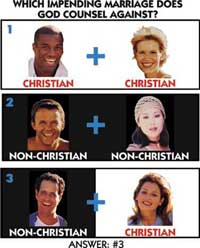
According to the Bible then, which of the following marriages in the picture at right does God counsel against entering into?
The answer is obvious—number 3. According to the Bible, the priority in marriage is that a Christian should marry only a Christian.
Sadly, there are some Christian homes where the parents are more concerned about their children not marrying someone from another ‘race’ than whether or not they are marrying a Christian. When Christians marry non-Christians, it negates the spiritual (not the physical) oneness in marriage, resulting in negative consequences for the couple and their children.13
Rahab and Ruth
The examples of Rahab and Ruth help us understand how God views the issue of marriage between those who are from different people groups but trust in the true God.
Rahab was a Canaanite. These Canaanites had an ungodly culture, and were descendants of Canaan, the son of Ham. Remember, Canaan was cursed because of his obvious rebellious nature. Sadly, many Christians state that Ham was cursed—but this is not true.14 Some have even said that this (non-existent) curse of Ham resulted in the black ‘races.’ This is absurd and is the type of false teaching that has reinforced and justified prejudices against people with dark skin.
In the genealogy in Matthew 1, it is traditionally understood that the same Rahab is listed here as being in the line leading to Christ. Thus Rahab, a descendant of Ham, must have married an Israelite (descended from Shem). Since this was clearly a union approved by God, it underlines the fact that the particular ‘people group’ she came from was irrelevant—what mattered was that she trusted in the true God of the Israelites.
The same can be said of Ruth, who as a Moabitess, also married an Israelite, and is also listed in the genealogy in Matthew 1 that leads to Christ. Prior to her marriage, she had expressed faith in the true God (Ruth 1:16).
When Rahab and Ruth became children of God, there was no longer any barrier to Israelites marrying them, even though they were from different ‘people groups.’
Real biblical ‘interracial’ marriage
If one wants to use the term ‘interracial,’ then the real ‘interracial’ marriage that God says we should not enter into is when a child of the Last Adam (one who is a new creation in Christ—a Christian) marries one who is an unconverted child of the First Adam (one who is dead in trespasses and sin—a non-Christian).15
Cross-cultural problems
Because many people groups have been separated since the Tower of Babel, they have developed many cultural differences. If two people from very different cultures marry, they can have a number of communication problems, even if both are Christians. Expectations regarding relationships with members of the extended family, for example, can also differ. Even people from different English-speaking countries can have communication problems because words may have different meanings. Counselors should go through this in detail, anticipating the problems and giving specific examples, as some marriages have failed because of such cultural differences. However, such problems have nothing to do with genetics or ‘race.’
Conclusion
-
There is no biblical justification for claiming that people from different so-called ‘races’ (best described as ‘people groups’) should not marry.
-
The biblical basis for marriage makes it clear that a Christian should marry only a Christian.
When Christians legalistically impose non-biblical ideas such as ‘no interracial’ marriage onto their culture, they are helping to perpetuate prejudices that have often arisen from evolutionary influences. If we are really honest, in countries like America, the main reason for Christians being against ‘interracial’ marriage is, in most instances, really because of skin colour. (By the way—every human being has the same skin colour—it just depends on how much of the colour one has).16
The church could greatly relieve the tensions over racism (particularly in countries like America), if only the leaders would teach that: all people are descended from one man and woman; all people are equal before God; all are sinners in need of salvation; all need to build their thinking on God’s Word and judge all their cultural aspects accordingly; all need to be one in Christ and put an end to their rebellion against their Creator.
References and notes
- ‘Missing links with mankind in early dawn of history,’ New York Tribune, p. 11, 10 February 1924. Return to text.
- Carl Wieland, Darwin’s bodysnatchers, Creation 14(2):16–18, 1992. Return to text.
- Steven Jay Gould, Ontogeny and Phylogeny, Belknap-Harvard Press, Cambridge, Mass. USA, pp. 127–128, 1977. Return to text.
- Jerry Bergman, ‘Ota Benga: The man who was put on display in the zoo!,’ Creation 16(1):48–50, 1993. Return to text.
- Robert Lee Hotz, ‘Race has no basis in biology, researchers say,’ Los Angeles Times article reprinted in the Cincinnati Enquirer, p. A3, 20 February 1997. Return to text.
- ‘We’re all the same,’ American Broadcasting Corporation News, 10 September 1998, <www.abcnews.com/sections/science/DyeHard/dye72.html>. Return to text.
- Susan Chavez Cameron and Susan Macias Wycoff, ‘The destructive nature of the term race: growing beyond a false paradigm,’ Journal of Counseling & Development, 76:277–285, 1998. Return to text.
- In the original, Ezra 9:2 refers to ‘seed,’ Romans 9:3 to ‘kinsmen according to the flesh.’ Return to text.
- Ken Ham, Where did Cain get his wife?, Answers in Genesis, Florence, Kentucky, USA, 1997. Return to text.
- J.C. Gutin, ‘End of the rainbow,’ Discover, pp. 72–73, November 1994. Return to text.
-
- Don Batten, David Catchpoole, Jonathan Sarfati, Carl Wieland, How did all the different ‘races’ arise (from Noah’s family)?, The Creation Answers Book, chapter 18
- Rugby star ‘proof of evolution,’ Creation 18(1):8, 1995.
- ‘Races very close,’ Creation 17(2):9, 1995.
- ‘Modern “Stone Age” reconsidered’, Creation 15(4):51, 1993.
- Carl Wieland, ‘Shades of Babel’, Creation 13(1):23, 1990.
- Dennis and Lyn Field (translators), ‘Julmbanu: Aboriginal Babel,’ Creation 8(2):11, 1990.
- Jerry Bergman, ‘Evolution and the origins of the biological race theory,’ Journal of Creation 7(2):155–168, 1993. Return to text.
- See note on Acts 17:26, in: John Gill, D.D., An exposition of the Old and New Testament; the whole illustrated with notes, taken from the most ancient Jewish writings (nine volumes), London: printed for Mathews and Leigh, 18 Strand, by W. Clowes, Northumberland-Court, 1809. Edited, revised and updated by Larry Pierce, 1994–1995 for Online Bible CD-ROM. Return to text.
- It is true that in some exceptional instances when a Christian has married a non-Christian, the non-Christian spouse, by the grace of God, has become a Christian. This is a praise point but it does not negate the fact that Scripture indicates that it should not have been entered into in the first place. This does not mean that the marriage is not actually valid, nor does it dilute the responsibilities of the marital union—see also 1 Corinthians 7:12–14, where the context is of one partner becoming a Christian after marriage. Return to text.
- See Genesis 9:18–27. Return to text.
- Examples of such ‘mixed marriages’ and their negative consequences can be seen in Nehemiah 9 and 10, and Numbers 25. Return to text.
- Dr Don Batten (with contributing editors Dr David Catchpoole, Dr Jonathan Sarfati and Dr Carl Wieland), How did all the different ‘races’ arise (from Noah’s family)? The Creation Answers Book, chapter 18 (2014). Return to text.

Readers’ comments
Comments are automatically closed 14 days after publication.