

Johannes Kepler (1571–1630)
Outstanding scientist and committed Christian

Johannes Kepler was born in the town of Weil der Stadt, Germany, on 27 December 1571. Johannes was a very small boy who was frequently ill. At the age of three years he contracted smallpox and lingered close to death for several months. His childhood was also unsettled and unhappy. His father was a mercenary soldier who was away from home for long periods, sometimes years at a time.
When Johannes’ mother went away to be with her husband, Johannes was left with his grandfather. The separation from his parents was distressing for Johannes, but God blessed him during these years. His grandfather, a dedicated Christian, encouraged young Johannes as his faith grew. Although poor, Johannes’ grandfather appreciated the value of education and sent Johannes to school. The boy’s outstanding academic ability soon came to the attention of his teachers.
When Johannes’ parents returned after several years, his father, Heinrich, set up business as an innkeeper.
Heinrich was not interested in paying fees to send his son to school. Instead he saw Johannes as a cheap source of labour in the inn, so Heinrich made his son leave school. However, business at the inn later declined and Johannes’ help was not really needed. With his former teachers’ encouragement, Johannes successfully obtained a scholarship from the Duke of Württemberg to enable him to continue his schooling. Johannes’ drunken father reluctantly allowed him to return to school.
Education
Through the Duke’s continued generosity, Johannes Kepler was able to begin attending the University of Tübingen in 1587. His studies included Latin, Hebrew, Greek, the Bible, mathematics, and astronomy. Kepler was taught mathematics and astronomy by Michael Mästlin, one of the few astronomy professors of that time who had accepted Copernicus’ idea that the planets, including the earth, revolved around the sun. Almost all scholars of that era still believed that the earth was the centre of the solar system.
Kepler obtained his B.A. degree in 1588 and his M.A. degree in 1591. He then continued at Tübingen, studying theology. During his youth, Kepler had become a committed Christian and dedicated himself to serving God. As he said shortly before he died, he believed “only and alone in the service of Jesus Christ. In Him is all refuge, all solace”.1 Kepler intended to serve God as a Lutheran minister after completing his university education. However, God had other plans for this uniquely gifted young man.
In 1594, Kepler was asked to go to the Lutheran high school in Graz, Austria, to replace the mathematics teacher who had just died. Although close to finishing his theological training, Kepler felt led by God to take up this teaching position.
Astronomy and astrology
As well as teaching mathematics in Graz, Kepler became district mathematician. This position involved surveying land, settling disputes over the accuracy of weights and measures used in business, and calendar-making. In addition to actually listing dates, calendars today frequently include information on public holidays, school holidays, and phases of the moon (full moon, new moon, etc.). Some calendars even include the dates of sporting events, social services payment days, and the like. Similarly, in Kepler’s time, calendars were expected to include information which was useful to people’s everyday lives. The information given included advice to farmers on when to plant and harvest crops, advice to leaders on military campaigns, advice on matters of romance, etc.
Today we understand how the relative positions of the sun, moon and planets, together with the tilt of the earth on its axis, combine to determine the seasons of the year, the phases of the moon, tides, eclipses of the sun and moon, and so on. These occurrences have scientific implications for agriculture, fishing, military planning, and other things. (Even in modern times, some military offensives are timed to fit in with seasons and moonlight.)
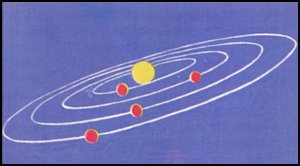
Each planet moves about the sun in an orbit that is an ellipse. The sun is at one focus of the ellipse.
With such present-day knowledge, legitimate conclusions based on the science of astronomy can be distinguished from unfounded claims based on astrology. However, in Kepler’s day, there was considerable confusion both in the general community and in universities regarding the distinction between astronomy and astrology. With their limited knowledge of the movements of heavenly bodies, scientists were unsure which events on earth were affected by events observed in the heavens and which were not.
Kepler continued making calendars. However, he determined that he would subsequently check the accuracy of his predictions in order to sort those which were legitimate from those which were not. As part of this process, Kepler published a book in 1601 which “rejected the superstitious view that the stars guide the lives of human beings”.2 Kepler progressively rejected other aspects of astrology as well. In his biography of Kepler, J. H. Tiner points out that, “Johannes was the first scientist to investigate the long term accuracy of astrology. His records showed that trusting in astrology could be a risky business”.3
Motion of the planets

The straight line joining a planet with the sun sweeps out equal areas in equal amounts of time. (This means that the planet travels faster when it is closer to the sun.)
| Planet | Av. Distance from sun, d (x 106 km) | Time (T) taken to revolve around sun | d3/T2 = constant (km3/yr2 x 1024) |
|---|---|---|---|
| Mercury | 57.9 | 0.241 | 3.34 |
| Venus | 108.2 | 0.615 | 3.35 |
| Earth | 149.6 | 1.00 | 3.35 |
| Mars | 227.9 | 1.88 | 3.35 |
| Jupiter | 778.3 | 11.9 | 3.35 |
| Saturn | 1427 | 29.5 | 3.34 |
| Uranus | 2870 | 84.0 | 3.35 |
| Neptune | 4497 | 165 | 3.34 |
| Pluto | 5900 | 248 | 3.33 |
Kepler strongly believed that “The world of nature, the world of man, the world of God—all three fit together”.4 In particular, Kepler reasoned that because the universe was designed by an intelligent Creator, it should function according to some logical pattern. To him, the idea of a chaotic universe was inconsistent with God’s wisdom. In contrast, many other scientists had given up searching for a simple logical pattern.
Without access to accurate data on the positions of the planets over a period of time, Kepler based his early attempts to discover the pattern behind the motion of the planets on the philosophies and mathematics of the ancient Greeks. He proposed his ideas in a book called Cosmic Mystery written in 1595. Although many of his ideas later proved to be incorrect (as is often the case in science), publication of this book brought Kepler to the attention of the outstanding Danish astronomer, Tycho Brahe.
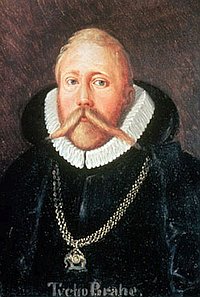
Tycho Brahe was so impressed with Kepler’s mathematical ability and keenness to apply mathematics to astronomy that he invited Kepler to join his team of astronomers. These astronomers had charted the paths of the planets across the sky for many years but could not make any sense of the complicated paths that they saw. In 1600, Kepler joined Tycho Brahe at his observatory in Prague. Kepler was given the task of investigating the orbit of Mars. At last he had access to the data he needed to really attack the problem of planetary motion scientifically.
The idea that the paths of the planets must be either circles or combinations of circles was almost universally accepted in Kepler’s time. However, Kepler found that even complex combinations of circles simply did not work. Turning away from popular thinking, Kepler “tried noncircular paths until he found the true solution: Mars revolves in an elliptical orbit with the Sun occupying one of its focuses”.5
Kepler further showed that a planet does not move an equal distance in an equal amount of time (i.e. at a constant speed) as was previously thought. Instead, he was able to show that the imaginary line joining the sun to the planet sweeps through equal areas of the ellipse in equal amounts of time. This means that the planet travels faster when it is closer to the sun, and slower when it is further away from the sun. Kepler published these first two laws of planetary motion in 1609 in a book entitled The New Astronomy.
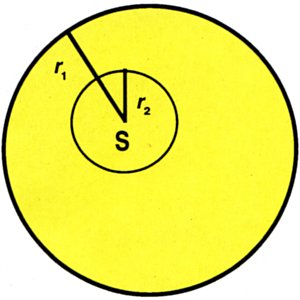
The squares of the periods (p) of any two planets’ revolutions are in the same ratio as the cubes of their mean distances from the sun (r). That is, r13 / r23 = p12 / p22
Ten years later, Kepler established his third principle of planetary motion, which mathematically related the time a planet takes to complete an orbit of the sun and the average distance of that planet away from the sun. This principle was published in Harmony of the Worlds in 1619. In this book, Kepler also praised God, saying, “Great is God our Lord, great is His power and there is no end to His wisdom”.6
Kepler’s Christian faith had led him to a pattern of thinking which had eventually enabled him to solve the riddle of planetary motion where so many other scientists had given up trying. Kepler had sought and found a simple logical pattern for planetary motion which reflected God’s wisdom. As Kepler said: “We see how God, like a human architect, approached the founding of the world according to order and rule and measured everything in such a manner.”7
Other discoveries
Kepler’s laws of planetary motion were his greatest contribution to science. These laws had an enormous impact on scientific thinking, providing the groundwork for Sir Isaac Newton’s later work on universal gravitation. However, Kepler made many other contributions to science as well. He discovered a new star (a supernova); he analysed how the human eye works; he made improvements to the telescope, and made other contributions in the field of optics. He published accurate data on the positions of stars and planets which were of immense value to navigators. He made various contributions to mathematics, including faster methods of calculation, and investigated the volume of many solid bodies.
Kepler is recognized as one of the founders of modern science. “In his three books, Cosmic Mystery, The New Astronomy, and Harmony of the Worlds, he began the process that eventually replaced superstition with reason.”8
Kepler also spent time investigating the dating of historical events in the Bible, including the birth of Jesus. In addition, he wrote a story called The Dream which is credited as being the first modern science-fiction story.
Life of tragedy
Johannes Kepler died after an acute illness in Regensberg, Germany, on 15 November 1630, aged 58 years. Kepler’s life had been filled with tragedy. The unhappiness and illness of his childhood were followed in adult life by the deaths of three of his six children during their childhood, the death of his first wife, and repeated religious persecution. Kepler lived in an era in which most rulers expected the people to adopt the religious beliefs held by the ruler. However, he refused to change his beliefs with a change of ruler. Kepler was a man of the Bible and refused to accept man-made rules which he believed contradicted the Bible. Unfortunately, this stand caused him to suffer great persecution on a number of occasions.
Another traumatic event in Kepler’s life was the trial of his superstitious mother who was accused of witchcraft. Had she been convicted, she would have been tortured and burnt at the stake. It was only Kepler’s skilful defence of his mother that saved her.
Throughout all these trials, Kepler kept his unshakable faith in God. He summarized his faith by saying simply that “I am a Christian”.9 Despite his great achievements, he remained humble. His desire was to “Let my name perish if only the name of God the Father is thereby elevated”.9
He acknowledged God as “the kind Creator who brought forth nature out of nothing”.9
Kepler was prepared to put aside the plans he had made for his life, and to humbly follow God’s leading.
As a result, he was able to say in later life that, “I had the intention of becoming a theologian … but now I see how God is, by my endeavours, also glorified in astronomy, for ‘the heavens declare the glory of God’.”9
References and notes
- Johannes Kepler, quoted in: Tiner, J. H., Johannes Kepler-Giant of Faith and Science, Mott Media, Milford, Michigan (USA), p. 193, 1977. Return to text
- Encyclopaedia Britannica, 15th ed., vol. 22, p. 506, 1985. Return to text
- Tiner, Ref. 1, p. 69. Return to text
- Kepler quoted in Tiner, Ref. 1, p. 172. Return to text
- Encyclopaedia Britannica, vol. 22, p. 507, 1985. Return to text
- Kepler quoted in Tiner, Ref. 1, p. 178. Kepler’s Third Law of Planetary Motion states: P² ∝ a³ where P is the orbital period of planet and a is the semimajor axis of the orbit, while ∝ means “is proportional to”. Return to text
- Ref. 1, (inside front cover). Return to text
- Tiner, Ref. 1, pp. 195-196. Return to text
- Kepler quoted in Tiner, Ref. 1, p. 197. Return to text


Readers’ comments
Comments are automatically closed 14 days after publication.