
Does Genesis allow any scientific theory of origin?
A response to J.P. Dickson
This is the pre-publication version which was subsequently revised to appear in Journal of Creation 26(1):106–115.
Editor‘s note: There is a response from Dr Dickson and reply from Prof. Zuiddam here: Genesis 1 and theories of origin.
Twenty years ago a minister of a large evangelical/reformed congregation in Holland was preaching on Genesis 1: Of course Moses did not write it. The Israelites only had a Bible with stories about Abraham and after. The rest was invented during the Babylonian captivity when Jewish children asked their parents about the origins of the world. Please don’t ask whether Genesis 1 happened historically. It is just a religious way of saying that sometime, somehow, God stood at the beginning of everything. There is no conflict between evolutionistic science and the Bible.
Over the last few years this same approach is preached in Australia, also in circles with a strong reformed inheritance. John P. Dickson (a prominent spokesperson in the Anglican diocese of Sydney) has been encouraging a “symbolic reading” of Genesis 1 and the creation story. In this way, like many scholars in non- or formerly-evangelical churches before him, he tries to create a ‘safe haven’ for faith and Scripture in the onslaught of Neo-Darwinism and other secular scientific views on the origin of man. It doesn’t matter what scientific view you hold to, Genesis 1 always fits the bill. Or so Dickson claims.
This article considers Dickson’s views, their doctrinal implications and the patristic sources that he calls in to support his theory.1
The way Dickson deals with the Church fathers sheds light on his methodology, so this is a good starting point to evaluate his approach. He claims that his kind of symbolic reading of Genesis has existed for many centuries and found a place in Jewish and Christian tradition. Through Philo of Alexandria, Clement of the same city, Ambrose of Milan and Augustine of Hippo a symbolic approach to Genesis 1 claims an accepted place among Judaism and Christianity alike. At least, that is the idea. Is this really so? Is there a possibility that Dickson’s claims rest on hearsay, rather than a careful consultation of the primary sources?
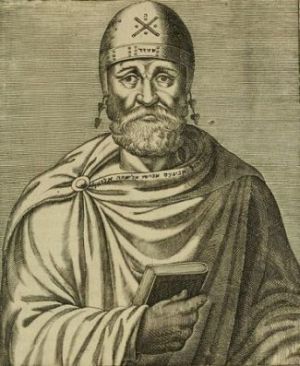
Philo Judæus (c. 20 BC – AD 50)
Dickson quotes from Colson and Whitaker’s introduction to the Loeb edition of Philo (dating back to 1929) to pave the way for his non-literalistic reading of the days in Genesis 1.
By ‘six days’ Moses does not indicate a space of time in which the world was made, but the principles of order and productivity which governed its making.
Had Dickson been more familiar with Philo’s writings, he would probably not have used this quote in this particular context. More recent scholarship on this subject would have dissuaded him from this course altogether. One of the foremost Philo specialists calls for extreme caution:
In actual fact, strange as it may seem, Philo scarcely allegorizes the account of Genesis 1 (it is excluded from his two series of allegorical commentaries).2
From a patristic point of view, the fact that Philo recognizes order and productivity in the creation account, and points this out, does not deny that he also saw Genesis 1 as factual history. Yes, the quote from the introduction to Colson’s translation leaves room for Dickson’s interpretation, but Philo does not. In Alexandrine philosophy and theology there are often layers of interpretation of the sacred text that do not rule one another out. It is not either/or, but both. Sometimes only one interpretation is relevant for the writer’s present goal, but that doesn’t mean that Philo rigidly clings to one possibility like a 19th century German source critic. For Philo it often was history and allegory. A closer look at Philo’s writings on the subject confirms this. The Alexandrian himself3 says:
The nation of the Jews keep every seventh day regularly, after each interval of six days; and there is an account of events recorded in the history of the creation of the world, comprising a sufficient relation of the cause of this ordinance; for the sacred historian says, that the world was created in six days, and that on the seventh day God desisted from his works, and began to contemplate what he had so beautifully created. (On the Decalogue XX,97)4
Philo makes it abundantly clear that he regarded Genesis 1 as an historical account: “Account of events recorded in the history of the creation of the world,” “for the sacred historian” and a “beautifully created” world. Do you want it any clearer? Whatever one’s personal thoughts on the subject, it is clear what Philo thought.
It is at best a logical fallacy to suggest that Philo practised a symbolic reading of Genesis only.
In fact, on a historical level of interpretation, the Alexandrian philosopher actually denies that God used periods of non-specified lengths of time. This is the very opposite of what Dickson alleges. Yes, as a theoretical possibility Philo allows that God could have taken any amount of time other than six days. Who could deny that, when speaking about a sovereign God? But one has to read further. Like Augustine a few centuries later, Philo considers the possibility that God could have done it quicker than in six days, rather than longer! However, that is not his personal view. Philo settles for a historical creation in six days:
But God, on one occasion, employed the six days for the completion of the world, though he had no need of any length of time for such a purpose; but each man, as partaking of a mortal nature, and as being in need of ten thousand things for the unavoidable necessities of life, ought not to hesitate, even to the end of his life, to provide himself with all requisites, always allowing himself an interval of rest on the sacred seventh day. (On the Decalogue XX,99)5
In this way, Philo stated, a Jew who keeps the Sabbath may be confident that he is imitating God. He is not using a symbolic day in Genesis to argue for a literal day in the present. Philo uses the actual length of the period of the days in Genesis to argue for literal days now.
The commandment, in effect says: Always imitate God; let that one period of seven days6 in which God created the world, be to you a complete example of the way in which you are to obey the law, and an all-sufficient model for your actions. (On the Decalogue XX,100)7

Clement of Alexandria (c. AD 150–215)
Dickson’s argument becomes confused when he tries to build a whole string of assumptions on his earlier inaccurate representation of Philo. Dickson says that Christian theologian and evangelist Clement of Alexandria followed Philo’s interpretation. This statement is rather puzzling, as Philo didn’t have the interpretation that Dickson alleges. But in a way it is true in the sense that Clement followed Philo’s interpretation: like Philo he was also some sort of a six day literalist,8 like all his Jewish and Christian contemporaries.
As with Philo, Dickson does not seem to realize that in patristic literature the recognition of potent symbolism in a text is not necessarily a denial of its historicity.
On the basis of Stromata 6.16 Dickson alleges that for Clement of Alexandria the days in Genesis are symbolic. It might be, but also with Church fathers it pays to have a look at the genre of a book, its purpose and context. In this respect I would add a caveat, that some caution applies. The Stromata are not so much books by Clement, but rather an assemblage of bits and pieces collected by Clement. Although this certainly seems to include Clement’s thoughts and opinion, it could be premature to conclude off-hand that a reference to the Stromata equals a reference to Clement’s opinion. For Stromata 6.16, however, there is no immediate objection to using this as a working hypothesis. The main question is: Does Clement make out a case for symbolic use of the days of creation in Stromata 6.16?
One wonders whether the passage in question was actually consulted, as 16.6 makes it evident that Clement does the very opposite of what Dickson thinks. He actually confirms that creation was completed in six days as we experience them. What is more, Clement places this in a firm (pre-) scientific context of his time: medicine, science, maths and philosophy. He uses the days it takes for an embryo to develop in the same breath as he speaks about the six days of creation.
“For the creation of the world was concluded in six days. For the motion of the sun from solstice to solstice is completed in six months— in the course of which, at one time the leaves fall, and at another plants bud and seeds come to maturity. And they say that the embryo is perfected exactly in the sixth month, that is, in one hundred and eighty days in addition to the two and a half, as Polybus the physician relates in his book On the Eighth Month, and Aristotle the philosopher in his book On Nature.”9
The days in Genesis are not part of his symbolic case. On the contrary, he bases his symbolic case on them. Clement is actually arguing for a symbolic scheme of salvation on the basis of facts in history and nature. One of these facts from history, as he saw it, was the conclusion of creation in six days. Clement put this on the same factual level as the (apparent) motion of the sun, the seasons and the development of the human embryo. So Clement introduces a reference to literal creation days to argue that the human body needs a day of rest per week and that it may look forward, symbolically, to eternal rest and salvation. For him six is a perfect number because it is derived from the creation of the world. In Clement’s thinking this is not some mythical story of which we should remember nothing but that the good Lord created the world sometime and somehow. In Stromata 6.16 the days are as literal as those of an embryo in the womb and other scientific phenomena around us.
It is not only important to consult primary sources, apply philology and recognize genre when one deals with Scripture, but also when one reads the fathers and their contemporaries. In alleging that Clement argues for a symbolic interpretation of the creation days in Genesis, Dickson actually assumes the very opposite of what Clement of Alexandria is saying.
Augustine (AD 354 – 430)
The confusion continues as Dickson calls in St Augustine to support his theory. Dickson doesn’t seem to be aware that Augustine stressed the historical layer of interpretation more as he grew older, and perhaps wiser. One of the present standard works on Patristic Studies (Moreschini and Norelli, Early Christian Greek and Latin Literature, a literary history, volume two, 2005:386–387) cautions:
“The most important of Augustine’s exegetic works, On Genesis Literally Interpreted (De Genesi AD literram), is directed in part against the Manicheans. As the title indicates, Augustine here renounces all allegorical and typological interpretation such as he had used in his preceding work of exegesis of Genesis. He rejects such interpretations even of the existence and location of the earthly paradise. This work is undoubtedly one of the most important of those produced by the ancients on the interpretation of Genesis, as well as one of the most important of Augustine’s writings. His purpose is to show that there is no contradiction between the facts of creation of the world and humanity, even when these are taken literally, and the human sciences as represented in particular by philosophy.”
Augustine believed in a literal creation of Adam and Eve, in an earthly paradise that could be located. According to Moreschini and Norelli, the older Augustine rejected many of his earlier allegorical and symbolic interpretations of Genesis. This basic patristic knowledge of Augustine’s approach to Genesis should have ruled out using him for a symbolic interpretation of Genesis that fits any scientific theory. In Dickson’s terms, the mature Augustine was a committed ‘literalist’. This is evident not only from On Genesis Literally Interpreted, but also from his other main work, The City of God.
Dickson continues:
“Augustine understood the ‘days’ in Genesis 1 as successive epochs in which the substance of matter, which God had created in an instant in the distant past, was fashioned into the various forms we now recognise.”
Dickson correctly asserts that Augustine suggested an instant creation that was worked out afterwards. But he does not rely on the primary sources when he says that the church father suggested that this was in a distant past. On the contrary, Augustine positively affirmed that this moment took place some seven thousand years ago. The bishop of Hippo vigorously argued against the old-earth philosophers of his day. A substantial part of his main work De Civitate Dei is taken up by this debate. What is even less well known is that Augustine firmly teaches that the whole human race descends from one man (De Civitate Dei 12.21):
That There Was Created at First But One Individual, and that the Human Race Was Created in Him.
Now that we have solved, as well as we could, this very difficult question about the eternal God creating new things, without any novelty of will, it is easy to see how much better it is that God was pleased to produce the human race from the one individual whom He created, than if He had originated it in several men. For as to the other animals, He created some solitary, and naturally seeking lonely places—as the eagles, kites, lions, wolves, and such like; others gregarious, which herd together, and prefer to live in company—as pigeons, starlings, stags, and little fallow deer, and the like: but neither class did He cause to be propagated from individuals, but called into being several at once. Man, on the other hand, whose nature was to be a mean between the angelic and bestial, He created in such sort, that if he remained in subjection to His Creator as his rightful Lord, and piously kept His commandments, he should pass into the company of the angels, and obtain, without the intervention of death, a blessed and endless immortality; but if he offended the Lord his God by a proud and disobedient use of his free will, he should become subject to death, and live as the beasts do—the slave of appetite, and doomed to eternal punishment after death. And therefore God created only one single man, not, certainly, that he might be a solitary, bereft of all society, but that by this means the unity of society and the bond of concord might be more effectually commended to him, men being bound together not only by similarity of nature, but by family affection. And indeed He did not even create the woman that was to be given him as his wife, as he created the man, but created her out of the man, that the whole human race might derive from one man.10
It is as clear as the daylight of creation: Even Augustine leaves no room for Dickson’s theory. Alas, the Church fathers seem to suffer the same fate as the classics: often referred to, but not always read.
Fathers in general
The evaluation of Philo, Clement and Augustine shows that Dickson’s anti-literalistic, symbolic interpretation of Genesis lacks support in history and the sources he refers to. It is a post-modern reinterpretation of what, in Dickson’s view, early philosophers and fathers should have said. Although they allow for symbolic interpretation, in addition to their understanding that it was history, their symbolism is of a very different kind than what Dickson’s theory proposes. Even Augustine has a far more ‘literalistic’ approach to number symbolism than Dickson (2008:8).11
The main problem with Dickson’s thesis for the field of patristic studies is not even his shaky methodology, but the fact that his theory is in flagrant opposition to virtually all fathers. On one crucial point Dickson’s interpretation of Genesis 1 as symbolism (allegedly fitting any scientific theory of origin) is ruled out by every available Church father, including Ambrose of Milan. That is where it concerns the creation of man.
“The Fathers are in accord in teaching that God immediately created the first man, both as to body and soul.”12
In other words, all Fathers taught a ‘literalistic’ interpretation of Genesis where the origin of mankind was concerned.13 None of them leaves room for the concept of common descent from animals, which is foundational to secular scientific thinking in the 21st century.
They all teach an immediate, historical creation of Adam. Not as a symbol, but as the first historical man.
Thomas Aquinas (1225–1274) shares this approach. Dickson’s article is blissfully unaware that Thomas didn’t make a wholesale endorsement of Augustine’s view of creation, particularly not as he matured. It is important to at least read, but preferably also understand your own references. The Summa Theologica combines aspects of Augustine’s view with a most literalistic approach to the text. Thomas even argues against actual death in the animal world before the Fall (ST.I.72 AD 5),14 and tells us that “since man before he sinned would have used the things of this world conformably to the order designed, poisonous animals would not have injured him” (ST.I.72 AD 6).15 In fact, earlier allowances that Thomas made as a young scholar in the Sentences (Scriptum super Sententiis, a commentary on Peter Lombard’s views), should be seen in their proper light. The Summa shows that eventually Thomas seems to have settled on the literal sense of the word day for Genesis 1. He even accepted that the day period was observed before the sun, moon and stars were created:
The general division of time into day and night took place on the first day, as regards the diurnal movement, which is common to the whole heaven and may be understood to have begun on that first day. But the particular distinctions of days and seasons and years, according as one day is hotter than another, one season than another, and one year than another, are due to certain particular movements of the stars: which movements may have had their beginning on the fourth day. (ST.I.70.2)16
In all things it was for Thomas ultimately: In contrarium sufficit auctoritas Scripturae.
Dickson’s views on Genesis are in fact a major clash with all the fathers, including Augustine, and medieval scholars like Thomas, to whom he refers for approval. For none of them was the creation story mere symbolism. All of them took at least crucial parts also very literally as history. And it is those crucial parts that seem irreconcilable with e.g. the Neo-Darwinist theory of origins, to mention just one view that Dickson allegedly accommodates.
No Mosaic authorship
Dickson not only find himself at grave odds with the fathers and traditional Christianity where it concerns allowing denial of the immediate creation of Adam as the first historical man.
Dickson (2008:9) also rejects the Mosaic authorship of Genesis 1:
In the case of Genesis we absolutely must remember that this text was composed two and half thousand years before the scientific era.
It is the same old story of 19th century liberal scholarship all over again: Jewish exiles inventing their own creation story, in opposition to Babylonian creation myths, nearly a thousand years after Moses.
Again, none of the church fathers endorsed this approach. They had a very different view on the origin of the book of Genesis and believed that Moses wrote it (c. 1400 BC). As Dickson denies this, this has consequences for the way the New Testament is approached as well. The traditional Mosaic link between the opening verses of John’s Gospel and Genesis (Jesus as the Word of God through whom all things were made “in the beginning”) disappears. Jesus claims that Moses wrote about him (John 5:46). This is linked to the first creation (John 1:1–17), and the second creation (regeneration and salvation, John 3:1–18). Dickson’s theory breaks this Mosaic connection in the literary context of this Gospel as far as natural history is concerned. For Dickson’s Moses, Jesus was all about salvation. For John’s Moses, however, Jesus was the Creator (maker and rightful owner) and Saviour (redeemer and rightful Lord). St John and Dickson seem to have very different views on who Moses was and what he wrote.
Serious and multiple doctrinal repercussions
Dickson’s views have many undesirable implications for the interpretation of the New Testament as well as the Old. The New Testament claims that it was through Jesus Christ, the pre-existing Son of God, that all things were created (e.g., John 1:1–3; Colossians 1:16–17). Did our Saviour create by means of death, struggle, elbow work and destruction? How dare he then call it “very good”? What sort of sinister maniac would do that? Is this the sort of God one meets in the Old and New Testament, whom Christians relate to and worship as the holy, righteous God?
These are some of the doctrinal repercussions that Dickson’s article doesn’t even touch on. There is not only the subject of Christology and creation, but also concerning the person of God and his works and the concept of theodicy. In other words, can you trust God, is He holy and just, or really morally responsible for natural evil in this world?
This has implications for eschatology as well. If the first creation, although it was called “very good” by God himself, was in actual fact a nightmare of death and destruction that lasted hundreds of millions of years, God might have a very different understanding of the new heavens and a new earth than what a 21st century person understands to be very good. The promises in Revelation chapters 21 and 22 (and 2 Peter 3) may turn out to be non-essential and irrelevant symbolism. It may well have another purpose than conveying that sin, sickness and death would once again disappear from the scene of history.
The doctrine of sin is at risk as well. Is death a consequence of sin and the last enemy that Christ came to conquer (1 Cor. 15:26)? Or was it actually one of God’s creation tools in the evolution of man? Did Christ come into the world to save sinners, or to undo some of the effects of his own devastating creation mechanisms?
The textual context of Genesis 3 clearly indicates that death and struggle for survival in the human world is God’s punishment on the first human sin. Genesis 3 (KJV):
16Unto the woman he said, I will greatly multiply thy sorrow and thy conception; in sorrow thou shalt bring forth children; and thy desire shall be to thy husband, and he shall rule over thee. 17And unto Adam he said, Because thou hast hearkened unto the voice of thy wife, and hast eaten of the tree, of which I commanded thee, saying, Thou shalt not eat of it: cursed is the ground for thy sake; in sorrow shalt thou eat of it all the days of thy life;18 Thorns also and thistles shall it bring forth to thee; and thou shalt eat the herb of the field;17
The KJV has still one of the best renderings of this passage, as the Hebrew shows that the curse of sorrow falls on man and woman alike (cf. Tamara Cohn Eskenazi, The Torah: a women’s commentary, URJ Press, 2008:17). In many of the scientific theories, which Dickson says his view accommodates, these curses are not a consequence of sin, but creation tools of a divine torturer who claims this is really “very good”.
Creation consequently suffers with man, the steward of creation, as a result (e.g. thorns and thistles grow from the soil). Paul affirms this, that the creation was “subjected to futility” (Romans 8:19–22).18 It is because of human sin that death entered the kosmos (Romans 5:12). That is why mankind needs to be reconciled to God. For all of the New Testament this is the reason why God’s Son became incarnate and paid the price for sin. The last enemy that shall be conquered is death.
While some might argue that this was only the origin of human death, Dickson accommodates theories which do not allow for this: for them, death was here all along; even human death did not begin with human sin. In this way, core biblical concepts are overturned. To retain some connection with the early chapters of Genesis, some might argue that it was ‘spiritual’ death in Genesis 3. The literary context, however, firmly indicates physical death:
19In the sweat of thy face shalt thou eat bread, till thou return unto the ground; for out of it wast thou taken: for dust thou art, and unto dust shalt thou return.19
Hence Jesus, as the “last Adam” died a physical death on the cross. Paul affirms that it was a crucial element of Christ’s mission to undo the curse of death. Without the prospect of the resurrection we are of “all men most miserable”. The death that people tried to come to terms with in Genesis 3, and ever since, is the mortality of the body: their own and that of loved ones. The severance of vague spiritual connections is nearly irrelevant, when compared with the impact of mortality on man, ancient and present. One should not try to read alien philosophical concepts of a different time and culture into an ancient text.
Most of the doctrinal repercussions of Dickson’s approach are in some way related to the doctrine of Scripture. This isn’t merely a matter of picking a different genre for Genesis. The doctrinal repercussions in several areas make that clear already. It isn’t only about the Old Testament either. Particularly in Anglican circles some have thought they could take this approach. C.S. Lewis was among them. While he defended the historicity of the Gospels and Jesus’ miracles, he was happy to consider Jonah and Job as myths.20 Reasoning along these lines, the first Adam was a metaphor (Romans 5),21 but the last Adam (1 Corinthians 15) “definitely” historical. How much of this notion is really based on careful interpretation of the Bible books concerned? Isn’t it rather the neo-evangelical notion that we want to have our ticket to heaven paid for, the selfish notion of Jesus dying on the cross for us, while we take away the historical basis that causes it to make sense? Has Karl Barth (who said it is not important whether the Bible is historically accurate, as long as it becomes the inspiring Word of God for you now) won after all?
Authority of Scripture
On the one hand it is the authority of the Old Testament that is at stake. Doesn’t Neo-Darwinism demolish both the historic and symbolic sense of Genesis 1, reducing it to a myth of the worst sort? Is Genesis 1 factually correct in proclaiming that God’s was a “very good” creation? Was it “excellent” on completion? Or was it really a never-ending torture room of millions of years of sickness, death, cheating and corruption that led to something good that really wasn’t? Wouldn’t such goodness in Genesis be a symbolism of the most sinister sort? Were all of these things that one instinctively deems wicked, actually creation tools like Neo-Darwinists confidently assert? Was there a good creation, a paradise and a fall? Or is that all part of the make-believe packaging, which claims that this is irrelevant as long as we remember that somehow, sometime God stood at the beginning of everything? What kind of god is he; does he exist at all? If so, isn’t he rather a monster, something like the Demiurge of old? Isn’t it time that we joined up with Marcion, the early heretic who rejected the Old Testament and regarded the God of the OT as a different, tyrannical God compared to the one of the NT? These pertinent questions are painfully avoided by Dickson’s article.
Dickson doesn’t even begin to consider the implications of his answers for the unity and authority of Scripture and the reality of salvation history.
The New Testament and its authority are also affected by how one chooses to interpret Genesis. The New Testament is different, C.S. Lewis would have said. Many repeat this sentiment. Luke is regarded as an eminent historian. But isn’t it Luke who purports to give his readers a factual historical family tree of Jesus? (Luke 3:23–38, NRSV)
23 Jesus was about thirty years old when he began his work. He was the son (as was thought) of Joseph son of Heli, 24 son of Matthat, son of Levi, son of Melchi, son of Jannai, son of Joseph, 25 son of Mattathias, son of Amos, son of Nahum, son of Esli, son of Naggai, 26 son of Maath, son of Mattathias, son of Semein, son of Josech, son of Joda, 27 son of Joanan, son of Rhesa, son of Zerubbabel, son of Shealtiel, son of Neri, 28 son of Melchi, son of Addi, son of Cosam, son of Elmadam, son of Er, 29 son of Joshua, son of Eliezer, son of Jorim, son of Matthat, son of Levi, 30 son of Simeon, son of Judah, son of Joseph, son of Jonam, son of Eliakim, 31 son of Melea, son of Menna, son of Mattatha, son of Nathan, son of David, 32 son of Jesse, son of Obed, son of Boaz, son of Sala, son of Nahshon, 33 son of Amminadab, son of Admin, son of Arni, son of Hezron, son of Perez, son of Judah, 34 son of Jacob, son of Isaac, son of Abraham, son of Terah, son of Nahor, 35 son of Serug, son of Reu, son of Peleg, son of Eber, son of Shelah, 36 son of Cainan, son of Arphaxad, son of Shem, son of Noah, son of Lamech, 37 son of Methuselah, son of Enoch, son of Jared, son of Mahalaleel, son of Cainan, 38 son of Enos, son of Seth, son of Adam, son of God.22
If Adam was a myth, in what part of this genealogy does Luke stop being an eminent historian? Wasn’t he rather un-careful to refer to Moses as the author of the Torah (16:31, 24:44)? Wouldn’t that be rather strange for someone who is described as meeting and talking with Moses (9:28–36)? Or was Luke portraying a Jesus who adopted the ignorant conventions of his time, or, perhaps, who did not know any better himself (kenosis theology) and as a result confirmed people in their ill-founded literalistic approach of Genesis stories like the one about Sodom and Gomorra (Luke 10:12), Lot (Luke 17:28–30), even Lot’s wife turning into a pillar of salt (Luke 17:32), not to mention Noah and the Ark (Luke 17:26–27, cf. 3:36)?
If Genesis 1–11 is an invention by well-meaning religious Jews in the Babylonian exile; if it is essentially mythological in character, there should be implications for how one reads the New Testament as history as well. Luke has a thoroughly ‘literalistic’ approach to Genesis. With someone that ignorant (in terms of Dickson’s theory), how can one rely on the historical nature of his accounts that deal with the supernatural? For instance, when Luke describes Jesus raising the widow’s son (7:11–17), or Jaïrus’s daughter (8:40–56). What about the resurrection of Jesus himself (Luke 24)? If Dickson’s approach to Scripture is valid, then the same principles that apply to Genesis have a literary basis in the text of the Gospel as well. Consequently, one could argue that Jesus is all about overcoming spiritual death, that asking questions about the historical nature of the miracles and mythological references is just silly literalism. Luke didn’t mean to teach that Jesus really descended from Adam, Noah and Shem. Nor did he want his readers to believe that all the ‘fanciful’ things he writes about the life of Jesus really happened. Luke just tried to get the message across that he thought that Jesus was a great guy, who continues to be spiritually present in the lives of those he touched. Luke is just showing appreciation in his pre-scientific way, just like Genesis only intends to show that somehow God stood at the beginning.
Dickson’s theory not original
As Dickson presents ‘his’ solution to the Genesis ‘problem’, the reader should realize that he is far from original. Henry Blocher (who also lectured at Moore Theological College in 1995) and Meredith Kline both advocated similar views.23 All of these are versions of substantially the same thing: the framework hypothesis of Arie Noordtzij, which dates back to 1924.24 This theory has serious flaws that were pointed out by G.Ch. Aalders as early as 1932.25
Dickson does not give any reference or credit to C. John Collins, one of the best-known contemporary scholars on Genesis. As Dickson wrote several years after Collins’ main publication, one must, because of the lack of reference, suppose he is not familiar with this scholar’s work. Still, what Dickson writes is basically the same as Collins proposes in his Genesis 1–4: A Linguistic, Literary, and Theological Commentary (Phillipsburg 2006).
Collins (who is not original in his approach either, but in turn leans heavily on others) gave a summary of his view in a way that is virtually identical to the argument in Dickson’s article two years later:
Many popular figures, both of the secular and creationist varieties, are sure that the two are incompatible, and we must ditch either the biblical story or the scientific one. It may come to that, but not just yet. First we must decide whether the two stories really do conflict; and in raising the question, we realize that to do so we have to compare interpretations of the data. I have given reasons against a literalistic reading of Genesis, and this literalistic reading is the one on which the supposed conflict is based. (Collins 2006:255)
John Collins regards Genesis 1:1–2:3 as an uncommon narrative genre and refers to chapter one as “exalted prose narrative”. From this label he draws the conclusion that as a narrative Genesis 1 has to be connected up to other narratives about the origins of the world. Dickson does this as well by following what liberal scholarship has done for more than a century now, suggesting a connection with the Babylonian creation myth. As far as the terminology is concerned, it was Collins who warned earlier that one must not read “literalistic” hermeneutics into the text (e.g. 2006:44, 77, 123, 163). Collins sees Genesis 1 as an alternative for other middle-eastern creation stories. Dickson does the same and singles out the Babylonian creation myth Enuma Elish (cf. Collins, 2006:45) for that purpose. Collins doesn’t see conflict between any theories of origins in contemporary Neo-Darwinist science and Genesis. Dickson idem dito.
For someone familiar with the field of OT studies, it is somewhat surprising to find Dickson suggesting, in so many words, that “literalistic” is his invention:
Six day creationists and scientific materialists approach the opening chapter of the Bible in a ‘literalistic’ fashion. I use the word ‘literalistic’ deliberately, as I want to distinguish between literalistic and literal. A literalistic reading takes the words of a text at face value, interpreting them with minimal attention to literary genre and historical context.
In summary, Dickson has not come up with an original theory. On critical issues his method does not include (or give credit to) contemporary scholarship on his subject.
Early religious recipients
The crucial defect in Collins’ approach, followed (unwittingly) by Dickson, is that it isolates passages from their chapter, book and collection. As a rule it is much better to establish the scope and character of the book, rather than attributing a certain literary genre to a passage in isolation. Like Collins, Dickson alleges that Genesis 1 is ‘debunking’ pagan creation stories. The literary form of Genesis 1, however, does not show any polemics. Deuteronomy and many of the Prophets deserve this label, but not Genesis 1. On a philological level, the formal indicators and polemic contents are absent here.26 The polemics are read into the text on the basis of historical assumptions for which there is a lot of consensus among (liberal) scholarship but little or no evidence in the primary sources.
In the Jewish religious tradition, Genesis comes as a book and in the package of the Torah. As a book it has a historic focus: the toledot (history/origin), first of the world,27 subsequently of the Israelite nation. Packaged in the Torah and universally attributed to Moses in Jewish tradition, it would seem unhistorical to remove Genesis 1 from this wider literary context. There is no evidence that this approach was shared by Jews and early Christians. Exodus 20:11 applies the description of the creation days in Genesis 1 to the workweek of the Israelites. Because God created in six days, the Israelites have to follow that pattern for their week: six days labour, one day rest. Within this wider context, the specific use of the terms “evening” and “morning” points to days as the Israelites knew them.
Historically it is important how the first recipients of a religious text interpreted it and how it was appreciated in their community and tradition. They spoke the language and shared the same culture. There is not much doubt as to how Genesis 1 was read and received in Judaism. For the Jews it was an historical account of how God created the world, less than ten thousand years ago. This is evident even in Philo and was so general a view that it is still reflected by the Jewish calendar. Pre-scientific or not, the mainstream interpretation among Jews and Christians from Exodus to Ussher is that Genesis 1 conveys the message that God created the earth in roughly six days and at a point in history that is regarded as impossible in terms of the Neo-Darwinist meta-narrative of origin and descent.
By all means, conclude that the early Jewish interpretation was wrong and prescientific, even that the Christian Church uncritically followed this ‘literalistic’ approach and should now mend its way in the light received from Neo-Darwinism and other theories. If one has determined that Christianity and its concepts of God are no longer tenable, so be it. Let’s be ‘honest to God’ about it, but to men as well. But let’s do justice to the prima facie evidence of the primary source and its history in religious tradition. Only a ventriloquist would read (post-) modern symbolism in a religious tradition that in fact does the opposite.
Common ground?
Fortunately Dickson confirms one aspect of a high view of creation (2008:14). What God made was “good” and looking back on it all on the seventh day, the end result was “very good.” This gives him some common ground with the fathers and doctors of the Church.
It is this same ancient conviction that continues to resound, even in modern praise and worship:
God is good. We sing and shout it. God is good. We celebrate. God is good. No more we doubt it. God is good.
But is He? Or is this just an irrational leap of faith, with no basis in the historical facts available to us?
The premise that God is historically and factually good is an anomaly in Dickson’s theory, inconsistent with his accommodation of Neo-Darwinist views on the origin of this world.
The fallacies in Dickson’s methodology and his treatment of primary and secondary sources make one thing clear:
Genesis does not fit any secular scientific theory.
References
- This article is a response to John P. Dickson, The Genesis of Everything, ISCAST Journal for Christians in Science and Technology 2008(4):1–18. Return to text.
- Runia, David T., Review of Carmichael, Calum, M., The Story of Creation: Its Origin and Its Interpretation in Philo and the Fourth Gospel, Cornell University Press (Ithaca and London), 1996; Review of Biblical Literature, 15 Feb., 1999; www.bookreviews.org/bookdetail.asp?TitleId=2243&CodePage=922,2740,2160,2108,2753,611,916,62,2243,1658. Return to text.
- The full quote of Philo on the fourth commandment. On the Decalogue XX:
(96) The fourth commandment has reference to the sacred seventh day, that it may be passed in a sacred and holy manner. Now some states keep the holy festival only once in the month, counting from the new moon, as a day sacred to God; but the nation of the Jews keep every seventh day regularly, after each interval of six days; (97) and there is an account of events recorded in the history of the creation of the world, comprising a sufficient relation of the cause of this ordinance; for the sacred historian says, that the world was created in six days, and that on the seventh day God desisted from his works, and began to contemplate what he had so beautifully created; (98) therefore, he commanded the beings also who were destined to live in this state, to imitate God in this particular also, as well as in all others, applying themselves to their works for six days, but desisting from them and philosophising on the seventh day, and devoting their leisure to the contemplation of the things of nature, and considering whether in the preceding six days they have done anything which has not been holy, bringing their conduct before the judgment-seat of the soul, and subjecting it to a scrutiny, and making themselves give an account of all the things which they have said or done; the laws sitting by as assessors and joint inquirers, in order to the correcting of such errors as have been committed through carelessness, and to the guarding against any similar offences being hereafter repeated. (99) But God, on one occasion, employed the six days for the completion of the world, though he had no need of any length of time for such a purpose; but each man, as partaking of a mortal nature, and as being in need of ten thousand things for the unavoidable necessities of life, ought not to hesitate, even to the end of his life, to provide himself with all requisites, always allowing himself an interval of rest on the sacred seventh day. (100) Is it not a most beautiful recommendation, and one most admirably adapted to the perfecting of, and leading man to, every virtue, and above all to piety? The commandment, in effect says: Always imitate God; let that one period of seven days in which God created the world, be to you a complete example of the way in which you are to obey the law, and an all-sufficient model for your actions. Moreover, the seventh day is also an example from which you may learn the propriety of studying philosophy; as on that day, it is said, God beheld the works which he had made; so that you also may yourself contemplate the works of nature, and all the separate circumstances which contribute towards happiness. (101) Let us not pass by such a model of the most excellent ways of life, the practical and the contemplative; but let us always keep our eyes fixed upon it, and stamp a visible image and representation of it on our own minds, making our mortal nature resemble, as far as possible, his immortal one, in respect of saying and doing what is proper. And in what sense it is said that the world was made by God in six days, who never wants time at all to make anything, has been already explained in other passages where we have treated of allegories.
The Greek text may be found online at: khazarzar.skeptik.net/books/philo/decalogg.pdf Return to text. - Greek text online: khazarzar.skeptik.net/books/philo/decalogg.pdf Return to text.
- Greek text online: khazarzar.skeptik.net/books/philo/decalogg.pdf Return to text.
- Philo refers to the period of the creation week as a whole, which in Genesis 1 included God’s subsequent rest and satisfaction. Return to text.
- Greek text online: khazarzar.skeptik.net/books/philo/decalogg.pdf Return to text.
- In the Old Testament earth days are not always of equal length, e.g. Joshua 10:12 and Isaiah 38:8. Return to text.
- Stromata 6.16 (Migne): ἥ τε γὰρ κοσμογονία ἐν ἓξ περαιοῦται ἡμέραις, ἥ τε ἀπὸ τροπῶν ἐπὶ τροπὰς κίνησις τοῦ ἡλίου ἐν ἓξ συντελεῖται μησί, καθ‘ ἣν πῇ μὲν φυλλορροεῖ, πῇ δὲ βλαστάνει τὰ φυτὰ καὶ αἱ τῶν σπερμάτων γίνονται τελειώσεις. φασὶ δὲ καὶ τὸ ἔμβρυον ἀπαρτίζεσθαι πρὸς ἀκρίβειαν μηνὶ τῷ ἕκτῳ, τουτέστιν ἑκατὸν ἡμέραις καὶ ὀγδοήκοντα πρὸς ταῖς δύο καὶ ἡμίσει, ὡς ἱστορεῖ Πόλυβος μὲν ὁ ἰατρὸς ἐν τῷ Περὶ ὀκταμήνων, Ἀριστο τέλης δὲ ὁ φιλόσοφος ἐν τῷ Περὶ φύσεως·οἵ τε Πυθαγόρειοι ἐντεῦθεν, οἶμαι, ἀπὸ τῆς τοῦ κόσμου κατὰ τὸν προφήτην γενέσεως, τὸν ἓξ ἀριθμὸν τέλειον νομίζουσι καὶ μεσευθὺν καλοῦσι τοῦτον καὶ γάμον διὰ τὸ μέσον αὐτὸν εἶναι τοῦ εὐθέος, τουτέστι τοῦ δέκα καὶ τοῦ δύο·[“Having reached this point, we must mention these things by the way; since the discourse has turned on the seventh and the eighth. For the eighth may possibly turn out to be properly the seventh, and the seventh manifestly the sixth, and the latter properly the Sabbath, and the seventh a day of work. For the creation of the world was concluded in six days. For the motion of the sun from solstice to solstice is completed in six months— in the course of which, at one time the leaves fall, and at another plants bud and seeds come to maturity. And they say that the embryo is perfected exactly in the sixth month, that is, in one hundred and eighty days in addition to the two and a half, as Polybus the physician relates in his book On the Eighth Month, and Aristotle the philosopher in his book On Nature. Hence the Pythagoreans, as I think, reckon six the perfect number, from the creation of the world, according to the prophet, and call it Meseuthys and Marriage, from its being the middle of the even numbers, that is, of ten and two. For it is manifestly at an equal distance from both.”] Return to text.
- Unus creatur homo AD unitatem societatis …
21. De Civitate Dei 12.21: Hac igitur quaestione difficillima propter aeternitatem Dei nova creantis sine novitate aliqua voluntatis, quantum potuimus, explicata non est arduum videre multo fuisse melius quod factum est, ut ex uno homine, quem primum condidit, multiplicaret genus humanum, quam si id incohasset a pluribus. Nam cum animantes alias solitarias et quodammodo solivagas, id est, quae solitudinem magis appetant, sicuti sunt aquilae milvi, leones lupi et quaecumque ita sunt, alias congreges instituerit, quae congregatae atque in gregibus malint vivere, ut sunt columbi sturni, cervi damulae et cetera huiusmodi: utrumque tamen genus non ex singulis propagavit, sed plura simul iussit existere. Hominem vero, cuius naturam quodammodo mediam inter angelos bestiasque condebat, ut, si Creatori suo tamquam vero domino subditus praeceptum eius pia oboedientia custodiret, in consortium transiret angelicum, sine morte media beatam immortalitatem absque ullo termine consecutus; si autem Dominum Deum suum libera voluntate superbe atque inoboedienter usus offenderet, morti addictus bestialiter viveret, libidinis servus aeternoque post mortem supplicio destinatus, unum ac singulum creavit, non utique solum sine humana societate deserendum, sed ut eo modo vehementius ei commendaretur ipsius societatis unitas vinculumque concordiae, si non tantum inter se naturae similitudine, verum etiam cognationis affectu homines necterentur; quando ne ipsam quidem feminam copulandam viro sicut ipsum creare illi placuit, sed ex ipso, ut omnino ex homine uno diffunderetur genus humanum. Return to text. - Augustine, On Genesis, IV.3.6 (translation Edmund Hill, John E. Rotelle, New City Press 2002:244): “So it was in a perfect number of days, that is, in six, that God perfected his works, which he had made. That, you see, is what is written: And God finished on the sixth day his works which he had made (Gen 2:2).” Latin: De Genesi AD Litteram IV.2.6:2.6. Perfecto ergo numero dierum, hoc est senario, perfecit Deus opera sua quae fecit. Ita enim scriptum est: Et consummavit Deus in die sexto opera sua quae fecit. Augustine bases himself on the notion of the Septuagint (Gen 2:2) that as the seventh was a day of rest, the work was completed by the end of the sixth day.
Augustine confirms that he is, historically speaking, inclined to go for short period of creation. For him the number six is not mere symbolism but a historical creation ordinance (On Genesis, IV.3.6–7, 2002:245–46): “And there can be none so out of their minds that they would have the face to say that God was unable to make all things in one day if he so wished, or if he so wished in two; on one day the spiritual creation and on the other day the bodily or on one day heaven and all its appurtenances, and on the other the earth with all the things that are on it; and in a word, when he wished and as long as he wished and in the way he wished—who would ever say that anything would have been able to resist his will? For this reason, when we read that he perfected all things in six days, and find that six, when we take a look at it, is a perfect number, and that the order of creation runs its course in such a way as to show up even the graded distinction, so to say, of the parts by which this number is perfected, let us call to mind what is said to him in another place in scripture: You have arranged all thins in measure and order (Wis 11:20).” (This reference concerns Sap 11:21).
Latin: De Genesi AD Litteram IV.2.6–7: Nec quisquam ita demens est, ut audeat dicere non potuisse Deum facere uno die cuncta, si vellet; aut si vellet biduo, uno die spiritalem creaturam, et alio die corporalem; sive uno die coelum cum omnibus pertinentibus, et alio terram cum omnibus quae in ea sunt; et omnino quando vellet et quamdiu vellet, et quomodo vellet: quis est qui dicat voluntati eius aliquid potuisse resistere? 3.7: Quapropter cum eum legimus sex diebus omnia perfecisse, et senarium numerum considerantes, invenimus esse perfectum, atque ita creaturarum ordinem currere, ut etiam ipsarum partium, quibus iste numerus perficitur, appareat quasi gradata distinctio; veniat etiam illud in mentem, quod alio loco Scripturarum ei dicitur: Omnia in mensura, et numero, et pondere disposuisti, nisi: Omnia in te disposuisti? Return to text. - Ott, Ludwig, Fundamentals of Catholic Dogma: A One Volume Encyclopedia of the Doctrines of the Catholic Church, Showing Their Sources in Scripture and Tradition and Their Definitions By Popes and Councils, 4th ed., Rockford, IL, Tan Books, 1960, p. 95. For a general introduction on the Church fathers and Genesis: James R. Mook, the Church Fathers on Genesis, the Flood and the Age of the Earth. In: Mortenson, T. and Ury, T.H., Coming to Grips with Genesis, Biblical Authority and the Age of the Earth, Masterbooks, 2008, pp. 23–51. Return to text.
- Adherence to this minimum view on the history of mankind was required by the Pontifical Biblical Commission in 1909. Return to text.
- Unde animalia quae generantur ex corruptione rerum inanimatarum vel plantarum, potuerunt tunc generari. Non autem quae generantur ex corruptione animalium, tunc potuerunt produci, nisi potentialiter tantum. Return to text.
- Homo autem ante peccatum ordinate fuisset usus rebus mundi. Unde animalia venenosa ei noxia non fuissent. Return to text.
- AD tertium dicendum quod in prima die facta est communis distinctio temporis per diem et noctem, secundum motum diurnum, qui est communis totius caeli; qui potest intelligi incoepisse primo die. Sed speciales distinctiones dierum et temporum, secundum quod dies est calidior die, et tempus tempore, et annus anno, fiunt secundum speciales motus stellarum; qui possunt intelligi quarto die incoepisse. Return to text.
- Genesis 3:16–18 (BHS):
אֶֽל־הָאִשָּׁ֣ה אָמַ֗ר הַרְבָּ֤ה אַרְבֶּה֙ עִצְּבֹונֵ֣ךְ וְהֵֽרֹנֵ֔ךְ בְּעֶ֖צֶב תֵּֽלְדִ֣י בָנִ֑ים וְאֶל־אִישֵׁךְ֙ תְּשׁ֣וּקָתֵ֔ךְ וְה֖וּא יִמְשָׁל־בָּֽךְ׃ ס 16
וּלְאָדָ֣ם אָמַ֗ר כִּֽי־שָׁמַעְתָּ֮ לְקֹ֣ול אִשְׁתֶּךָ֒ וַתֹּ֨אכַל֙ מִן־הָעֵ֔ץ אֲשֶׁ֤ר צִוִּיתִ֨יךָ֙ לֵאמֹ֔ר לֹ֥א תֹאכַ֖ל מִמֶּ֑נּוּ אֲרוּרָ֤ה הָֽאֲדָמָה֙ בַּֽעֲבוּרֶ֔ךָ בְּעִצָּבֹון֙ תֹּֽאכֲלֶ֔נָּה כֹּ֖ל יְמֵ֥י חַיֶּֽיךָ׃ 17
וְקֹ֥וץ וְדַרְדַּ֖ר תַּצְמִ֣יחַֽ לָ֑ךְ וְאָכַלְתָּ֖ אֶת־עֵ֥שֶׂב הַשָּׂדֶֽה׃ 18 Return to text. - Cf. Cosmic and universal death from Adam’s fall: an exegesis of Romans 8:19–23a, Journal of Creation 21(1):75–85, 2007. Return to text.
- Genesis 3:19 (BHS):
בְּזֵעַ֤ת אַפֶּ֨יךָ֙ תֹּ֣אכַל לֶ֔חֶם עַ֤ד שֽׁוּבְךָ֙ אֶל־הָ֣אֲדָמָ֔ה כִּ֥י מִמֶּ֖נָּה לֻקָּ֑חְתָּ כִּֽי־עָפָ֣ר אַ֔תָּה וְאֶל־עָפָ֖ר תָּשֽׁוּב׃ 19 Return to text. - C.S. Lewis (In his lecture Modern Theology and Biblical Criticism, read at Westcott House, Cambridge, on 11 May 1959) said about the historicity of Jonah and Job: “Jonah, a tale with as few even pretended historical attachments as Job, grotesque in incident and surely not without a distinct, though of course edifying, vein of typically Jewish humour.” This lecture was published in Christian Reflections, 1981:154–155. Return to text.
- Cosner, L., Romans 5:12–21: Paul’s view of literal Adam, Journal of Creation 22(2):105–107, 2008. Return to text.
- Luke 3 (NA27): 23Καὶ αὐτὸς ἦν Ἰησοῦς ἀρχόμενος ὡσεὶ ἐτῶν τριάκοντα, ὢν υἱός, ὡς ἐνομίζετο, Ἰωσὴφ τοῦ Ἠλὶ 24τοῦ Μαθθὰτ τοῦ Λευὶ τοῦ Μελχὶ τοῦ Ἰανναὶ τοῦ Ἰωσὴφ 25τοῦ Ματταθίου τοῦ Ἀμὼς τοῦ Ναοὺμ τοῦ Ἑσλὶ τοῦ Ναγγαὶ 26τοῦ Μάαθ τοῦ Ματταθίου τοῦ Σεμεῒν τοῦ Ἰωσὴχ τοῦ Ἰωδὰ 27τοῦ Ἰωανὰν τοῦ Ῥησὰ τοῦ Ζοροβαβὲλ τοῦ Σαλαθιὴλ τοῦ Νηρὶ 28τοῦ Μελχὶ τοῦ Ἀδδὶ τοῦ Κωσὰμ τοῦ Ἐλμαδὰμ τοῦ Ἢρ 29τοῦ Ἰησοῦ τοῦ Ἐλιέζερ τοῦ Ἰωρὶμ τοῦ Μαθθὰτ τοῦ Λευὶ 30τοῦ Συμεὼν τοῦ Ἰούδα τοῦ Ἰωσὴφ τοῦ Ἰωνὰμ τοῦ Ἐλιακὶμ 31τοῦ Μελεὰ τοῦ Μεννὰ τοῦ Ματταθὰ τοῦ Ναθὰμ τοῦ Δαυὶδ 32τοῦ Ἰεσσαὶ τοῦ Ἰωβὴδ τοῦ Βόος τοῦ Σαλὰ τοῦ Ναασσὼν 33τοῦ Ἀμιναδὰβ τοῦ Ἀδμὶν τοῦ Ἀρνὶ τοῦ Ἑσρὼμ τοῦ Φάρες τοῦ Ἰούδα 34τοῦ Ἰακὼβ τοῦ Ἰσαὰκ τοῦ Ἀβραὰμ τοῦ Θάρα τοῦ Ναχὼρ 35τοῦ Σεροὺχ τοῦ Ῥαγαὺ τοῦ Φάλεκ τοῦ Ἔβερ τοῦ Σαλὰ 36τοῦ Καϊνὰμ τοῦ Ἀρφαξὰδ τοῦ Σὴμ τοῦ Νῶε τοῦ Λάμεχ 37τοῦ Μαθουσαλὰ τοῦ Ἑνὼχ τοῦ Ἰάρετ τοῦ Μαλελεὴλ τοῦ Καϊνὰμ 38τοῦ Ἐνὼς τοῦ Σὴθ τοῦ Ἀδὰμ τοῦ θεοῦ. Return to text.
- Batten, D.J., et al., Is Genesis poetry / figurative, a theological argument (polemic) and thus not history? Critique of the Framework Hypothesis. Return to text.
- Noordtzij, A., Gods Woord en der Eeuwen Getuigenis: Het Oude Testament in het Licht der Oostersche Opgravingen (Kampen1924). Cf. Edward J. Young, The Days of Genesis, Westminster Theological Journal 25 (1962/3):134. Return to text.
- G. Ch. Aalders: De Goddelijke Openbaring in de eerste drie Hoofdstukken van Genesis, Kampen, 1932:233: “Wij kunnen dit niet anders verstaan dat ook naar het oordeel van Noordtzij aan de „dagen" geen realiteit in betrekking tot de Goddelijke scheppingswerkzaamheid toekomt.” (We can only understand that with Noordtzij too, the days have no actual/real contents of Divine creational activity.) Aalders gave two reasons to reject this theory: “1°, dat de tekst van Gen. 1 zelf geen enkele aanwijzing bevat, dat de dagen slechts als een vorm of voorstellingswijze zouden bedoeld zijn en derhalve voor de wezenlijke kennis van de Goddelijke scheppingswerkzaamheid geen waarde zouden hebben: en 2° dat in Ex. 20:11 het doen Gods aan den mensch tot voorbeeld wordt gesteld; en dit veronderstelt zeer zeker, dat in dat doen Gods een realiteit is geweest, welke door den mensch hun worden nagevolgd. Hoe zou den mensch kunnen worden voorgehouden dat hij na zes dagen arbeiden op den zevenden dag moet rusten, omdat God in zes dagen alle dingen geschapen heeft en rustte op den zevenden dag, indien aan die zes scheppingsdagen in het Goddelijk scheppingswerk geen enkele realiteit beantwoordde?” Young translates this accurately as: “(1) In the text of Genesis itself, he affirmed, there is not a single allusion to suggest that the days are to be regarded as a form or mere manner of representation and hence of no significance for the essential knowledge of the divine creative activity. (2) In Exodus 20:11 the activity of God is presented to man as a pattern, and this fact presupposes that there was a reality in the activity of God which man is to follow. How could man be held accountable for working six days if God himself had not actually worked for six days?” Return to text.
- An indication of the length some people go to, to argue polemic intentions in Genesis 1, is the often repeated view that the terms sun and moon are avoided. Dickson shares this approach (p. 14). Within the passage it is a practical way to relate to how the reader is experiencing the small light by night and the big light by day. Return to text.
- Gen 2:4 אֵ֣לֶּה תֹולְדֹ֧ות הַשָּׁמַ֛יִם וְהָאָ֖רֶץ Return to text.


Readers’ comments
Comments are automatically closed 14 days after publication.