

Journal of Creation 20(3):111–117, December 2006
Browse our latest digital issue Subscribe
Kinsey, Darwin and the sexual revolution
Alfred Kinsey is the father of the modern Western sexual revolution. A review of the life and work of Kinsey reveals Darwinism was critically important in his crusade to overturn traditional sexual morality. He tried achieving this goal by convincing the public and the scientific world that what was widely regarded as deviant behaviour then, including adultery, fornication, homosexuality, sadomasochism and paedophilia, were all widely practiced and therefore ‘normal’ and acceptable. Kinsey’s conclusions have now been shown by extensive empirical research to be fatally flawed. Kinsey’s sexual revolution has caused major social problems, an epidemic of disease and the breakdown of the family.

Few people have had a more profound influence on modern society than Alfred Kinsey (born 23 June 1894, died 26 August 1956). Kinsey, ‘more then any other human being’ brought on both the sexual and the gay liberation movements.1 Called the father of the sexual revolution, Kinsey is honoured by some and condemned by others (especially in view of the increasing evidence that the modern sexual revolution has aggravated many social problems that have caused an enormous amount of misery and death). Many applaud Kinsey as one of the most important researchers since Darwin, and conclude that both men changed American society for the better. Others condemn both because, like Freud, both Darwin and Kinsey adversely affected morality.
The thousands of reviews of Kinsey’s work indicate that many writers fully support his totally uninhibited open marriage, with freedom to have sex of any kind, which he openly and aggressively advocated for most of his life. His critics note that Kinsey ignored many of the factors that most people consider most important in relationships—love and companionship.
Although Freud cracked the door open to a society free of sexual prohibitions, Kinsey opened it wide, ending what many call our historical sexual puritanism.2 Historically, unrestrained sexual freedom has in fact been common in many societies except Christian, Muslim and Jewish societies. Licht3 and Kiefer4 document that the sexually free society Kinsey envisioned existed in both ancient Greece and ancient Rome. Betty Friedan, Margaret Sanger and Helen Gurley Brown all furthered Kinsey’s revolution, even glamorizing the ‘newly liberated single women who had come to symbolize the sexual revolution … and encouraged single women to flaunt their sexual prowess and to have intercourse freely’.5
The debate over Kinsey has recently intensified, partially because several biographies have been published that made ample use of the extensive Kinsey Institute archives. Kinsey has also been in the news because of the rash of publicity about pedophilia—such as the allegations against Catholic priests and Michael Jackson, and the claim that Kinsey’s work resulted in encouragement of intergenerational sex. Studies indicate that pedophiliacs consist of as much as 10% of the population, judging by the sale of what is called soft child pornography. Soft child pornography involves photographs of children who look like they are thirteen, but are actually at least eighteen (thus it only looks like child pornography). Interestingly, Kinsey’s goal in college was to work with boys at the YMCA.6
Yet another reason for the resurgence in the discussions of Kinsey is because homosexual behaviour played a key role in his research, and was an important component in Kinsey’s own life. Kinsey’s work has strengthened greatly the burgeoning homosexuality movement, and was a critical basis for the legalization of hard core pornography. Hugh Hefner, who led the pornographic revolution, labelled himself Kinsey’s ‘pamphleteer’.7
Kinsey’s personal life
Kinsey’s own adolescence was deeply troubled: Jones concludes that by adolescence ‘Kinsey’s behaviour was clearly pathological, satisfying every criterion of sexual perversion’. He was so obsessed with masochism, Jones claims, that he could not satisfy his sexual urges without first experiencing physical and emotional pain.8
Accounts of his masochism indicate involvement in behaviour that is now considered not only gruesome, but openly dangerous. His sexual behaviour at times landed him in a hospital for the reason that, as drug users need more drugs to achieve a high because the mind adapts, masochism requires increased pain levels to achieve the same effect.9 His involvement in a variety of abnormal sexual practices was accompanied by a lack of normal sexual relationships.10 When he met his future wife in 1920, he had never been on a date with a woman—and when he married her he didn’t consummate the marriage for months.11
Some commentators blame Kinsey’s sexual problems on his strict upbringing. This is a questionable conclusion because many children in different cultures, such as the Amish, many Muslim cultures, as well as many Christian homes in America experience a strict upbringing but very few become sadomasochists. Kinsey’s rebellion did not involve keeping his private life private, as most people do, but in flaunting part of his private life to the world, as few people do.
From theist to Darwinist and atheist
Kinsey—a tall, blond, good looking youth—was an Eagle Scout, a Sunday-school teacher, and appeared to be religiously devout.12,13 Major, if not critical, influences that changed this devotion were Darwin and eugenics.14 Kinsey’s school newspaper informed the class of 1914 that they would have to work hard because the students were entering a world where, in the language of social Darwinism, ‘only the fittest survive’.15 His class also predicted that Kinsey would become ‘a second Darwin’.16
Critical in his life was the influence of a high school biology teacher, Natalie Roeth, who both inspired Kinsey and set him on the road to study biology and become an evolutionist (and eventually give up religion and become a militant campaigner against all religion). Drawn by a love of nature, he felt his career choice allowed him to combine biology and the outdoors. Always a good student (he was high-school valedictorian), Kinsey excelled in college and finished his doctorate at Harvard, where he became an atheist. Kinsey concluded that science held the key to uplifting humanity, an idea that both inspired and dominated his human sexuality work. His ideas on eugenics also permeated his work, although this was not always obvious (see below).
His atheism allegedly was partly a result of ‘vigorously’ rebelling against the strict religion of his father (his father was a Methodist, today considered one of the more liberal Protestant denominations in America). Rather than rebelling against his strict upbringing, some argue that Kinsey indulged in deviant sexual behaviour from a very early age—and his strict upbringing may, in part, have been his father’s attempt to deal with his behaviour. He not only became an atheist, but actively fought ‘against Judaism and Catholicism’.17 Kinsey repeatedly attacked what he termed the ‘self-appointed rule’ of religious institutions in regulating sexual conduct, causing what he erroneously claimed was rampant ‘sexual dysfunction’. He continued to attack all churches in other ways until he died.18
Kinsey’s early fascination with Darwinism was unquestionable. His first love was biology—he became an international expert on an obscure insect called the gall wasp—and wrote some of the most authoritative works ever published in this tiny field. Once he began his new career liberating the western world from (actually demolishing) sexual restrictions, he pursued this goal with the same gusto that he once pursued his gall wasp research. For the reason that he was far more of an advocate than a scientist, many critics have concluded that Kinsey’s work is unscientific, even fraudulent, if not criminal, because of its pedophilia content.
Kinsey as biology textbook author
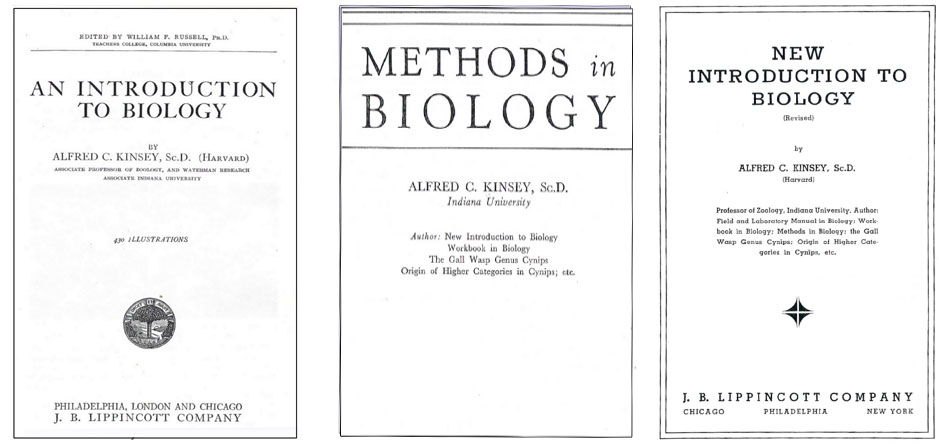
Kinsey was also the author of biology textbooks, all of which were ‘unapologetically pro-evolution’.19 His An Introduction to Biology, published by J.B. Lippincott in 1926, was a leading high-school biology textbook that went through many editions and sold almost half a million copies.20 In his biology texts, Kinsey strongly advocated Darwinism—almost 40 pages were devoted to this topic alone. To help convert people to Darwinism, Kinsey claimed that evolution is only ‘the scientific word for change’.21 (Interestingly, the index did not contain either the name Darwin or the term evolution.) Cashill opines that to
‘ … keep parents at bay, he pioneered the kind of bait-and-switch pseudo-science that dominates high school texts to this day. The formula was simple: merely define evolution as “the scientific word for change” and ridicule those who challenged evolution as denying the small changes obvious to anyone who had bred anything in a still largely rural America. In the accompanying teacher’s manual, he counselled teachers on how to handle those parents who saw through or around the deception.’19
Chapter 19 of Kinsey’s 1926 biology text, titled ‘New Kinds of Organisms’, covers not only breeding but also the importance of mutations in producing new organisms. It concludes that ‘new kinds of plants and animals are continually coming into existence by select variations from their ancestors’.22
The examples of mutations he discussed are likewise very questionable. His only example of mutations producing a new animal breed was the now discredited Ancon sheep—all other examples were plants, although Kinsey does note that ‘at least four hundred mutations have been observed’ in fruit flies, but admitted that none are beneficial, yet concluded ‘think of what the result might be in a thousand or a million years in any one line of descent!’23
Breeding success of plants and animals is also given as proof of Darwinism. Kinsey then implies that small changes can accumulate to produce molecules-to-human evolution. He concludes that mammals, reptiles, etc. ‘probably originated directly from long-extinct, reptile-like ancestors … [and] few, if any, of the ancestral forms are still in existence’.24
The evidences for evolution that he cites include homology, vestigial organs (‘small and useless structures which are always to be found in species’), embryology and the geographical distribution of life.25 Kinsey concluded that, although numerous biologists before Darwin believed that species change, it remained for Darwin to
‘ … offer such abundant proof that the whole scientific world was convinced of the truth of the idea. Since then, modern biology has kept evolutionary notions to the fore. It has reclassified the plants and animals and arranged them to show their origins from common ancestors.’26
Had Kinsey lived to study genetic sequence comparisons today, he would have been unable to make this claim.
Stressing that no part of biology has been left untouched by evolution, Kinsey claimed ‘there are no biologists who are not agreed that evolution has occurred’.27 He concludes that if one is discreet, evolution can be effectively taught in school even if the community is opposed. Kinsey’s agenda—to indoctrinate in Darwinism—was effective, but
‘Kinsey could not conspicuously advance his own agenda. “He had to appear disinterested … his pronouncements value free.” Kinsey, however, knew how to mold young minds. He would marshal his evidence so precisely and present it so matter-of-factly that students were drawn to one inevitable conclusion: his own.’28
Kinsey felt his work on gall-wasps failed to convince the world of the truth of Darwinism (and, conversely, the falsity of religion). It didn’t. With missionary zeal, he then plunged into his work on human sexuality (see below).
Eugenics
Kinsey also actively supported eugenics. In a 1937 text designed to train biology teachers, Kinsey predicted that eugenics will have a
‘ … permanent place, both in high school and college teaching. Events in the last decade have made the younger generation wonder how eugenic factors account for the dependence of a third of the population on the other two thirds, even in times of prosperity. It is one of the most hopeful signs for the future that young people are becoming interested in problems of human breeding.’29
He concluded that it is wrong not to apply information about human heredity to social problems, and even advocated that ‘eugenics ideas should be given to boys and girls as early as their first interest in companions of the opposite sex’.30
After noting the problems of applying eugenics to people (such as determining which people are ‘undesirable’) Kinsey stressed that, ‘there would be little difficulty in selecting the ten percent which is the greatest drain on the advancement of our social institutions. The limitation of the reproduction among this ten percent might be necessary before we can expect any decrease in the number of helpless dependents.’31 He concluded that people who were ‘hereditarily sound and environmentally privileged may contribute to society by planning to have as many or more children than the average’.31
Kinsey’s list of eugenic references is especially telling—he recommends Dugdale’s now infamous The Jukes,32 Goddard’s The Kallikak Family,33 Davenport’s Heredity in Relation to Eugenics,34 and Castle’s Genetics and Eugenics.35 Both the Jukes and Kallikak accounts have been fully refuted by modern research.
Kinsey’s drift into sex research
After college, Kinsey was hired by Indiana University to teach introduction to biology, entomology, and insect taxonomy. He preferred field work to teaching and soon was spending a great deal of his time working with students on projects, especially topics dealing with human sexuality. Soon he became more adventuresome, even to the point of dispensing sexual advice to his students. Kinsey’s first sexual case histories came from ‘counselling’ sessions that he offered to students, launching his career as a sexologist. This led to Kinsey teaching a course in marriage, which, in turn, led to research that cumulated in his two volumes on human sexuality. Although all his training was in biology, not psychology, sociology, marriage, family or even anthropology, he plunged ahead. In his course, Kinsey discussed the most intimate details of sexual behaviour without either embarrassment or euphemisms.13 He also showed graphic slides depicting sexual intercourse and a variety of sexual behaviours, including masochism. Although cloaked in the mantel of science, the course was actually an advocacy for not only sexual freedom, but also for Darwinism and against religion.36
Kinsey becomes a full time sex researcher
Although he had some resistance—especially due to his dictatorial management style—many people were offended by the marriage course’s content and blatancy. Kinsey had first agreed that the course would be open only to married seniors, and he was not to use outside publicity. He soon violated these rules; he opened the course up to anybody and sought outside publicity. Kinsey’s students often remarked that he would twist the conversations to sex, no matter what they were talking about, commonly asking them about their sex lives. Appropriately charged with exploiting students, his peers petitioned the president to remove Kinsey from the marriage course. President Wells gave Kinsey a choice—he could keep his ‘research’ or the class, but not both. The class ended and Kinsey devoted most of his time to his ‘research’ while remaining a paid professor.
As his work in human sexuality increased, he invested less and less time in his family, which soon created much friction in his marriage. Eventually, and evidently to keep the marriage together, his wife Clara agreed to participate in both his professional life and his sexual research. They had what is now referred to as an open marriage, where each spouse freely took on lovers (although Alfred Kinsey seemed to take on more male than female lovers).
Kinsey dominated his researchers in many ways. In the name of research, he openly encouraged sexual relationships among his staff, but stressed that they be discreet because of the negative publicity that public awareness could produce.37 Kinsey also regularly seduced his subordinates, including graduate students and staff members, males included, whether they were married or single. Several carried on affairs with him for years, all evidently approved by his wife (who also carried on her own affairs). Not unexpectedly, these affairs had some tragic consequences, such as Kinsey’s health problems.38
Kinsey later moved into filming sex involving his staff, students and others, producing not only heterosexual, but homosexual and even sadomasochism pornography—all in the name of science.39 The films and also photographs were placed in a library of erotica that Kinsey was collecting (this collection eventually attracted the attention of the US Customs, resulting in a lawsuit that remained unsettled when Kinsey died in 1956).
Kinsey’s work was motivated largely by his own personal crusade against virtually all taboos (and most laws) against almost all forms of sexual behaviour. He, like Darwin, opened the flood gates. Soon Masters and Johnson followed, going even further, filming the sexual behaviour of more than seven hundred subjects. Kinsey was also a crusader for prisoners—especially those jailed for sex crimes, offences for which he believed they never should have been imprisoned in the first place. He rationalized that they were just doing what many other people do, and everyone’s sin is no one’s sin: commonality makes a behaviour, by definition, non-deviant, thus normal. Kinsey did not seem to have any compunction about any type of sexual behaviour, excepting possibly only that which is forced on another person.
Kinsey’s views, especially his involvement in communism, eventually resulted in a House of Representatives investigation of him and his work. One outcome was that his funding was terminated, which soon stopped most of his research. Kinsey spent the next couple of years unsuccessfully trying to secure funding. His health at this time also began to decline, partly as a result of his promiscuous sexual behaviour. While working in his garden, he bruised a leg, causing a fatal embolism, and died on 25 August 1956, aged 62.
Researcher or proselytizer?
Kinsey, although he thought of himself as a scientist, is viewed by many biographers as a missionary whose destiny was to change the world through science, especially by changing human sexual behaviour.40 The goal of his research was clear—he wanted to show that abnormal sexual behaviour was common, and therefore normal (and, consequently, appropriate). Behaviour that was common could not be abnormal, wrong or condemned (and now laws even exist to ‘protect’ criticism of behaviour once considered abnormal). The classic ‘if everybody else is doing it, why can’t we?’ approach was successful—he began the process that eventually completely changed the morals in the West.
Other Darwinists have used similar techniques to achieve the same end. An example is Bagemihl,41 who documented in a massive study that ‘homosexual, bisexual, and transgender wildlife’ and even intergenerational sexuality are common (thus normal) in the animal kingdom. Therefore, since such behaviour is normal (thus appropriate) for animals, it is also normal for humans, since humans are just animals, in contrast to the clear biblical teaching that humans were created in God’s image.
Some of Kinsey’s conclusions seem unrealistic on their face—an example is the claim that 67–98% of all men, depending upon their social class, have premarital sex. Kinsey claimed that half of all men and 26% of all women had extra-marital affairs, and 37% of all men have had at least one homosexual experience. Kinsey also concluded that only 6% of the population is exclusively heterosexual. In contrast, scientific studies consistently find that only around 2% are homosexual).42 It is important to note that a disproportionately small number of Kinsey’s sample was of men influenced by religious values. Nonetheless the implication was clear—premarital sex, adultery and homosexuality are all ‘normal’ and, furthermore, traditional sexual morality—the Judeo-Christian sexual morality in particular—is ‘unnatural’. He confuses the fallacy of what is with, in his opinion, what ought to be.
The implication that average is normal is disproved by the fact that average is clearly often not desirable. The average American dies of heart disease, cancer or diabetes, hardly desirable conditions. The average American’s cholesterol, blood pressure and weight are certainly not desirable either. Few commentators discuss this critical concern.
The accuracy of his data
A major concern is that, since the period in which Kinsey was most actively collecting his data is often thought of as aggressively repressive and conservative, one may question the apparent ease at which Kinsey was able to gather the thousands of detailed intimate personal sex histories that he used as raw data for his research. Using volunteers is a serious error when questioning people about their sex life, something many people then (and many people today) are unwilling to talk about very freely, especially to strangers.
The lack of sample representation is another major concern—volunteers were utilized for both of his studies, and a highly disproportionate number were upper-class college students, drifters, male prostitutes, homosexuals found in gay bars, hardened criminals, and prison inmates convicted of sexual offences.43 About 80% of his sample was non-religious or at least religiously inactive, at a time when over half of the population was religiously active.44 This factor alone would have skewed the sample enormously. The elderly, blacks, Southerners and those with strong religious views were almost entirely omitted.
For the women study, Kinsey included 5,940 women, fully 75% of whom had attended college, and 19.4% were in graduate school (or, had completed) graduate school. When the survey was completed, only 7.5% of American white women had attended college.45 The occupations of those who contributed to the histories also included a significant number of prostitutes, women who worked in burlesque and other sex trade occupations.46
The sample of women was disproportionately from the upper-classes—and numerous studies have found adultery and promiscuity more common in the upper-classes compared to the middle class. Another problem is a disproportionately small number of Kinsey’s sample of women was influenced by religious values. These factors would all highly inflate the mean (arithmetic average) that Kinsey reported. Kinsey’s arguments for spouse unfaithfulness relied on those case histories that reportedly showed positive results from this behaviour.47 He implied, in contrast to the empirical research, that Judeo-Christian morality is to blame for problems that range from frigidity to sexual deviance.
Although Kinsey claimed to be ‘dispassionately objective’, it is clear that he was on a crusade. It is also clear from his writing that his acceptance of Darwinism was a critical step on the path to this crusade. For example, in the report on women Kinsey condemns what he calls the inconsistency of religious and legal codes.48 He also makes many questionable judgments regarding sexual behaviours, such as claiming that premarital intercourse helps girls select suitable marriage mates.49 In addition he claimed that most men approve of premarital and extra-marital sexual relationships.50
An evaluation of Kinsey’s work by a well-known Kinsey contemporary, William Croger, professor of obstetrics and gynecology at Chicago Medical School (27 September 1953 Parade Magazine) states that, from his experience, it is difficult to conclude that a normal healthy female will bear her innermost secrets about sex, especially several hundred questions worth. Research has consistently, even today, failed to verify Kinsey’s contentions.
Critics concluded that Kinsey should have been more open and honest about his sample population and its limits in applying his data to the general population. At best, it applies to the sexual behaviour of specific, limited groups in contrast to Kinsey’s claim that it applied to normal human males in general. The fact is Kinsey’s ‘estimates were known to be flawed and misleading from the outset because of the sampling procedures’.51 Reisman argued that Kinsey’s work was openly fraudulent and that his research was designed specifically to put Kinsey’s own sexual proclivities on a scientific basis in order to justify them.14
A very disturbing aspect of this study is his ‘researchers’, (or those they interviewed) claimed children as young as two months old engaged in sexual behaviour. It was this claim that motivated Dr Judith Reisman to review his work, and to become the most active critic of Kinsey ever.
It is not difficult to imagine why a public outcry resulted against the Kinsey survey. All of these sampling problems are well documented—even his editor, Lloyd Potter, recognized this problem.52 Unfortunately, many in the media did not—some even claiming that his sample of 12,000 men was a ‘cross section’ of Americans.52
By far the most damaging critique of his work was comparisons of his results to that of similar studies. A replication study by University of Chicago sociologist Laumann found that Kinsey’s results were higher—sometimes almost eight times higher—for virtually every piece of data that Laumann researched. (Laumann’s study was published in 1994, Kinsey’s in 1948, almost forty years earlier).
Kinsey and homosexuality
Kinsey claimed that 37% of the population had overt homosexual experience. However, Laumann, et. al., found only 4.9%.53 Kinsey also started the myth that 10% of the population is homosexual, still commonly cited today.54 Studies have consistently found only between 1 and 2% of the population are self-defined homosexuals.55
One of Kinsey’s goals was public tolerance for what he tried to convince the world was the enormous variety of sexual behaviour, especially sodomy, in which normal persons were involved. The importance of his influence is indicated by the 2003 US Supreme Court decision (Lawrence vs Texas 593 US 588) that ruled unconstitutional all sodomy laws in America—in spite of the obvious enormous adverse health consequences that result from this behaviour, as is well documented in the medical literature.
Kinsey’s work was also critically important in society’s increasing acceptance of homosexual behaviour (he planned to do an entire book on homosexuality a half century ago). Normalization of homosexuality has had profound implications for society. For example, a generation ago child molestation largely involved female victims—it now increasingly involves male victims. Furthermore, according to the US Center for Disease Control (CDC) data, the homosexually orientated are over thirty times more likely to be involved in pedophilia than heterosexuals, clearly a major difference. Another effect is the issue is now splitting the church—the most well-known example is the Episcopal Church, but the Methodist Church and many other denominations are affected as well.
Media support for his work
When Kinsey released his findings, the reaction by the media was overwhelmingly positive.56 Despite the plethora of studies that have overwhelmingly disproved most of Kinsey’s major results, the liberal media still tout them as valid.57 All too often, media reaction to valid criticism of the study is similar to a London Times article that stated, when published, the Kinsey report’s ‘impact on American society was likened to that of Darwin’s theory of evolution. And there are still plenty of people who don’t want to believe that, either.’58
The effects of the Kinsey revolution on society
It is well documented that Kinsey’s work was a critical factor in bringing about the so-called sexual revolution. Statistics that evaluate important social changes have documented the effects of this revolution. Around the turn of the century, illegitimacy in America was around 1%, now it averages close to 60%, and in some populations (such as African Americans) it is as high as 70%. The divorce rate in 1920 was below 17%; it is now about 50%.59,60 Up to half of Americans now grow up with one parent.
A fractured family (family is defined as a mother and father and one or more children) is the single most important factor that drives almost all major social problems, including delinquency, poor school performance, drinking, teen pregnancy, drug use, social deviancy, promiscuity, poverty, truancy and school misbehaviour. Children born to unwed mothers are over ten times more likely to live in poverty as children with fathers in the home. The official CDC data stated that children reared in fatherless homes account for 63% of teen suicides, 71% of high-school dropouts, 75% of children in chemical-abuse centres, 80% of rapists, 85% of youths in prison, 85% of children who exhibit behavioural disorders and 90% of homeless and runaway children (for a summary see Daniels20 ).
These problems tend to continue into the next generation. Children from intact homes are more likely to have successful marriages, and less likely to divorce—and less likely to experience all of the problems noted above.61 Critically important is the fact that the majority of persons living in poverty consist of single mothers and their children. The importance of a father in the normal growth and development of both boys and girls has been well documented.20,62 As documented by Gairdner,63 no single factor influences how a child turns out as much as an intact family. The ‘children of divorce and never-married mothers are less successful in life by almost every measure than’ even the children of widowed mothers.64
A view of Kinsey today
Reading about Kinsey’s life strains the credibility of many today. Part of the reason is the recent reversion back to what Kinsey’s supporters called puritanical attitudes as a result of both the women’s movement and the recent multi-million dollar pedophilia lawsuits. Many women, especially today, interpret the behaviour that Kinsey advocated as exploitative—such as supervisors in an academic setting coercing students for sex.65 Although Kinsey hid this behaviour at first, it was later openly flaunted with the support of some high-level officials at Indiana University, including its president.66 If a professor in an American, European or Australian university today regularly seduced students or subordinates, this would be grounds for, and likely result in, termination.
Acknowledgements
I wish to thank Jody Allen, Clifford Lillo and John Woodmorappe for their helpful review of an earlier draft of this paper.
References
- Flynn, D.J., Intellectual Morons: How Ideology Makes Smart People Fall for Stupid Ideas, Crown Forum, New York, p. 34, 2004 Return to text.
- Tone, A., Historical Influences on Women’s Sexual and Reproductive Health; in: Wingood, G.M. and DiClemente. R.J. (Eds.), Handbook of Women’s Sexual and Reproductive Health, Kluwer Academic/Plenum Publishers, New York, pp. 7–20, 2002. Return to text.
- Licht, H., Sexual Life in Ancient Greece, Abbey Library, London, 1971. Return to text.
- Kiefer, O., Sexual Life in Ancient Rome, Abbey Library, London, 1971. Return to text.
- Tone, ref. 2, p. 15. Return to text.
- Bethell, T., Kinsey as pervert, The American Spectator 38(3):42–44, 2005. Return to text.
- Flynn, ref. 1, p. 35. Return to text.
- Jones, J.H., Alfred Kinsey: A Private Life, Norton, New York, pp. 82, 533, 1997. Return to text.
- Jones, ref. 8, p. 610. Return to text.
- Flynn, ref. 1, p. 38. Return to text.
- Flynn, ref. 1, p. 37. Return to text.
- Cashill, J., Hoodwinked: How Intellectual Hucksters have Hijacked American Culture, Nelson, Nashville, TN, p. 239, 2005. Return to text.
- Christenson, C.V., Kinsey: A Biography, Indiana University Press, Bloomington, IN, pp. 19–20, 30, 1971. Return to text.
- Reisman, J., Kinsey: Crimes and Consequences, The Institute for Media Education, Arlington, VA, p. 6, 1998. Return to text.
- Jones, ref. 8, p. 101. Return to text.
- Jones, ref. 8, p. 87. Return to text.
- Jones, ref. 8, p. 611. Return to text.
- Cashill, ref. 12, p. 242. Return to text.
- Cashill, ref. 12, p. 241. Return to text.
- Daniels, C.R., Lost Fathers: The Politics of Fatherlessness in America, St. Martin’s Press, New York, p. 130, 1998. Return to text.
- Kinsey, A.C., An Introduction to Biology, J.B. Lippincott, Philadelphia, PA, p. 196, 1926. Return to text.
- Kinsey, ref. 21, p. 189. Return to text.
- Kinsey, ref. 21, p. 192. Return to text.
- Kinsey, ref. 21, p. 199. Return to text.
- Kinsey, ref. 21, pp. 200–201. Return to text.
- Kinsey, ref. 21, pp. 522–523. Return to text.
- Kinsey, A.C., Methods in Biology, J.B. Lippincott, Chicago, IL, p. 224, 1937. Return to text.
- Cashill, ref. 12, p. 243. Return to text.
- Kinsey, ref. 27, p. 222. Return to text.
- Kinsey, ref. 27, pp. 222–223. Return to text.
- Kinsey, ref. 27, p. 224. Return to text.
- Dugdale, R., The Jukes, Putnam, New York, 1910. Return to text.
- Goddard, H., The Kallikak Family, MacMillan, New York, 1912. Return to text.
- Davenport, C., Heredity in Relation to Eugenics, Henry Holt, New York, 1911. Return to text.
- Castle, W.E., Genetics and Eugenics, Harvard University Press, Cambridge, MA, 1930. Return to text.
- Jones, ref. 8, pp. 190, 192, 340–349. Return to text.
- Jones, ref. 8, p. 499. Return to text.
- Jones, ref. 8, p. 500. Return to text.
- Jones, ref. 8, p. 611. Return to text.
- Flynn, ref. 1, p. 39. Return to text.
- Bagemihl, B., Biological Exuberance: Animal Homosexuality and Natural Diversity, St. Martin’s Press, New York, 1999. Return to text.
- Mosher, W., Chandra, A. and Jones, J., Sexual Behavior and Selected Health Measures: Men and Women 15–44 Years of Age, United States, 2002, Advanced Data from Vital and Health Statistics, Centers for Disease Control and Prevention, Washington, D.C., Number 362, 15 September 2005; p. 3. Return to text.
- Laumann, E.O., Gagnon, J.H., Michael, R.T. and Michaels, M., The Social Organization of Sexuality: Sexual Practices in the United States, The University of Chicago Press, Chicago, IL, pp. 44–46, 1994. Return to text.
- Flynn, ref. 1, p. 40. Return to text.
- Daniels, E.J., I Accuse Kinsey, Christ For The World Publishers, Orlando, FL, p. 24, 1954. Return to text.
- Daniels, ref. 45, p. 39. Return to text.
- Gathorne-Hardy, J., Sex the Measure of All Things: A Life of Alfred C. Kinsey, Indiana University Press, Bloomington, IN, 1998. Return to text.
- Kinsey, A.C., Sexual Behavior in the Human Male, Saunders, Philadelphia, p. 258, 1948. Return to text.
- Kinsey, ref. 48, p. 360. Return to text.
- Kinsey, ref. 48, p. 559. Return to text.
- Laumann, E.O. and Michael, R.T., Sex, Love and Health in America: Private Choices and Public Policies, The University of Chicago Press, Chicago, IL, p. 14, 2001. Return to text.
- Cashill, ref. 12, p. 247. Return to text.
- Laumann, E.O., Ellingson, S., Mahay, J., Paik, A. and Youm Y. (Eds.), The Sexual Organization of the City, The University of Chicago Press, Chicago, IL, p. 294, 2004. Return to text.
- Laumann et al., ref. 53, p. 287. Return to text.
- Laumann et al., ref. 53, p. 311 Return to text.
- Flynn, ref. 1, p. 49. Return to text.
- Hackett, D., Indiana University shuns Kinsey biographer, The Journal Gazette, p. 2C, 11 March 2003. Return to text.
- Anonymous, Alfred Kinsey: the swinging detective—he opened their eyes to sex, London Sunday Times, 7 April 2005. Return to text.
- Phillips, R., Putting Asunder: A History of Divorce in Western Society, Cambridge University Press, Cambridge (UK), New York, 1988. Return to text.
- White, K., Sexual Liberation or Sexual License? The American Revolt against Victorianism, Ivan Dee, Chicago, IL, 2000. Return to text.
- Whitehead, B.D., The Divorce Culture, Alfred A. Knopf, New York, 1997. Return to text.
- Sommers, C.H., The War against Boys, Simon and Schuster, New York, 2000. Return to text.
- Gairdner, W., The War against the Family, Stoddart Publishing Co., Toronto, Canada, 1992. Return to text.
- Daniels, ref. 20, p. 34. Return to text.
- Browder, S.E. Kinsey’s secret: the phony science of the sexual revolution, Crisis 22(5):12–17, 2004. Return to text.
- Jones, ref. 8, p. 348. Return to text.
- Kinsey, A., The gall wasp genus Cynips: A study in the origin of species, Indiana University Studies, Vol. 16, Study 84–86, pp. 1–577, 1930, p. 545. Return to text.
Readers’ comments
Comments are automatically closed 14 days after publication.