

Let my people go
Anti-slavery activist William Wilberforce: a Christian hero
A longer, more detailed version of this article is available at <creation.com/wilberforce>.
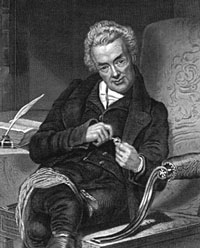
This year is a historical bicentennial: on 25 March 1807, William Wilberforce’s long fight to end slavery resulted in the Royal Assent to ‘An Act for the Abolition of the Slave Trade’, which abolished the buying and selling of humans throughout the British Empire. This was after 20 years of struggle and repeated previous defeats of his anti-slavery bills in Parliament.
Even the usually anti-Christian Hollywood is commemorating this historic day with the film Amazing Grace, about Wilberforce and his mentor John Newton, the slaver-turned-abolitionist who composed the famous hymn of that name.1
With all the attacks on Christianity, it is important to remember the great good it has achieved when truly followed. Slavery is one of the best examples—far from being a Western Christian invention, it was the Christian west that abolished it.2
Slavery throughout history

As conservative black economist Thomas Sowell points out,3 slavery has been around all over the world for most of its history. And for most of this dismal history, it was not a racial issue. Most slaves did not differ racially from their masters. Africans enslaved Africans, Asians enslaved Asians, and Europeans enslaved Europeans. In fact the Slavonic peoples were such a prolific source of slaves for Western Europe that the very word ‘slave’ derives from ‘Slav’. The dark-skinned Muslim Moors enslaved ‘white’ Europeans during their occupation of the Iberian peninsula from 711 to 1492. Later, from the 16th century, the Muslim Barbary States of North Africa encouraged pirates which had a flourishing white slave trade.
Wilberforce and the anti-slavery society
Wilberforce and his anti-slavery fight were documented in a recent book Bury the Chains: Prophets and Rebels in the Fight to Free an Empire’s Slaves by Adam Hochschild (2005). Dr Sowell summarizes in a review:
‘The anti-slavery movement was spearheaded by people who would today be called “the religious right” and its organization was created by conservative businessmen. Moreover, what destroyed slavery in the non-Western world was Western imperialism.
‘Nothing could be more jolting and discordant with the vision of today’s intellectuals than the fact that it was businessmen, devout religious leaders and Western imperialists who together destroyed slavery around the world.’
Indeed, Hochschild documents that the world’s first anti-slavery movement began with a meeting of 12 ‘deeply religious’ men in London in 1787, including Wilberforce.
Wilberforce’s motivations are crystal clear from his own book A Practical View of Christianity (1797). John Piper writes:
‘What made Wilberforce tick was a profound Biblical allegiance to what he called the “peculiar doctrines” of Christianity. These, he said, give rise, in turn, to true affections—what we might call “passion” or “emotions”—for spiritual things, which, in turn, break the power of pride and greed and fear, and then lead to transformed morals which, in turn, lead to the political welfare of the nation. He said, “If … a principle of true Religion [i.e., true Christianity] should … gain ground, there is no estimating the effects on public morals, and the consequent influence on our political welfare.”’4
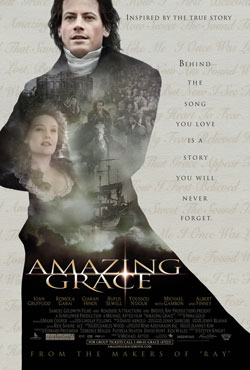
A cinema promotional poster from the new production stating ‘Behind the song you love is a story you will never forget’.
Wilberforce had to struggle against not only repeated rejections, but also ill health. Yet not only did he lead the way to abolish slavery, he also promoted hospitals and prison reform, and advocated positive reform in India and other colonies. He also fought against cruelty to animals, founding what we know today as the ‘Society for the Prevention of Cruelty to Animals’. No wonder he was eventually called the ‘Conscience of Parliament.’
Wilberforce was not always a Christian. Indeed, he was born into the privileged class, and that culture, much like today’s Hollywood, loved gambling, fancy clothes, fast horses, drinking and gluttony. Furthermore, he had denounced the deity of Christ after attending an apostate church much like today’s liberal ones.
However, Wilberforce gave his life truly to Christ in 1875, then wanted to quit parliament because of the immorality and infighting. However, he visited John Newton of Amazing Grace fame. Newton in his earlier days had been a slave trader himself before his conversion to Christ. Newton was the one who convinced Wilberforce that he would do the most good by remaining in Parliament.
After Newton’s conversion, he first insisted that slaves were to be treated humanely. But he soon came to see that since the slaves were also created in the image of God, the slave trade was wrong in itself, and could not be humanized. He left the trade, became friends with the great evangelists George Whitfield (1714–1770) and John Wesley (1703–1791) and his brother Charles (1707–1788), became a minister, and testified to King George III (1738–1820) about the atrocities of the slave trade.
John Wesley was instrumental in the conversion of Wilberforce himself. And <http://gbgm-umc.org/umw/wesley/wilber.stm> Wesley’s last letter of his life of 24 February 1791was to Wilberforce commending his abolitionist work, comparing this to the gallant struggle of Athanasius (c. 293–373) for the vital biblical doctrine of the full deity of Christ:
‘Unless the divine power has raised you up to be as Athanasius contra mundum [Athanasius against the world], I see not how you can go through your glorious enterprise in opposing that execrable villainy which is the scandal of religion, of England, and of human nature. Unless God has raised you up for this very thing, you will be worn out by the opposition of men and devils. But if God be for you, who can be against you? Are all of them together stronger than God? O be not weary of well doing! Go on, in the name of God and in the power of his might, till even American slavery (the vilest that ever saw the sun) shall vanish away before it.’
Sequel to anti-slave trade act
The 1807 Act for the Abolition of the Slave Trade didn’t actually abolish slavery, just trading in slaves. So Wilberforce’s campaign was not over. But as it stood, it allowed the British navy to declare slave-transporting ships as equivalent to pirates, and capture them to free the slaves and possibly execute the crew. This is what Dr Sowell means by ‘Western Imperialism’. It was also an example of ‘imposing one’s morals on others’!
Fortunately, Wilberforce lived to see the passing of the ‘Slavery Abolition Act’. He had become seriously ill with influenza when on 26 July 1833, he learned with much rejoicing that this act had passed the final reading in the House of Commons. Three days later, he died. One month after that, Parliament passed the act.
Biblical teachings and applications
It should not be too surprising that Wilberforce and his allies should have such a strong Christian commitment. Indeed, the opposition is founded in the Creation account of Genesis. God created a male and female human in His image, and gave humanity dominion over the rest of creation, not over fellow humans (Genesis 1:26–28). And Galatians 3:28 explicitly teaches the foundational equality of human beings in nature.

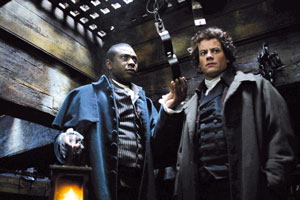
The movie portrays an event where Wilberforce presents a petition to the British parliament supporting the abolition of slavery.
This is reinforced in the Mosaic Law, which explicitly prohibits kidnapping and selling others into slavery: ‘Whoever steals a man and sells him, and anyone found in possession of him, shall be put to death’ (Exodus 21:16). And of course, Moses was the man God used in His miraculous deliverance of the Israelite nation from bondage in Egypt, commemorated in the great Jewish celebration of the Passover.
In the Law of Christ, the Apostle Paul lists ‘slave traders’ / ‘menstealers’ (ανδραποδιστής andrapodistēs) with murderers, adulterers, perverts, liars and other evil people (1 Timothy 1:10). Paul tells slaves to become free, if they can (1 Corinthians 7:21), and conversely tells free people to not become slaves (1 Corinthians 7:23). When it came to a personal example, he encouraged Philemon to free his escaped slave Onesimus
Such practice would see the end of slavery, and without bloodshed. This indeed happened, as thoroughly documented in Rodney Stark’s book For the Glory of God.5 He devoted chapter 4 to the consistent church teachings against slavery.
Stark documented that even back in the 7th century, Christians publicly opposed slavery. The bishop and apologist Anselm (c. 1033–1109) forbade enslavement of Christians, and since just about everyone was considered at least a nominal Christian, this practically ended slavery within Europe. As Stark writes, ‘The problem wasn’t that the [Church] leadership was silent. It was that almost nobody listened.’
Does the Bible support slavery?
Most anti-Christian writers ignore the overwhelming evidence (see main text) of Christianity’s powerful anti-slavery influence, and try instead to portray the Bible as advocating slavery. But in so doing, they are guilty of gross decontextualizing of the Bible. They write as if the word ‘slave’ in the Bible refers to the pre–civil-war American South. In reality, it had a wide range of meanings. E.g. in the biblical culture, the Prime Minister’s cabinet members would be called his ‘slaves’. The New World slavery that most people think of was expressly forbidden in the Bible, because it resulted from kidnapping, and because converted slaves were not freed as per Philemon and Anselm (main text).
Then why is there no command in the Bible to free the slaves immediately? Because the commands in the Bible already documented would subtly undermine the institution far better than a slave rebellion. E.g. the prohibition on trading in slaves would drastically localize it. Compare the application of Paul’s teachings with the tragic end to the rebellion of Spartacus (c. 120–70 bc), or in modern times, compare Martin Luther King’s peaceful (and Bible-based) protests with the secular revolutionary Malcolm X.
What does Wilberforce’s fight teach us today?
We can learn much from Wilberforce’s fight against slavery. Not only did it take decades, but also he had to face many of the same tactics that anti-christians use today.
Anti-biblical worldview
As pointed out in Christianity on Trial6, pagan philosophers, like Aristotle, regarded some people as natural slaves, and ‘Enlightenment’ philosophers hostile to Christianity such as Hume and Voltaire believed in the inferiority of dark-skinned people. They had no time for the equality of nature taught in the Bible.
‘Keep religion out of politics’
This is probably the most common trap that Christians can fall into today. But Wilberforce faced exactly the same attitudes. For example, William Lamb aka Lord Melbourne (1779–1848), a future Prime Minister of the UK and a mentor of Queen Victoria (and the eponym of Australia’s second city), pontificated: ‘Things have come to a pretty pass when religion is allowed to invade public life.’ In the same context, Willoughby Bertie, 4th Earl of Abingdon (1740–1799) spouted, ‘Humanity is a private feeling, not a public principle to act upon.’
Thus pro-abortion policitians who say crude things like, ‘Keep your rosaries off my ovaries’ are saying nothing new. But in reality, facile slogans such as, ‘Don’t like abortions? Don’t have one!’ are as immoral as, ‘Don’t like slavery? Don’t own slaves!’
The fact that slavery is today so widely regarded as heinous is not the result of some natural evolutionary ‘betterment’ of society, but a direct heritage of the Gospel of Christ, the most powerful force for good the world has ever seen.
References and notes
- See the review on our website by Lita Sanders, creation.com/amazing, 16 March 2007. Return to text.
- See also Koukl, G., Christianity’s real record, www.townhall.com/columnists/GregKoukl/2006/11/21/christianitys_real_record, 21 November 2006, showing that atheists frequently exaggerate atrocities by professing Christians, ignore the great good done by Christians practising their faith, and ignore the far greater atrocities of atheist regimes. Return to text.
- Sowell, T., Black Rednecks and White Liberals, chapter on slavery, Encounter Books, San Francisco, 2005. Return to text.
- Piper, J., Peculiar doctrines, public morals, and the political welfare: reflections on the life and labor of William Wilberforce, www.desiringgod.org/ResourceLibrary/Biographies/1492_Peculiar_Doctrines_Public_Morals_and_the_Political_Welfare/, 5 February 2002. Return to text.
- Stark, R., For the glory of God: How monotheism led to reformations, science, witch-hunts and the end of slavery, Princeton University Press, 2003; see also review by Williams A., The biblical origins of science, Journal of Creation 18(2):49–52, 2004; creation.com/stark. Return to text.
- Carroll, V. and Shiflett, D., Christianity on Trial: Arguments Against Antireligious Bigotry, Encounter Books, San Francisco, 2001; see review Hardaway, D. and Sarfati, J., Countering christophobia, Journal of Creation 18(3):28–30, 2004; creation.com/trial. Return to text.
Readers’ comments
Comments are automatically closed 14 days after publication.