
Disclaimer: How biblical chronology relates to archaeological periods in the ancient Near East (e.g., Paleolithic, Chalcolithic, Early Bronze Age, Iron Age, etc.) is a complex subject. For many years, Creation Ministries International (CMI) has published a range of views by various authors in its publications (CREATION.com, Journal of Creation, Creation magazine, etc.). These views do not necessarily agree with the present views of CMI’s writers on this topic, but remain available online as they form part of CMI’s historical archives of its publications. For key articles about this subject see our Archaeology Q&Ahaeology Q&A.
Egyptian history and the biblical record: a perfect match?
[Editor: the suggested synchronisations of Egyptian and biblical history in this article are controversial; see Resolving alleged conflicts between the Bible and other accounts of Egyptian history.]
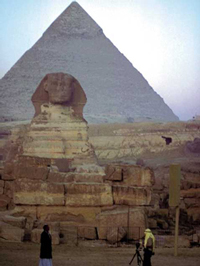
For years, the popular media has mocked the biblical accounts of Joseph, Moses, the Passover, and the Exodus as being completely incompatible with standard Egyptian chronology. Year after year, we have been told by numerous scholars that events recorded in the books of Genesis and Exodus are nice legends devoid of any historical or archaeological merit.
However, a new wind is blowing. An emerging pool of scholars, representing diverse backgrounds, has been openly calling for a drastic reduction in Egyptian chronology. Such a reduction would serve to line up the historical and archaeological records of Egypt and the Old Testament. Surprisingly, there is a substantial amount of evidence to warrant a significant reduction of Egyptian history. And by doing so, the reliability of Genesis, Exodus, and the entire Old Testament will have to be reconsidered as a viable source of historical truth.
Advocates of chronological revision
Those who advocate a revision of orthodox Egyptian chronology are admittedly in the minority, but their credentials and scholarship are highly esteemed. David Rohl, author of Test of Time, suggests ‘Ramses II should be dated to the tenth century BC—some three hundred and fifty years later than the date which had been assigned him in the orthodox chronology.’1 Peter James and four other scholars published the book Centuries of Darkness.2 They claim that the dates of Egyptian dynasties need to be reduced by hundreds of years, specifically Dynasties 21–24. Dr Colin Renfrew, professor of archaeology at Cambridge University, wrote a foreword to this book:
This disquieting book draws attention … to a crucial period in world history, and to the very shaky nature of the dating, the whole chronological framework, upon which our current interpretations rest…the existing chronologies for that crucial phase in human history are in error by several centuries, and that, in consequence, history will have to be rewritten.3
Sir Alan Gardiner, an authority on Egyptian history, admits to the inherent problems surrounding Egyptian chronology:
Even when full use has been made of the king lists and of such subsidiary sources as have survived, the indispensable dynastic framework of Egyptian history shows lamentable gaps and many a doubtful attribution …What is proudly advertised as Egyptian history is merely a collection of rags and tatters.4
Last year, David Down (who also wrote the very relevant item ‘False History—out with David and Solomon’) and Dr John Ashton wrote Unwrapping the Pharaohs: How Egyptian Archaeology Confirms the Biblical Timeline. Down has performed archaeological research in Egypt, Israel, and the Middle East for nearly half a century. In their book, they propose a revised chronology that harmonizes Egyptian and Old Testament history.
Reasons for questioning the traditional Egyptian timeline
Astronomical assumptions
Supposedly, lunar and solar eclipses have been discovered to perfectly match the established dates of Egyptian chronology. This is simply untrue. The concept of astronomical fixation is not based on celestial eclipses but on the ‘Sothic Cycle’. However, the Sothic Cycle is mentioned nowhere in Egyptian texts.5 There are references to ‘the rising of Sothis’ which has been assumed to have been the sighting of the bright star Sirius. The real issue is that many modern scholars theorize that the ancient Egyptians were slightly off in their calendar keeping, and when corrected in light of modern science, the dates line up accordingly. Yet the Egyptians were able to orient their pyramids to within a fraction of a degree to the north, south, east, and west. It is more likely that the Egyptians were meticulous timekeepers. Thus, in Centuries of Darkness, James and his four fellow scholars write, ‘…There are good reasons for rejecting the whole concept of Sothic dating as it was applied by the earlier Egyptologists.’ (See also our Journal of Creation article, Fall of the Sothic theory: Egyptian chronology revisited.)
Manetho’s maze
Another reason for questioning the traditional timeline is Manetho, an Egyptian priest who wrote a history of Egypt in the third century BC. Many consider Manetho’s writings to be indisputable fact. He was skilled at deciphering the hieroglyphs and had access to inscriptions, documents, and other valuable artifacts. However, two problems emerge. First, Manetho was writing hundreds, even thousands of years after many of the actual events. Second, none of Manetho’s writings exist.6 The only source we have for Manetho’s writings are some of his statements that have been quoted by much later historians such as Josephus, Africanus, Eusebius, and Syncellus.
Historical sources for Egyptian chronology
The Egyptian evidence consists of numerous inscriptions, texts, papyrus documents, and artifacts. Although it is very helpful, this evidence provides an incomplete picture of Egyptian history.
The ancient writings of Herodotus, Manetho, Josephus, Africanus and Eusebius provide added historical insight. Herodotus, the famous Greek historian, traveled to Egypt in the 5th century BC and interviewed priests and other knowledgeable individuals. Manetho, as stated above, composed a history of Egypt for the library at Alexandria in the 3rd century BC. Josephus, the famous Jewish historian, quoted from Manetho when writing his historical anthologies in the first-centuryAD. Africanus and Bishop Eusebius, renowned historians writing in the third and fourth centuriesADrespectively, also quoted Manetho and wrote about Egyptian history. However, all of these highly esteemed historians often disagree with one another in the calculation of Egyptian chronology.
Because of the discordant nature of Egyptian chronology, it is impossible to present a comprehensive list of dates, pharaohs, and dynasties. Sir Alan Gardiner wrote, ‘Our materials for the reconstruction of a coherent picture are hopelessly inadequate.’ As a result, we must cross reference the Egyptian accounts with other accurate historical sources. Biblical and Assyrian chronology offer highly consistent dates that can be utilized to rectify many of the ambiguities of Egyptian history. In other words, if Old Testament and Assyrian historical records significantly overlap, then a revision of Egyptian chronology would be perfectly logical in order to harmonize with two independent reliable sources.
Noah’s link to Egypt
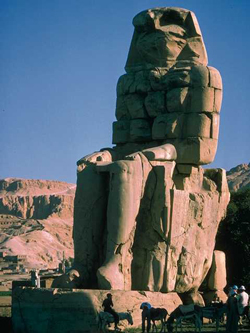
The Hebrew name for one of Noah’s grandsons is Mizraim (Genesis 10:6). It is no coincidence that modern Egyptians call themselves Misr, which is a derivative of Mizraim. According to the Book of Genesis, Noah’s grandson, Mizraim,7 is the father of the Egyptians. In a revised chronology, Egypt comes into existence soon after the dispersion from Babel, around 2100 BC. Eusebius, the famous 4th centuryADhistorian, writes:
Egypt is called Mestraim by the Hebrews; and Mestraim lived not long after the flood. For after the flood, Cham (or Ham), son of Noah, begat Aeguptos or Mestraim, who was the first to set out to establish himself in Egypt, at the time when the tribes began to disperse this way and that…Mestraim was indeed the founder of the Egyptian race; and from him the first Egyptian Dynasty must be held to spring.8
In the traditional chronology, a pre-dynastic period of approximately 2,000 years precedes the first Egyptian dynasty. Genesis establishes a much shorter period of time. In addition, the 1988–1989 annual report of the Oriental Institute of Chicago published a summary of extensive archaeological research by Bruce Williams. Williams re-examined discoveries related to the pre-dynastic period and concluded:
Both articles are part of an expanding body of evidence that links the period once known as ‘predynastic’ so firmly to the ages of the pyramids and later, that the term should be abandoned.9
Williams has published several articles in archaeology journals, and his modern research appears to confirm the Genesis account.
Abraham visits Egypt
The biblical date for the Exodus is approximately 1445 BC. Exodus 6:4 and Galatians 3:16–17 tell us that the Lord made a covenant with Abraham 430 years earlier, around 1875 BC. Not long after this date, Abraham traveled to Egypt to escape a severe famine in the land of Canaan (Genesis 12:10). Abraham’s visit did not go unnoticed, as Pharaoh’s officials reported to their king that Abraham’s wife, Sarah, was extremely beautiful. Out of fear, Abraham told Pharaoh that Sarah was his sister. As a result, Pharaoh temporarily inducted Sarah into his harem and paid Abraham many expensive gifts. However, the Lord struck Pharaoh’s house with plagues causing him to release her upon discovering that she was actually Abraham’s wife.
Abraham came from Ur of the Chaldees (Genesis 11:31). From 1922 to 1934, Sir Leonard Woolley discovered it to be the first civilization10 with a superior knowledge of astronomy and arithmetic. In addition, the Sumerian civilization invented writing, composed dictionaries, and calculated square and cube roots.11 Woolley’s discoveries appear to corroborate the writings of Josephus concerning Abraham’s visit to Egypt Josephus writes about Abraham:
He communicated to them arithmetic, and delivered to them the science of astronomy; for before Abram came into Egypt they were unacquainted with those parts of learning; for that science came from the Chaldeans into Egypt.12
In a revised chronology, Abraham would have visited Egypt when Khufu (aka Cheops) was Pharaoh. Before Khufu, the early Egyptian pyramids were fantastic architectural structures, but they were not perfectly square or exactly oriented to all four points on a compass. However, when Khufu built his masterful pyramid, there appears to have been an explosion of astronomical and mathematical expertise. Khufu’s pyramid was perfectly square, level, and orientated to the four points of the compass.
When placed in the proper dynasty, Abraham’s visit to Egypt may have been the catalyst that sparked an architectural revolution in Egyptian history.
Joseph rises to power in Egypt
Dynasty 12 was one of the high points in Egyptian history. By a revised chronology, Joseph would have risen to power under Sesostris I during this dynasty. [Editor: the suggested synchronisations of Egyptian and biblical history in this article are controversial; see Resolving alleged conflicts between the Bible and other accounts of Egyptian history.] According to Genesis, Joseph was one of Jacob’s twelve sons. Out of jealousy, Joseph’s brothers sold him to Midianite traders and these traders sold Joseph to an Egyptian officer named Potiphar. Eventually, through a period of trials and tribulations, the Lord enabled Joseph to rule over Egypt, second only to Pharaoh himself.

Sesostris I is known to have had a vizier, or prime minister, named Mentuhotep who possessed extraordinary power. Egyptologist, Emille Brugsch, writes in his book Egypt Under the Pharaohs, ‘In a word, our Mentuhotep…appears as the alter ego of the king. When he arrived, the great personages bowed down before him at the outer door of the royal palace.’13 Brugsch’s description appears to corroborate Joseph’s status in Genesis 41:43, ‘He (Pharaoh) had him ride in the second chariot which he had; and they cried out before him, ‘Bow the knee’: and he made him ruler over all the land of Egypt.’
Joseph’s ultimate claim to fame was his ability to interpret dreams. The Egyptians attached significant importance to dreams. Joseph was able to interpret Pharaoh’s perplexing dreams to mean that seven years of plenty would be followed by seven years of the most severe famine. Convinced by Joseph’s interpretation, Pharaoh appointed Joseph to supervise the gathering of grain during the seven years of plenty.
Two clues from Egyptian inscriptions appear to confirm the Genesis account. First, a large relief on ‘Hungry Rock’ states, ‘…Because Hapy [the river god] had failed to come in time in a period of seven years. Grain was scant, kernels were dried up, scarce was every kind of food…’14
Second, a tomb belonging to Ameni, a provincial governor under Sesostris I, says:
No one was unhappy in my days, not even in the years of famine, for I had tilled all the fields of the Nome of Mah…thus I prolonged the life of its inhabitants and preserved the food which it produced.12
Hebrew slaves in Egypt
In the traditional chronology, the Egyptian oppression of Hebrew slaves would have occurred in the 18th dynasty. The problem is there is little to no historical evidence of Hebrew slaves in Egypt at this time. However, when placed in the 12th dynasty under a revised chronology, there is substantial evidence for Israelite slave laborers in Egypt.
Dr Rosalie David, in charge of the Egyptian department of the Manchester Museum, writes about Semitic slavery in Kahun during the second half of the 12th dynasty:
It is apparent that the Asiatics were present in the town in some numbers, and this may have reflected the situation elsewhere in Egypt. It can be stated that these people were loosely classed by Egyptians as ‘Asiatics’, although their exact homeland in Syria or Palestine cannot be determined … The reason for their presence in Egypt remains unclear.15
The Bible makes it quite clear why the Israelite slaves resided in Egypt:
Now there arose a new king over Egypt who did not know Joseph, and he said to his people, ‘Look, the people of the children of Israel are more and mightier than we’…Therefore they set taskmasters over them to afflict them with their burdens…And they made their lives bitter with hard bondage… (Exodus 1:8-14).
Dr Rosalie David also writes about the slave presence at Gurob, Egypt:
The scattered documentation gives no clear answer as to how or why the Asiatics came to Egypt in the Middle Kingdom…There is nevertheless firm literary evidence that Asiatic slaves, women and children were at Gurob.16
Another piece of circumstantial evidence that supports the biblical account is the existence of pyramids built with mud bricks and straw during this dynasty. Amenemhet III, a pharaoh whose statues are sour-faced and cruel-looking in appearance, was likely the Pharaoh who answered the complaining Hebrew supervisors, ‘You shall no longer give the people straw to make brick as before Let them go and gather straw for themselves (Exodus 5:7).’
Another tantalizing piece of circumstantial evidence was the discovery of boxes beneath the floors of houses excavated in Kahun. Sir Flinders Petrie excavated a number of these boxes which contained the skeletons of babies up to three months old, sometimes up to three in a box.17 It is plausible that these baby skeletons are the bones of Hebrew babies killed by Pharaoh’s direct orders in an attempt to limit their population (Exodus 1:16). However, one particular baby boy would escape Pharaoh’s death sentence and change the course of Hebrew history.
Moses is born
According to the Book of Exodus, the baby Moses was adopted by Pharaoh’s daughter while she was bathing at the river. His parents defied Pharaoh’s order and left his destiny in the Lord’s hands, placing him in a basket to be discovered by Pharaoh’s daughter. Many consider this to be a nice story, but completely unrealistic. After all, what Egyptian princess would adopt a Hebrew slave child and offer to make him the next Pharaoh?
However, if you place Moses in the 12th dynasty, the family history of the Pharaonic court appears to line up.18 Amenemhet III had two daughters, but no sons have been positively identified. Amenemhet IV has been proposed as the son of Amenemhet III, but he could just as easily have been the son of Sobekneferu, one of the daughters of Amenemhet III. Amenemhet IV is a very mysterious figure in Egyptian history and may have been a co-regent of Amenemhet or Sobekneferu.
Josephus wrote concerning Pharaoh’s daughter, ‘Having no child of her own…she thought to make him her father’s successor.’ In addition, Dr Donovan Courville has proposed Sobekneferu as the foster mother of Moses. It is plausible since there is no historical record of Sobekneferu having a biological son. If Sobekneferu was the foster mother of Moses, then the biblical account of her bathing by the riverside would make sense. The river god Hapy was the fertility god of Egypt, and Sobekneferu would have likely been observing a religious ritual in the river. Perhaps the appearance of a baby floating in the river would have been interpreted as a direct answer to her prayer for a child.
Exodus from Egypt
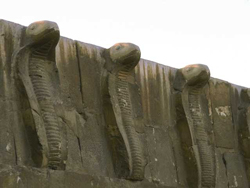
In a revised chronology, Neferhotep I was likely the Pharaoh of the Exodus in the 13th dynasty. Exodus 7:10 tells us that Moses and Aaron confronted Pharaoh ‘… and Aaron cast down his rod before Pharaoh and before his servants, and it became a serpent.’ Pharaoh was not impressed ‘… so the magicians of Egypt, they also did in like manner with their enchantments. For every man threw down his rod, and they became serpents (Exodus 7:11–12).’ In the Liverpool Museum there is a magician’s rod that hails from this same period in Egyptian history.19 The rod is in the form of a long cobra Perhaps the magicians practiced some form of hypnotic power that transformed the cobra rods into the appearance of real snakes, or applied sleight of hand to substitute a real cobra for the rod.
The ten plagues are probably one of the most famous aspects of the Exodus story. If the plagues were historical events as recorded by Moses, then there should be some fragment of evidence describing their catastrophic consequences. In fact, there is a papyrus in the Leiden Museum in Holland which provides a graphic portrayal eerily reminiscent of the biblical account. There is no consensus among archaeologists as to when it was originally penned An excerpt reads:
… Plague stalks through the land and blood is everywhere … Nay, but the river is blood. Does a man drink from it? As a human he rejects it. He thirsts for water … Nay, but gates, columns and walls are consumed with fire…Nay but the son of the high-born man is no longer to be recognized … The stranger people from outside are come into Egypt … Nay, but corn has perished everywhere…Everyone says ‘there is no more.’20
(See also The ten plagues of Egypt: miracles or ‘Mother Nature’?, which also thoroughly refutes the popular ‘algal bloom’ theory).
The final plague cut Pharaoh to the heart. The Lord struck down all the firstborn in each Egyptian family at midnight. The Hebrews were warned of this horrific disaster and Moses ordered them to kill a lamb and splash its blood on their doorposts. The Destroyer would pass over every home with the blood of the lamb. It is quite significant that Neferhotep’s son, Wahneferhotep, did not succeed his father on the throne. Instead, Neferhotep I was succeeded by his brother Sobkhotpe IV ‘who occupied the throne which his brother had recently vacated.’21 To this day, historians are unable to pinpoint the reason why the son of Neferhotep I did not succeed him. Perhaps a closer look at the biblical account is necessary.
Another piece of very interesting circumstantial evidence is the sudden departure of Kahun’s inhabitants. Dr Rosalie David writes:
It is evident that the completion of the king’s pyramid was not the reason why Kahun’s inhabitants eventually deserted the town, abandoning their tools and other possessions in the shops and houses …The quantity, range, and type of articles of everyday use which were left behind in the houses may suggest that the departure was sudden and unpremeditated.22
The evidence appears to confirm Exodus 12:33 which states, ‘And the Egyptians urged the people, that they might send them out of the land in haste…’
But what happened to the mighty Egyptian army? According to the Bible, Pharaoh pursued the fleeing Israelites with his army as they miraculously crossed the Red Sea. However, the Egyptian army ended up at the bottom of the Red Sea (Exodus 14:28). It is no coincidence that the mummy of Neferhotep I has never been found.
The Hyksos mystery solved
Also, archaeologists and other scholars have long puzzled over the rapid occupation of Egypt by the mysterious Hyksos without a military confrontation. Those scholars advocating a revised chronology have identified the Hyksos with the Amalekites, who attacked the Israelites fleeing from Egypt. It is plausible that the Amalekites flowed into Egypt without resistance because of God’s decimation of the Egyptian army under the Red Sea.
The identification of the Hyksos with the Amelekites would explain the otherwise strange passage ‘Amalek was the first of the nations’ (Numbers 24:20), and why an Egyptian would be ‘servant to an Amalekite’ (1 Samuel 30:13). This makes sense in the revised chronology where the Amalikites ruled the mighty Egyptian empire.
Their current obscurity fulfils God’s prophecy to Moses, ‘I will utterly blot out the remembrance of Amalek from under heaven’ (Exodus 17:14). Thus hardly anyone today has even heard of them, let alone their former pre-eminence The physical extermination (see also Was this a war crime?) was first fulfilled in the time of Saul, but he disobeyed God (1 Samuel 15), so the Amalekites still caused mayhem in David’s time so he practically finished the job (1 Samuel 30).
Conclusion
There is a story of an older, well-respected archaeologist digging next to a young archaeologist at Gezer, Israel.23 The young archaeologist was mocking the historical reliability of the Bible when the older archaeologist quietly responded, ‘Well, if I were you, I wouldn’t rubbish the Bible.’ When the young archaeologist asked ‘Why?’ he replied, ‘Well, it just has a habit of proving to be right after all.’
At this time of year, Christians will be bombarded with shows and magazine articles that portray the biblical accounts of Joseph, Hebrew slavery, Moses, and the Exodus as legend and myth As we have seen, however, when placed at the proper time, there is an abundance of historical and archaeological evidence to confirm the books of Genesis and Exodus.
Synchronizing the biblical timeline with a revised Egyptian chronology will require more testing, research, hard work, and careful scholarship Presupposing biblical accuracy and applying professional research standards, a number of scholars are off to a promising start Dr Clifford Wilson, former Director of the Australian Institute of Archaeology, said it best:
I know of no finding in archaeology that’s properly confirmed which is in opposition to the scriptures. The Bible is the most accurate history textbook the world has ever seen.24
References
- Rohl, David A Test of Time: The Bible: from Myth to History, p. 128, Century Limited, London, UK, 1995; see also review by John Osgood, Journal of Creation 11(1):33–35, 1997. Return to text.
- James, Peter Centuries of Darkness, pp. XV–XVI, Pimlico, London, UK, 1992. Return to text.
- James, ref. 2, p. 39. Return to text.
- Gardiner, Allan Egypt of the Pharaohs, p. 53, Oxford University Press, London, UK, 1964. Return to text.
- Ashton, J. and Down, D., Unwrapping the Pharaohs: How Egyptian Archaeology Confirms The Biblical Timeline, p. 74, Master Books, Green Forest, AR, 2006. Return to text.
- Ashton and Down, ref. 5, p. 73. Return to text.
- Hebrew מצרים (mitsrayim) John Gill’s commentary, available in the Online Bible, states, ‘The word is of the dual number, and serves to express Egypt by, which was divided into two parts, lower and upper Egypt.’ Return to text.
- Waddell, History of Egypt and Other Works by Manetho: The Aegyptiaca of Manetho, pp. 8–9. Return to text.
- Sumner, William ‘Scholarship Individual Research,’ The Oriental Institute Annual Report 1988–1989, p. 62, University of Chicago, Chicago, IL, 1990. Return to text.
- Obviously, it was not the first civilization, but the first ‘re-civilization’—after the Flood. Return to text.
- Ashton and Down, ref. 5, p. 201. Return to text.
- Whiston, W., Josephus’ Complete Works, Antiquities of the Jews, Book I, chapter VIII, para. 2. Return to text.
- Breasted, James A History of Egypt, p. 162, Scribner and Sons, New York, NY, 1954. Return to text.
- Ashton and Down, ref. 5, p. 84. Return to text.
- David, R The Pyramid Builders of Ancient Egypt: A Modern Investigation of Pharaoh’s Workforce, p. 191, Guild Publishing, London, UK, 1986. Return to text.
- David, ref. 15, p. 192. Return to text.
- Ashton and Down, ref. 5, p. 100. Return to text.
- Ashton and Down, ref. 5, p. 93. Return to text.
- Ashton and Down, ref. 5, p. 98. Return to text.
- Velikovsky, Immanuel, Ages in Chaos, Vol.1, ‘From the Exodus to King Akhnaton’, pp. 25–28, Abacus, London, UK, 1973. Return to text.
- Edward, C.J. et al., The Cambridge Ancient History, Vol. II, Part I, ‘History of the Middle East and the Aegean Region c. 1800–1380 B.C.’, p. 50, Cambridge University Press, Cambridge, UK, 1980. Return to text.
- David, ref. 15, p. 195 and 199. Return to text.
- Wieland, C., Archaeologist confirms creation and the Bible: Interview with archaeologist Clifford Wilson, Creation 14(4):46–50, 1992 Return to text.
- Wilson, C, Archaeologist Speaks Out, Creation 21(1):15, 1998. Return to text.

Readers’ comments
Comments are automatically closed 14 days after publication.