

Disclaimer: How biblical chronology relates to archaeological periods in the ancient Near East (e.g., Paleolithic, Chalcolithic, Early Bronze Age, Iron Age, etc.) is a complex subject. For many years, Creation Ministries International (CMI) has published a range of views by various authors in its publications (CREATION.com, Journal of Creation, Creation magazine, etc.). These views do not necessarily agree with the present views of CMI’s writers on this topic, but remain available online as they form part of CMI’s historical archives of its publications. For key articles about this subject see our Archaeology Q&Ahaeology Q&A.
False history—‘Out with David and Solomon!’
Archaeological challenges to the historicity of the Bible are the latest ‘fad’. What are the facts?
‘Out with David and Solomon!’ That is the latest trend in the archaeological world, and the secular world is eager to repeat the refrain.
Even Australia’s The Financial Review1 decided to depart from its mandate and devote several pages to an article headed ‘False Testament’ in which ‘Daniel Lazare explains how archaeology has dismantled the Bible’s claim to history.’ And if we are to accept the dates that are usually assigned to the archaeological eras, the arguments presented seem very strong.
The criticism involves two main claims: First, that there is no archaeological record to support the stories of David and Solomon, and second, that the archaeological strata flatly contradict the Biblical records. The first claim, even if true, would be simply an argument from silence, and thus irrelevant. As has often been said in archaeology, ‘Absence of evidence is not evidence of absence.’ Many aspects of Biblical history were discounted as fictional because there was ‘no archaeological evidence’—leaving much egg on face when evidence was later discovered. But actually there is inscriptional evidence to support the existence of King David—see box.
However, the second claim is more cogent. Let me explain how archaeology works.
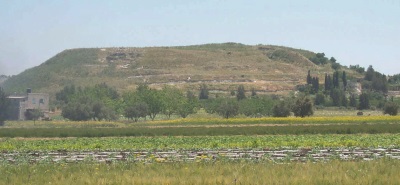
In Biblical times people mostly preferred living on hills. Jesus Christ said, ‘A city that is set on a hill cannot be hidden’ (Matthew 5:14). Little by little, the height of these hills rose due to the occupational debris that accumulated. Storms, earthquakes and invasions brought destruction to these cities, and subsequent occupants simply levelled off the area and built on top of it.
Archaeologists are now able to dig down into this occupational debris, which can be 30 m or more above the original height of the hill (called a ‘tel’). As they cut into this debris, it is possible to distinguish the layers of successive occupation that can be identified by the style of pottery they contain. These layers have been named Early Bronze, Middle Bronze, Late Bronze and Iron Age. Although no-one disputes these identifications, the dates assigned to these successive layers are another matter altogether.

Ignoring the Biblical information, archaeologists in their wisdom have assigned the approximate dates to these eras as shown in the diagram on p. 19. According to this, David and Solomon would have lived at the beginning of Iron Age II—and that is where the problem lies, as we shall see.
Facts against the Bible?
Concerning Solomon’s building activities, 1 Kings 9:17–19 says, ‘And Solomon built Gezer, and Beth-horon the lower, and Baalath, and Tadmor in the wilderness, in the land. And he built all the store-cities which Solomon had, and cities for his chariots, and cities for his horsemen, and that which Solomon desired to build in Jerusalem, and in Lebanon, and in all the land of his dominion.’ Also, the Bible describes Solomon’s economy as being on an enviable scale. ‘And the king made silver and gold at Jerusalem like stones, and he made cedar trees as plentiful as the sycamore trees in the valley’ (2 Chronicles 1:15). But the architectural remains from Iron Age I and early Iron Age II reveal that this was a period of pitiful poverty, few people and scant building activity. This is why the critic Lazare could write, ‘Not one goblet, not one brick, has ever been found to indicate that such a reign existed.’2
So let’s face it—if the usual archaeological chronology is correct, we have to abandon confidence in the historical records of the Bible. Incidentally, all these dates also have a bearing on the date of the Flood and consequently the creation of the world about 6,000 years ago.3 The Biblical date for the Flood is about 2300 BC but the beginning of the Early Bronze Period is usually dated to about 3100 BC.
Take another look
Fortunately, there is light through this darkness, though it is going to require some radical thinking. Actually, when the archaeological ages are correctly dated, the evidence for Biblical history is quite stunning, but we are talking about lopping anything up to six centuries off the traditional dates.
Bible history of Israel is divided into four neat eras for which we should expect solid archaeological evidence. First, the Exodus and military occupation of Palestine followed by the period of the Judges. There should be evidence of destruction and fire (of the Canaanite civilization), and above that, the appearance of a new people (the Israelites) with new pottery styles, different burial practices and manufacturing skills (Exodus 35:30–35).
This is exactly what we find at the end of the Early Bronze Age and the beginning of the Middle Bronze I Period. Kathleen Kenyon, who excavated Jericho, wrote in her book, ‘The final end of the early Bronze Age civilization came with catastrophic completeness. The last of the Early Bronze Age walls of Jericho was built in a great hurry, using old and broken bricks, and was probably not completed when it was destroyed by fire. Little or none of the town inside the walls has survived subsequent denudation, but it was probably completely destroyed, for all the finds show that there was an absolute break, and that a new people took the place of the earlier inhabitants. Every town in Palestine that has so far been investigated shows the same break. The newcomers were nomads, not interested in town life, and they so completely drove out or absorbed the old population, perhaps already weakened and decadent, that all traces of the Early Bronze Age civilization disappeared.’4
‘An absolute break … a new people … every town in Palestine … newcomers were nomads … completely drove out or absorbed the old population …’.4 Could we expect to find a more apt description of the Israelite invasion, nomads from the desert who initially were not interested in living in the cities?
The King David artifact

Avraham Biran is an experienced and recognized Israeli archaeologist who excavated for 27 years in ancient Dan in northern Israel. In his 1994 book Biblical Dan, he reported finding a broken stela on which was an Aramaic inscription. The stela had been used simply as filling in a wall which was dated to the third quarter of the 8th century BC, but the style of writing suggested that it had been originally written in the 9th century BC.
In this inscription was the expression ‘BTH DWD’ which would be read as ‘House of David’.1 This was convincing confirmation of the detailed Biblical historical records that David and his house (family) were known in the 9th century BC. The critics were disconcerted. At first they said that it was simply the name of a place like Bethshemesh (House of the Sun) or Bethlehem (House of Bread). The only catch to that suggestion was that Bethshemesh and Bethlehem are known sites but there is no known city called Bethdavid. So, in their desperation to discredit the Bible, some critics accused Biran of forging the stela. However, there is no evidence to support this claim.
Reference
- Biran, A., Biblical Dan, Israel Exploration Society, Jerusalem, pp. 275–278, 1994.
Still more correlation
Next came the period of affluence and power during the centuries of the Israelite monarchy. Concerning the Middle Bronze IIB Period, prominent Israeli archaeologist Dr Amihai Mazar wrote, ‘The Middle Bronze Age architecture was to a large extent innovative and original. Together with the massive fortifications of this period, it evidences a thriving, prosperous urban culture. The magnitude of the palaces and temples manifests the wealth and power concentrated in the hands of the autocracy and theocracy of the period.’5
Then came the exile into Assyria and Babylon when large portions of the population were despatched into captivity. Soon after the Assyrian conquest of Israel, the prophet Isaiah wrote, ‘Your land is wasted, your cities burned with fire. Strangers devour your land right before your eyes, and it is wasted, as overthrown by strangers’ (Isaiah 1:7). We should find in the next layer, the Late Bronze Age, evidence of a depleted population, and we do.
Israeli archaeologist Israel Finklestein wrote, ‘The entire country flourished in MB IIB … fortified cities, villages, and individual farms—were founded throughout the region … . In contrast to the extraordinary prosperity of MB II, the Late Bronze period was characterized by a severe crisis in settlement … . Moreover, those sites where occupation did continue, frequently shrank in size.’6
Fourth came the return from exile, when many of the Israelites migrated back to their original lands. ‘The whole congregation together was forty-two thousand, three hundred and sixty’ (Ezra 2:64). Finklestein says, ‘The Iron I period again witnessed a dramatic swing in the population of the hill country, this time in the opposite direction.’7 And then he voices the dilemma that faces archaeologists because of their wrong dates: ‘… MB II, Late Bronze and Iron I periods … leave two critical questions for which satisfactory answers must be found: Why and to where did over half of the MB II population, i.e., virtually all the inhabitants of the hill country, “vanished”? From where did the people who settled the hundreds of sites in Iron I “materialized”?’7 If Israel Finklestein changed his dates, he would soon have the answers.
It was a period of danger and hardship. Building activity was slow. ‘The ones who built on the wall, and the ones who carried burdens; with those who were lifting, one a worker in the work, and one held a weapon’ (Nehemiah 4:17). This then is the early Iron Age, which Mr Lazare so loudly trumpets to be a period of poverty, which cannot fit the reign of Solomon. You are right, Mr Lazare. It does not fit the reign of Solomon, but if you get your dates right, it perfectly fits the return from exile.

The way it works
The Bible is a historical document containing detailed chronologies. When such a document is ‘out of synch’ with another source of chronological information in, say, four separate areas, then if making one adjustment to the other chronology causes all four of these areas to be reconciled simultaneously, this is powerful evidence in favour of the validity of the adjustment.
To match Event 1 to Circumstance 1, Chronology 2 needs to be brought forward by ‘x’ years (see below)
Since there are now three additional match-ups, and no remaining contradictions, this is powerful independent evidence confirming the need for the revision.
Getting it right
It is of course appropriate to modify the fallible opinions of man to fit the infallible Word of God. But this revision of dates can be independently justified, and an answer given to the challenge that it is some arbitrary ‘fiddle’. Consider these three points:
- The revised chronology gives a remarkable consistency with the Bible record in a number of separate areas, which further confirms the appropriateness of the revision. See The way it works box.
- The ‘standard’ dates for the archaeological strata have been assigned, not on information that comes from the strata themselves, but simply by their correlation with the dynasties of Egypt.
- Some scholars are now challenging these dates.
In the introduction to Peter James’ book Centuries of Darkness, the highly regarded Cambridge Professor Colin Renfrew wrote, ‘The revolutionary suggestion is made here that the existing chronologies for that crucial phase in human history are in error by several centuries, and that, in consequence, history will have to be rewritten …. I feel that their critical analysis is right, and that a chronological revolution is on its way.’8
Let the archaeological history be rewritten, then, and it will be found to give remarkable support to the Biblical records. David and Solomon did exist and were the triumphant builders of a great nation that dominated Palestine and the surrounding areas.
References
- Lazare, D., The Financial Review, 28 March–1 April 2002, pp. 1–2, 8. Return to text.
- Ref. 1, p. 8. Return to text.
- Pierce, L., The forgotten Archbishop, Creation 20(2):42–43, 1998; In the days of Peleg, Creation 22(1):46–49, 1999. Return to text.
- Kenyon, K., Archaeology in the Holy Land, Ernest Benn Limited, London, p. 134, 1965. Return to text.
- Mazar, A., Archaeology of the Land of the Bible, Double Day, New York, p. 213, 1990. Return to text.
- Finklestein, I., The Archaeology of the Israelite Settlement, Israel Exploration Society, Jerusalem, pp. 339–341, 1988. Return to text.
- Ref. 6, p. 341. Return to text.
- James, P., Centuries of Darkness, Pimlico, London, pp. XIV, XVI, 1992. Return to text.

Readers’ comments
Comments are automatically closed 14 days after publication.